Supply Chain Decarbonisation Services Market Research Report
Global Market Size, Share & Trends Analysis Report, 2026-2035
Segmentation Analysis By Service Type: By Application: By End Use Industry: By Deployment Mode: By Region and Industry Forecast
1. Market Summary:
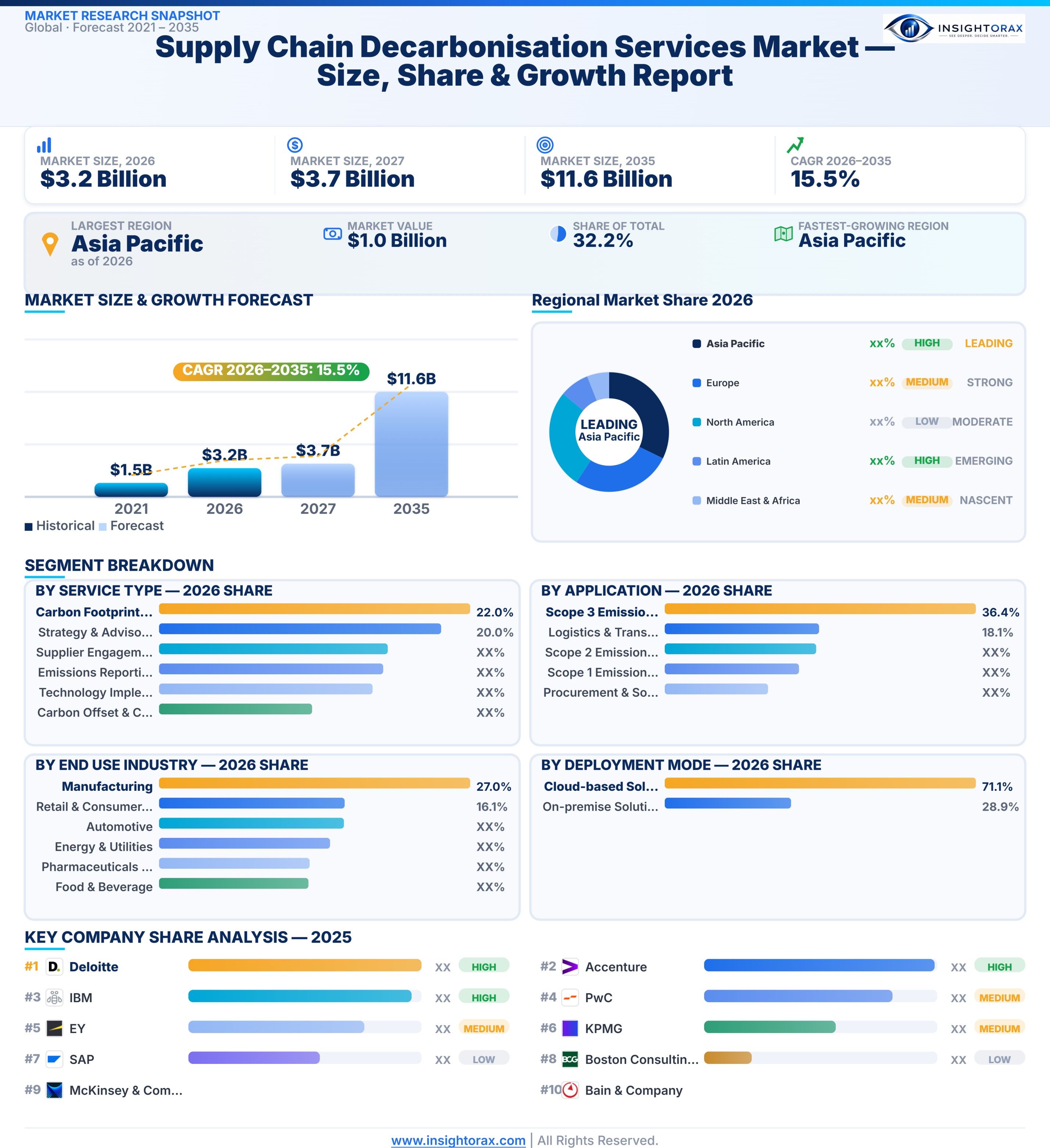
According to data analyzed by Insightorax, the global supply chain decarbonisation services market size was valued at USD 3.2 billion in 2026 and is projected to grow from USD 3.7 billion in 2027 to USD 11.6 billion by 2035, registering a CAGR of 15.5% during the 2026–2035 forecast period. Asia Pacific accounted for the largest revenue share of 32.2% in 2026. Market growth is driven by corporate net-zero commitments, stricter emissions regulations, rising pressure to measure and reduce Scope 3 emissions, and increasing adoption of low-carbon supply chain strategies. Demand is further supported by growing investments in carbon accounting, supplier engagement, renewable energy procurement, sustainable logistics, energy efficiency, and emissions monitoring solutions as businesses seek to reduce environmental impact while improving supply chain resilience and compliance.
2. Market Overview:
The Supply Chain Decarbonisation Services Market covers professional services that help organizations measure, reduce, manage, and report greenhouse gas emissions across their supply chains. The market spans emissions assessment and carbon accounting, Scope 1, 2, and 3 emissions measurement, supplier emissions analysis, decarbonisation roadmaps, target setting, and sustainability reporting. Services may address procurement, manufacturing, warehousing, transportation, distribution, and end-of-life activities, depending on an organization’s supply chain structure and decarbonisation objectives.
Key components include carbon footprint assessment, supplier engagement and capability building, renewable energy and energy-efficiency strategies, sustainable logistics optimization, low-carbon procurement, circular economy initiatives, carbon reduction planning, and emissions monitoring. Service providers also support organizations with regulatory compliance, climate disclosures, data management, and progress tracking. The market serves manufacturers, retailers, logistics providers, technology companies, and other organizations seeking to integrate emissions reduction into supply chain operations and long-term sustainability strategies.
3. Market Size & Forecast:
Historically, supply chain decarbonisation developed from basic carbon-footprint measurement and sustainability reporting toward broader programs covering supplier emissions, energy efficiency, logistics optimization, and low-carbon procurement. As companies gained greater visibility into Scope 3 emissions, demand expanded for specialized services capable of establishing emissions baselines, identifying reduction opportunities, and developing practical decarbonisation roadmaps. Complex supply networks and limited emissions data have further increased the need for external expertise and supplier collaboration.
The market is currently expanding as businesses strengthen net-zero commitments and integrate emissions reduction into procurement, operations, logistics, and supplier management. Future growth is expected to be supported by increasing regulatory and customer expectations, greater availability of emissions data and digital measurement tools, and rising demand for low-carbon logistics and sourcing strategies. The growing importance of value-chain emissions—particularly Scope 3—will continue to encourage companies to invest in specialized consulting, measurement, implementation, monitoring, and supplier-engagement services.
Key Market Trends & Insights
- By service type: Carbon Footprint Assessment segment dominated the market with a 22.0% share in 2026.
- By application: Scope 3 Emissions Management segment led the market in terms of share, accounting for 36.4% in 2026.
- By end user: Manufacturing segment commanded the largest market share at 27.0% in 2026.
- By deployment mode: Cloud-based Solutions segment accounted for the highest market share of 71.1% in 2026.
Regional Highlights
- Largest regional market: Asia Pacific (32.2% revenue share, 2026)
- Fastest-growing regional market: Asia Pacific Highest CAGR, 2026–2035
Market Size & Forecast
- Market size in 2026: USD 3.2 Billion
- Estimated market size in 2027: USD 3.7 Billion
- Projected market size by 2035: USD 11.6 Billion
- CAGR (2026-2035): 15.5%
4. Market Drivers, Restraints & Opportunities:
The Supply Chain Decarbonisation Services Market is driven by growing corporate net-zero commitments, increasing pressure to reduce Scope 3 emissions, and evolving environmental regulations and disclosure requirements. Companies are increasingly assessing emissions across procurement, manufacturing, transportation, warehousing, and distribution to identify reduction opportunities. Customer and investor expectations for transparent sustainability performance are also encouraging organizations to adopt carbon accounting, supplier engagement, renewable energy procurement, energy-efficiency programs, and low-carbon logistics. The expansion of global supply networks further increases demand for specialized services that can provide consistent emissions measurement and practical decarbonisation strategies.
However, market expansion faces challenges including fragmented supply-chain data, inconsistent emissions reporting methodologies, limited supplier participation, and difficulties in measuring indirect emissions across complex international networks. Smaller suppliers may lack financial resources, technical expertise, or digital systems required for emissions tracking and reduction programs. High implementation costs, uncertainty around technology investments, and differences in regulatory requirements between markets can also slow adoption. Organizations may additionally face challenges integrating sustainability objectives with procurement costs, operational efficiency, and existing supply-chain priorities.
Significant opportunities exist in digital carbon-accounting platforms, AI-enabled emissions analytics, supplier decarbonisation programs, and automated sustainability reporting. Service providers can also expand through solutions combining emissions measurement with renewable energy sourcing, sustainable transportation, circular supply chains, and energy optimization. Growing demand for transparent Scope 3 data creates opportunities for verification, monitoring, and supplier-data management services, while emerging regulations and sustainability-linked business requirements can encourage broader adoption across industries and regions.
5. Market Trends:
Supply chain decarbonisation is increasingly shifting from emissions reporting toward measurable reduction across procurement, suppliers, logistics, and product categories. In 2025–2026, companies are placing greater emphasis on supplier-specific emissions data, hotspot identification, supplier engagement, and embedding carbon criteria into procurement decisions. Digital carbon-management platforms, traceability systems, product-level emissions intelligence, and integrated ESG and procurement tools are supporting this transition. Industry activity is particularly visible in manufacturing, consumer goods, healthcare, logistics, aviation, shipping, and steel, where value-chain emissions and supplier collaboration remain important decarbonisation priorities.
Regional trends are increasingly shaped by trade and regulatory requirements. In Europe, the EU Carbon Border Adjustment Mechanism entered its definitive phase in January 2026, increasing the importance of emissions data for carbon-intensive imports. Companies are also responding to evolving value-chain disclosure, due-diligence, and product-transparency requirements. Meanwhile, global supply-chain volatility is encouraging organizations to combine decarbonisation with resilience, energy efficiency, and resource security.
Another major trend is the movement from standalone sustainability programs toward cross-functional decarbonisation involving procurement, finance, sustainability, R&D, and suppliers. Companies are increasingly using product carbon footprints and emissions criteria in tenders and sourcing decisions. Standardized supplier reporting, primary emissions data, digital monitoring, low-carbon procurement, renewable energy, and supplier-led innovation are gaining importance. The market is consequently evolving from compliance-focused services toward integrated solutions designed to deliver measurable emissions reductions and operational value.
6. Technology Landscape:
Supply chain decarbonisation increasingly relies on digital carbon-accounting platforms, supplier-data systems, life-cycle assessment (LCA), emissions databases, and product-carbon-footprint tools to measure emissions across complex value chains. The GHG Protocol Scope 3 Standard provides methodologies for accounting across 15 upstream and downstream categories, while its Product Standard supports product-level life-cycle emissions assessment. In 2026, GHG Protocol and ISO are advancing work toward a harmonized product-level GHG accounting standard, building on existing frameworks including ISO 14067.
Technology adoption is also being shaped by verification and regulatory requirements. ISO 14064-3:2019 provides requirements and guidance for verification and validation of GHG statements. In the EU, the Carbon Border Adjustment Mechanism (CBAM) requires embedded-emissions reporting, with actual emissions subject to independent verification under the applicable framework. These developments are increasing demand for auditable emissions data, digital traceability, standardized calculations, supplier data integration, and automated monitoring across international supply chains.
7. Regulatory Framework:
The regulatory framework for supply chain decarbonisation is increasingly shaped by carbon-pricing, emissions-reporting, and sustainability-disclosure requirements. In the EU, the Carbon Border Adjustment Mechanism (CBAM) entered its definitive regime on 1 January 2026, requiring importers of covered carbon-intensive goods to meet authorization, reporting, and certificate obligations based on embedded emissions. Actual emissions data must be independently verified under the applicable accreditation framework. The EU has also revised its European Sustainability Reporting Standards (ESRS) in 2026, covering climate and other ESG disclosures, while introducing changes intended to reduce reporting burdens.
Compliance requirements increasingly extend into supply-chain data collection, verification, and supplier information management. EU sustainability-reporting guidance addresses the use of value-chain information and circumstances where estimates may be used when supplier data is unavailable. CBAM regulations additionally establish methodologies, verification principles, accreditation requirements, and sector-specific guidance for covered imports. In the United States, the regulatory environment differs: the SEC voted in March 2025 to end its defense of its 2024 climate-disclosure rules, which had already been stayed during litigation.
8. Supply Chain Decarbonisation Services Market Segmentation Analysis:
9. By Service Type:
Carbon Footprint Assessment accounted for the highest 2026 market share at 22.02%, reflecting the growing requirement for accurate emissions baselines across suppliers, facilities, transportation activities, and purchased inputs. Organizations are increasingly using footprint assessments to identify emissions-intensive processes, establish reduction priorities, and strengthen sustainability reporting. Emissions Reporting & Compliance, Supplier Engagement Programs, Technology Implementation Services, and Carbon Offset & Credit Management further support organizations in measuring, managing, and reducing value-chain emissions. Demand is reinforced by corporate climate commitments, greater supplier transparency, reporting expectations, and the need for credible emissions information.
Strategy & Advisory Services followed with the next-highest 2026 market share of 19.97%, supported by rising demand for practical decarbonisation roadmaps and implementation strategies. Companies increasingly require advisory expertise to align climate objectives with procurement, logistics, operations, and supplier management. Technology Implementation Services help integrate emissions monitoring and analytical capabilities, while Supplier Engagement Programs encourage participation across value chains. Emissions Reporting & Compliance and Carbon Offset & Credit Management further contribute to governance and residual-emissions management. Together, these services help organizations translate measurement into structured and actionable decarbonisation initiatives.
10. By Application:
Scope 3 Emissions Management represented the highest 2026 market share at 36.41%, reflecting the complexity and scale of emissions generated throughout suppliers, purchased goods, transportation, and other value-chain activities. Organizations are strengthening Scope 3 programs because supply chain decarbonisation increasingly depends on visibility beyond internal operations. Demand is supported by corporate climate targets, customer expectations, supplier transparency, sustainability disclosures, and pressure to address indirect emissions. Scope 1 Emissions Management and Scope 2 Emissions Management remain important for controlling direct operational emissions and emissions associated with purchased energy, respectively, supporting broader organizational decarbonisation strategies.
Logistics & Transportation Decarbonisation recorded the second-highest 2026 market share at 18.06%, driven by efforts to reduce emissions associated with freight movement, fleet operations, routing, and transportation efficiency. Companies are adopting cleaner transportation approaches, route optimization, shipment visibility, and improved fleet management to reduce environmental impact while supporting operational efficiency. Procurement & Sourcing Decarbonisation also strengthens demand by incorporating environmental considerations into purchasing and supplier-selection processes. These applications connect emissions reduction with logistics performance, sourcing decisions, supplier collaboration, and operational planning, making them increasingly relevant to organizations pursuing measurable improvements throughout their supply chains.
11. By End Use Industry:
Manufacturing accounted for the highest 2026 market share at 26.99%, supported by extensive supplier networks, material consumption, production processes, and complex logistics requirements. Manufacturers are increasing their focus on emissions measurement, supplier collaboration, sustainable sourcing, and operational efficiency as environmental objectives become increasingly integrated into business strategies. Retail & Consumer Goods, Automotive, Food & Beverage, Energy & Utilities, and Pharmaceuticals & Healthcare also generate substantial demand because of their diverse supply networks and sustainability requirements. These industries require improved emissions visibility across sourcing, production, distribution, supplier relationships, and other value-chain activities.
Retail & Consumer Goods followed with the next-highest 2026 market share of 16.10%, supported by extensive supplier ecosystems, product sourcing, packaging requirements, transportation networks, and rising consumer expectations for sustainable products. Automotive companies are addressing emissions across component sourcing, manufacturing, logistics, and supplier operations, while Food & Beverage organizations are focusing on agricultural inputs, processing, packaging, and distribution. Energy & Utilities and Pharmaceuticals & Healthcare are also strengthening supply chain transparency alongside resilience objectives. Across these industries, decarbonisation services support emissions tracking, supplier engagement, sourcing strategies, reporting, and the development of longer-term environmental programs.
12. By Deployment Mode:
Cloud-based Solutions held the highest 2026 market share at 71.13%, reflecting increasing demand for scalable digital environments capable of managing emissions information across geographically distributed supply chains. Cloud platforms can facilitate centralized data collection, emissions calculations, analytics, reporting, supplier collaboration, and integration with procurement and logistics systems. Their flexibility is particularly relevant for organizations managing large supplier networks across multiple markets. On-premise Solutions continue to serve organizations with established internal technology infrastructure, specific governance requirements, and preferences for greater control over data and system environments.
On-premise Solutions represented the second-highest 2026 market share at 28.87%, maintaining relevance among organizations that prioritize internal infrastructure, controlled data environments, customized integrations, or specific security and governance requirements. Both deployment approaches support emissions monitoring, reporting, analytics, and decarbonisation planning. Market demand is being reinforced by digital transformation, expanding sustainability-data requirements, supplier connectivity, and the need for timely performance visibility. As supply chain decarbonisation becomes increasingly data-driven, organizations are evaluating deployment models according to scalability, integration needs, governance priorities, infrastructure preferences, and the complexity of their sustainability-management requirements.
13. Regional Analysis:
Asia Pacific accounted for the highest 2026 regional market share at 32.24%, supported by expanding manufacturing activity, complex supplier networks, increasing energy requirements, and growing attention to value-chain emissions. Organizations across the region are strengthening carbon measurement, supplier engagement, emissions reporting, and decarbonisation planning as sustainability requirements become more integrated into business operations. Demand is also encouraged by industrial digitalization and the adoption of cloud-based platforms capable of collecting, analyzing, and monitoring emissions data across geographically dispersed supply chains. Manufacturing, automotive, electronics, consumer goods, and logistics applications provide important opportunities for service adoption. Technology-enabled emissions tracking, supplier collaboration, and data integration are becoming increasingly relevant as companies seek greater visibility across procurement, production, transportation, and distribution activities. The region therefore represents a significant market environment for services that connect operational efficiency with structured supply chain emissions reduction.
Europe represented the next-highest 2026 regional share at 26.95%, reflecting strong attention to sustainability reporting, emissions transparency, supply-chain accountability, and corporate climate objectives. Organizations are increasingly incorporating carbon considerations into procurement, supplier management, transportation, manufacturing, and operational planning. Demand for carbon footprint assessment and emissions reporting services is reinforced by the need for consistent environmental information across complex value chains. Companies are also adopting digital technologies to improve emissions data collection, analytics, monitoring, and reporting while connecting sustainability systems with existing enterprise processes. Automotive, manufacturing, retail, food and beverage, and pharmaceuticals are important application areas because of their extensive supplier and distribution networks. Supplier engagement and advisory services further support organizations in developing practical reduction pathways. Europe’s market significance is therefore linked to the increasing integration of environmental performance into supply chain governance, purchasing decisions, operational strategies, and long-term corporate sustainability programs.
North America accounted for 26.81% of the 2026 regional market, supported by increasing corporate focus on Scope 3 emissions, supplier transparency, operational efficiency, and measurable climate objectives. Organizations are expanding emissions-management programs beyond internal facilities to address purchased goods, logistics, transportation, suppliers, and other value-chain activities. Demand is reinforced by sustainability reporting requirements, customer expectations, investor attention, and the need for reliable emissions information to support strategic decisions. Cloud-based sustainability platforms, data analytics, emissions calculation tools, and digital supplier-engagement solutions are gaining importance as businesses manage increasingly complex supply networks. Manufacturing, automotive, retail, consumer goods, technology, and logistics organizations can apply these services across sourcing, production, transportation, and distribution activities. Advisory and technology implementation services also help companies convert emissions information into actionable reduction strategies. The region remains significant because decarbonisation services are increasingly connected with procurement optimization, operational resilience, supplier management, and broader corporate sustainability initiatives.
Middle East & Africa held a 5.98% regional share in 2026, with market development supported by growing attention to energy efficiency, environmental performance, supply-chain resilience, and corporate sustainability. Organizations across energy-intensive industries and developing commercial ecosystems are increasingly examining emissions generated through operations, suppliers, transportation, and procurement activities. Carbon footprint assessment, emissions reporting, advisory services, and supplier engagement can support organizations seeking greater visibility into environmental performance and opportunities for reduction. Technology adoption is also becoming relevant as companies implement digital systems for data collection, monitoring, analytics, and sustainability reporting. Energy and utilities, manufacturing, logistics, food and beverage, and industrial activities provide important application areas. The region’s diverse economic structures create demand for solutions that can accommodate varying levels of digital maturity and supply-chain complexity. As environmental objectives become increasingly incorporated into business planning, decarbonisation services can support more structured emissions management and resource-efficiency initiatives.
Latin America represented 8.02% of the 2026 regional market, supported by increasing interest in sustainable sourcing, supply-chain transparency, operational efficiency, and emissions reduction. Organizations are strengthening attention to emissions associated with agriculture, manufacturing, food processing, transportation, energy use, and international supply chains. Demand for carbon assessment, emissions reporting, supplier engagement, and advisory services is encouraged by sustainability expectations from customers, multinational partners, investors, and corporate stakeholders. Digital adoption is supporting improved collection and management of emissions information, while cloud-based platforms can help organizations coordinate data across suppliers and geographically distributed operations. Food and beverage, agriculture-linked supply chains, manufacturing, logistics, and energy-related activities provide relevant applications for decarbonisation services. The region’s market significance is also connected with the need to combine environmental objectives with resource efficiency and supply-chain resilience. As organizations strengthen sustainability practices, emissions-management services can increasingly support procurement, supplier collaboration, logistics planning, and long-term decarbonisation strategies.
14. Competitive Landscape:
Competition in the Supply Chain Decarbonisation Services Market is increasingly centered on end-to-end capabilities combining emissions measurement, supplier engagement, sustainable procurement, logistics optimization, and technology-enabled monitoring. Major providers differentiate through sector expertise, proprietary digital platforms, global delivery networks, certifications, and partnerships. Accenture and Deloitte, for example, integrate sustainability with technology-enabled supply-chain transformation, while EcoVadis combines supplier assessments, carbon data, scorecards, and procurement integration.
Geographic expansion and ecosystem partnerships are important strategies as customers require localized regulatory and supplier support. Providers are increasingly integrating primary supplier data, AI-enabled analytics, carbon-management platforms, and audit-ready reporting. In 2026, EcoVadis expanded its Carbon Data Network through a strategic partnership with Workiva, while Schneider Electric and Deloitte announced an AI-enabled industrial transformation collaboration. Industry initiatives such as CDP accreditation and supplier-engagement assessments also help providers demonstrate capabilities and strengthen market differentiation.
15. Supply Chain Decarbonisation Services Market Company Insights:
Competition spans consultancies, technology firms, and sustainability providers. Accenture, Deloitte, PwC, EY, KPMG, McKinsey, BCG and Bain combine decarbonisation strategy with supply-chain transformation, emissions measurement, procurement and supplier engagement. IBM and SAP differentiate through AI, analytics and carbon-management platforms, while Schneider Electric provides energy-management expertise and launched Zeigo Hub for supplier decarbonisation. Capgemini, Wipro, TCS, Infosys and Genpact integrate ESG; ERM, Ramboll, Sphera and Persefoni provide climate, carbon-accounting, data and reporting capabilities.
Competitive strategies emphasize geographic reach, sector expertise, partnerships, digital platforms and reporting. Accenture uses its Sustainable Procurement Hub; IBM offers Envizi Supply Chain Intelligence; Infosys embeds verified PCF/EPD data into procurement; and Schneider Electric operates its Zero Carbon Project. BCG emphasizes supplier engagement, measurement, accountability and funding, while providers combine consulting, technology, training and data services for differentiation.
16. Key Supply Chain Decarbonisation Services Market Companies:
· Accenture
· Deloitte
· Pwc
· Ey
· Kpmg
· Mckinsey & Company
· Boston Consulting Group
· Bain & Company
· Ibm
· Sap
· Schneider Electric
· Capgemini
· Wipro
· Tata Consultancy Services
· Infosys
· Genpact
· Erm (environmental Resources Management)
· Ramboll
· Sphera Solutions
· Persefoni
17. Recent Developments:
· July 15, 2025 –Schneider Electric launched Zeigo™ Hub, a digital platform designed to help organizations decarbonize supply chains at scale. The platform supports supplier engagement, emissions tracking across multiple supplier tiers, decarbonization roadmaps and Scope 3 reporting, with AI-enabled capabilities.
· September 3, 2025 –Sphera announced a significant growth investment from Neuberger Berman Capital Solutions, alongside existing investor Blackstone. The investment is intended to support Sphera's expansion and innovation in sustainability, operational-risk, data and supply-chain solutions.
· September 2025 –Accenture's FY2025 Annual Report reported USD 69.7 billion in revenue and highlighted continued investment in strategic acquisitions, R&D, skills and transformation capabilities. Its sustainability and supply-chain transformation capabilities remain part of its enterprise services portfolio.
· September 30, 2025 –Deloitte reported USD 70.5 billion in FY2025 aggregate global revenue. Its 2025 Global Impact reporting also documents supplier sustainability progress, including science-based targets among suppliers, while Deloitte continues to provide sustainability and supply-chain transformation services.
· October 22, 2025 –Persefoni and Diligent announced a strategic partnership under which Diligent would transition carbon-accounting clients to Persefoni's platform and take an equity position in the company. The partnership includes Scope 3 supply-chain sustainability and carbon-footprint management capabilities.
· December 16, 2025 –KPMG reported USD 39.8 billion in FY2025 global revenue and said its member firms continued expanding sustainability services, including science-based decarbonization roadmaps, ESG data transformation and regulatory-compliance solutions.
· February 13, 2026 –Capgemini reported EUR 22.465 billion in 2025 revenue, with continued investment in technology, AI and transformation capabilities. The company also maintains ESG and sustainability services relevant to supply-chain transformation.
· March 18, 2026 –Ramboll reported DKK 17.282 billion in 2025 gross revenue and continued activities across sustainable energy, environment and infrastructure. Its sustainability portfolio remains relevant to corporate decarbonization and value-chain transformation.
· April 23, 2026 –BCG reported USD 14.4 billion in 2025 revenue, up 7% from 2024, while noting strong demand for large-scale transformation and technology-enabled services. BCG continues to publish research addressing supply-chain decarbonization and Scope 3 supplier engagement.
18. Future Outlook:
The Supply Chain Decarbonisation Services Market is expected to expand as companies strengthen Scope 3 emissions management, supplier engagement, sustainable procurement, and climate-disclosure practices through 2035. Growing regulatory requirements, corporate net-zero commitments, pressure from investors and customers, and demand for transparent emissions data are likely to increase adoption of specialized consulting, measurement, reporting, and implementation services. Opportunities are expected across manufacturing, retail, logistics, energy, and technology-intensive supply chains, particularly where organizations require structured decarbonization roadmaps and supplier-level emissions visibility.
Emerging developments will include AI-enabled emissions analytics, automated carbon accounting, digital supplier platforms, lifecycle assessment tools, and integrated sustainability data systems. However, fragmented supplier data, inconsistent emissions methodologies, limited supplier capabilities, implementation costs, and evolving regulations may constrain adoption. Service providers are expected to strengthen partnerships, technology integration, supplier programs, and industry-specific solutions to address increasingly complex value-chain decarbonization requirements.
19. Methodology Overview
Extensive research from reliable academic sources, industry reports, and publications.
Interviews with industry experts, opinion leaders, and key stakeholders.
Validation of data through top-down and bottom-up approaches.