Machine Unlearning Market Research Report
Global Market Size, Share & Trends Analysis Report, 2026-2035
Segmentation Analysis By Component: By Technique: By Deployment Mode: By Application: By End-use Industry: By Organization Size: By Region and Industry Forecast
1. Market Summary:
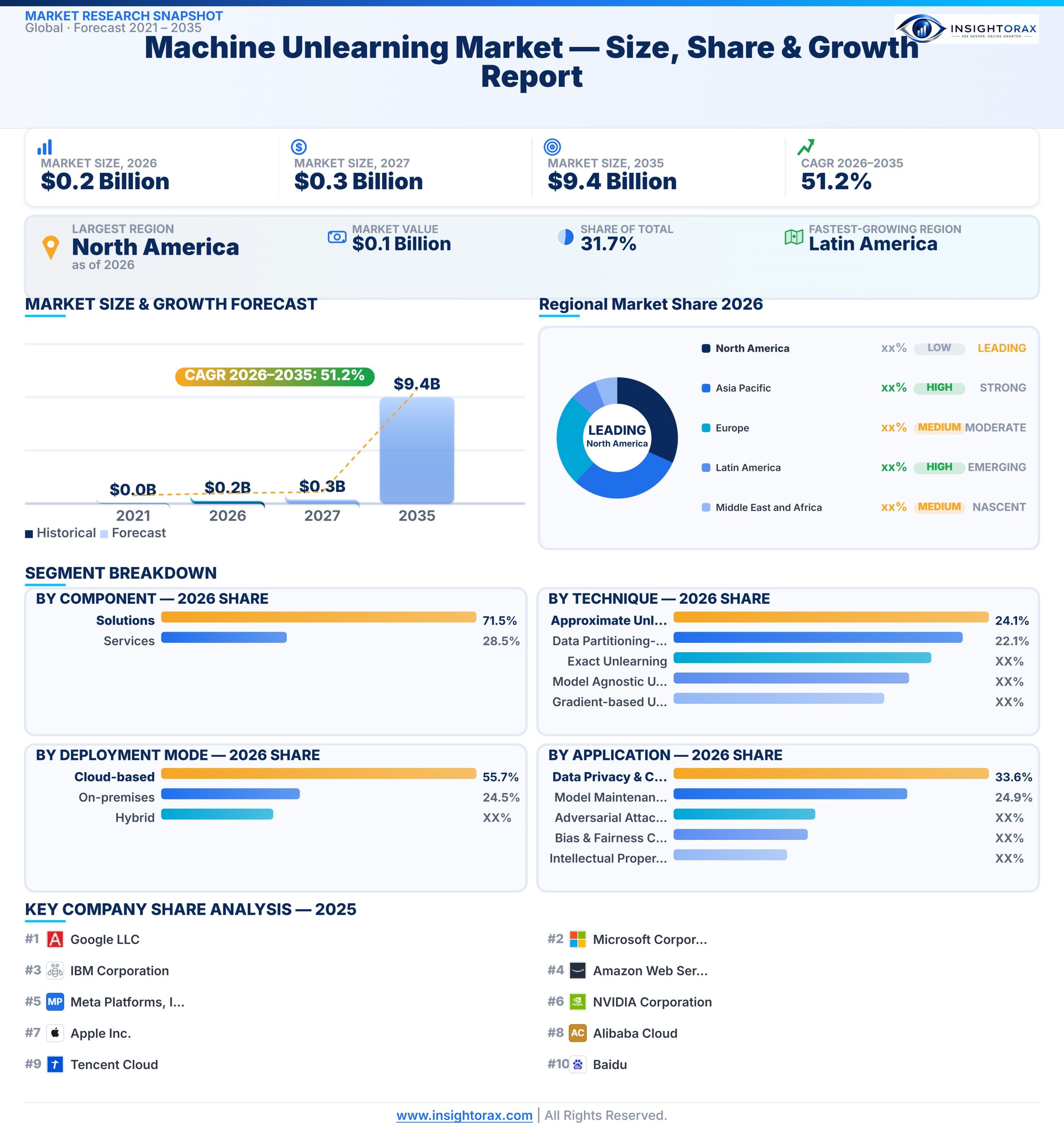
According to data analyzed by Insightorax, the global machine unlearning market size was valued at USD 0.2 billion in 2026 and is projected to grow from USD 0.3 billion in 2027 to USD 9.4 billion by 2035, registering a CAGR of 51.2% during the 2026–2035 forecast period. North America accounted for the largest revenue share of 31.7% in 2026. Global growth is driven by rising data privacy regulations, increasing demand for responsible AI, growing concerns over sensitive data retention, and the need to efficiently remove specific data from trained machine learning models. Demand is further supported by rapid AI adoption across industries, stricter compliance requirements, cybersecurity concerns, and increasing deployment of machine learning systems requiring flexible data management and model governance.
2. Market Overview:
The Machine Unlearning Market refers to technologies, software, platforms, and services designed to remove the influence of specific data from trained machine learning models without requiring complete model retraining. It enables organizations to address data deletion requests, privacy obligations, regulatory requirements, and unwanted or outdated information while maintaining model performance and reducing computational costs.
The market covers unlearning algorithms, model retraining and modification techniques, data removal solutions, privacy-preserving machine learning, and verification and validation tools. Key components include software frameworks, cloud-based platforms, consulting and implementation services, and associated research and development. Applications span healthcare, finance, technology, retail, government, and other data-intensive sectors, with demand driven by AI governance, data privacy, cybersecurity, regulatory compliance, and responsible AI practices.
3. Market Size & Forecast:
The Machine Unlearning Market has evolved from an emerging research area into a specialized technology segment addressing the challenges of removing selected data from trained machine learning models. Early development focused primarily on academic research into efficient unlearning algorithms and privacy-preserving model techniques. Increasing adoption of artificial intelligence and growing awareness of data governance have accelerated commercial interest, expanding applications across technology, healthcare, finance, retail, and other data-intensive industries.
Looking ahead, the market is expected to expand rapidly as organizations face stricter data privacy requirements, increasing data deletion requests, and greater pressure to demonstrate responsible AI practices. The growing volume of training data, rising cybersecurity concerns, and high computational costs associated with complete model retraining are encouraging demand for efficient unlearning solutions. Advances in AI governance, cloud computing, automated model management, and privacy-enhancing technologies are expected to further support market adoption and innovation.
Key Market Trends & Insights
- By component: Solutions segment dominated the market with a 71.5% share in 2026.
- By technique: Approximate Unlearning segment led the market in terms of share, accounting for 24.1% in 2026.
- By deployment mode: Cloud-based segment commanded the largest market share at 55.7% in 2026.
- By application: Data Privacy & Compliance segment accounted for the highest market share of 33.6% in 2026.
- By end user: IT & Telecommunications segment maintained a leading position in the market, holding a 21.9% share in 2026.
- By organization size: Large Enterprises segment dominated the market with a 67.2% share in 2026.
Regional Highlights
- Largest regional market: North America (31.7% revenue share, 2026)
- Fastest-growing regional market: Latin America (7.1% revenue share, 2026)
- By country: The United States held the largest market share in 2026
Market Size & Forecast
- Market size in 2026: USD 0.2 Billion
- Estimated market size in 2027: USD 0.3 Billion
- Projected market size by 2035: USD 9.4 Billion
- CAGR (2026-2035): 51.2%
4. Market Drivers, Restraints & Opportunities:
The market is driven by increasing data privacy regulations, growing adoption of artificial intelligence, and rising demand for responsible AI governance. Organizations are seeking efficient methods to remove sensitive, outdated, or improperly obtained data from trained models while avoiding the time and computational costs of complete retraining. Growing cybersecurity concerns, increasing data volumes, and greater use of machine learning in regulated industries are further strengthening demand for machine unlearning solutions.
However, the market faces challenges including algorithmic complexity, difficulties in verifying whether data has been completely removed, potential impacts on model accuracy, and the lack of standardized unlearning frameworks. High implementation costs and limited technical expertise may also restrict adoption among smaller organizations. Significant opportunities exist through the development of automated unlearning platforms, privacy-enhancing technologies, cloud-based solutions, and AI governance tools. Integration with enterprise data-management systems and regulatory compliance platforms can further create new commercial opportunities.
5. Market Trends:
Machine unlearning is gaining importance as organizations seek to remove specific data, knowledge, or unwanted behaviors from trained AI models without completely retraining them. Major trends include privacy-preserving AI, data deletion, copyright protection, responsible AI, model governance, generative AI, large language models, federated learning, cybersecurity, and efficient model-retraining alternatives. Research is increasingly focused on accurate forgetting while preserving overall model performance.
Regional adoption is being influenced by data-protection requirements, AI governance, and enterprise AI investment. Europe is emphasizing privacy, accountability, and the right to erasure, while North America is seeing growing interest in AI security, copyright, privacy, and enterprise applications. Asia-Pacific is expanding machine-unlearning research and adoption alongside rapid growth in AI, cloud computing, and data-driven technologies. Healthcare, financial services, technology, and government are emerging as important application areas.
Technological development is shifting toward scalable, automated, and verifiable unlearning methods. Key trends include certified unlearning, selective knowledge removal, machine-unlearning benchmarks, privacy-leakage testing, adversarial unlearning, fairness-aware approaches, model repair, and verification of successful data removal. Companies and research institutions are also exploring unlearning for removing personal information, outdated records, copyrighted material, poisoned data, and unsafe model outputs. The market is therefore moving toward practical, auditable, secure, and cost-efficient solutions that can integrate directly into enterprise AI lifecycle and governance frameworks.
6. Technology Landscape:
The Machine Unlearning Market is advancing through selective data-removal algorithms, approximate unlearning, model parameter updating, influence-function methods, knowledge editing, and verification techniques. NIST defines machine unlearning as selectively removing the influence of specific training data from a trained model, including approaches that can avoid complete retraining. Current technological development increasingly emphasizes efficient unlearning for foundation models and reliable evaluation of whether targeted information has been removed.
There is no dedicated ISO certification specifically for machine unlearning at present. Instead, relevant technology and governance practices can align with NIST AI RMF, ISO/IEC 42001:2023 for AI management systems, and ISO/IEC 27001:2022 for information-security management. ISO/IEC 42006:2025 establishes requirements for bodies auditing and certifying AI management systems under ISO/IEC 42001, supporting broader governance and assurance of AI systems that may incorporate unlearning capabilities.
7. Regulatory Framework:
The Machine Unlearning Market is primarily influenced by existing data-protection and AI regulations rather than a dedicated machine-unlearning law. In the EU, the General Data Protection Regulation (GDPR) establishes requirements governing personal-data processing and individual data rights, while the EU AI Act (Regulation 2024/1689) requires privacy and data protection throughout the AI lifecycle and applies data-governance, quality, integrity, and risk-management requirements to relevant AI systems. The EU Data Governance Act and Data Act further establish frameworks for trustworthy data sharing, access, security, and data-protection-by-design.
Compliance requirements increasingly emphasize data minimization, privacy by design and default, traceability, data quality, cybersecurity, technical robustness, and documented governance processes. The EU AI Act also provides for AI regulatory sandboxes to support controlled development, testing, and validation under appropriate safeguards. Government and industry initiatives are consequently moving toward interoperable data governance, privacy-preserving AI, and automated compliance practices. These frameworks can support adoption of machine-unlearning technologies, although machine unlearning itself is not currently subject to a standalone mandatory certification or safety standard.
8. Machine Unlearning Market Segmentation Analysis:
9. By Component:
Solutions are expected to account for the larger share of demand because organizations increasingly require dedicated technologies to identify, remove, and validate the influence of selected data within trained models. These offerings include unlearning algorithms, model-management capabilities, privacy controls, verification mechanisms, and tools designed to integrate with existing machine-learning workflows. Demand is particularly relevant for enterprises managing large datasets and models where complete retraining can be resource-intensive.
Services remain important for implementation, customization, integration, model assessment, and ongoing governance. Enterprises often require specialized expertise to determine appropriate unlearning techniques, establish validation procedures, and integrate these capabilities with existing AI infrastructure. Service providers can also support regulatory assessments and operational deployment. The combination of software capabilities and professional expertise is strengthening adoption, while increasingly complex AI environments are creating opportunities for managed and consulting services.
10. By Technique:
Approximate Unlearning is expected to represent the leading technique because it can remove the influence of targeted data without requiring complete model retraining. This approach can offer better computational efficiency and scalability, making it particularly relevant for large models and enterprise AI environments. Its practical value increases as organizations handle frequent deletion requests, evolving datasets, and increasingly complex machine-learning workloads.
Exact unlearning remains significant where organizations require stronger guarantees that specific training information has been removed. Data partitioning-based methods can improve efficiency by isolating datasets into manageable components, while model-agnostic and gradient-based approaches provide additional flexibility for different architectures. Demand across these techniques is influenced by the trade-off between removal accuracy, computational cost, model performance, and verification requirements, with ongoing research focused on improving reliability and scalability.
11. By Deployment Mode:
Cloud-based deployment is expected to maintain the leading position as organizations increasingly use cloud infrastructure for artificial intelligence development, model training, storage, and lifecycle management. Cloud environments can provide scalable computing resources for unlearning workloads and simplify integration with existing machine-learning platforms. They are particularly attractive to organizations seeking flexible infrastructure without maintaining dedicated hardware for specialized workloads.
On-premises deployment continues to be important for organizations with stringent data-control, security, and regulatory requirements, particularly in highly regulated sectors. Hybrid deployment provides an alternative by combining internal infrastructure with cloud resources, allowing organizations to balance control, scalability, and operational flexibility. Demand across deployment models will increasingly depend on data sensitivity, organizational infrastructure, compliance requirements, model size, and the frequency of unlearning operations.
12. By Application:
Data Privacy & Compliance is expected to remain the dominant application because growing data-protection requirements are increasing the need to remove personal or sensitive information from AI models. Organizations are evaluating unlearning capabilities to address data-deletion obligations, reduce privacy risks, and strengthen responsible AI practices. The application is particularly relevant where models have been trained using large volumes of personal, confidential, or regulated information.
Model maintenance and optimization represent another important use case, enabling organizations to update models when information becomes outdated or undesirable. Adversarial attack mitigation can support removal of compromised or manipulated training information, while bias and fairness correction can help address problematic data contributions. Intellectual property protection is also gaining attention as organizations seek greater control over copyrighted or proprietary training content. Together, these applications extend unlearning beyond privacy toward broader AI lifecycle management.
13. By End-use Industry:
IT & Telecommunications is expected to remain a major end-use sector because these industries operate large-scale AI systems, extensive customer datasets, cloud platforms, and data-intensive digital services. Their growing use of machine learning creates requirements for data governance, privacy protection, model maintenance, and efficient handling of information that should no longer influence deployed systems. Large technology companies are also actively researching machine unlearning for modern AI and foundation models.
Banking, financial services and insurance are significant adopters because of stringent data-management requirements and extensive use of AI for risk assessment, fraud detection, customer analytics, and decision-making. Healthcare and life sciences present additional opportunities because models frequently process sensitive patient information. Retail, government, media, and other sectors are also exploring these capabilities for privacy management, intellectual property protection, compliance, and responsible AI operations, supporting broader industry adoption.
14. By Organization Size:
Large enterprises are expected to account for the larger share of adoption because they typically operate larger AI environments, process substantial volumes of data, and face more complex privacy, security, and governance requirements. Their greater financial and technical resources also enable investment in specialized unlearning platforms, research, integration services, and continuous model monitoring. Organizations with extensive AI deployments have stronger incentives to reduce the computational burden associated with repeatedly retraining models.
Small and medium enterprises are expected to represent a growing opportunity as cloud-based tools and managed services reduce infrastructure and implementation barriers. SMEs can increasingly access unlearning capabilities without developing proprietary algorithms or maintaining specialized computing environments. Adoption will nevertheless depend on solution affordability, technical expertise, regulatory exposure, and the complexity of their AI workloads. Simplified platforms and subscription-based services could therefore accelerate penetration among smaller organizations.
15. Regional Analysis:
North America represents a major regional market for machine unlearning, supported by the strong presence of advanced technology companies and widespread adoption of artificial intelligence and machine learning solutions. The United States accounts for the dominant share of the regional market, while Canada contributes to the region's continued expansion. Growing investments in AI infrastructure, cloud computing, data security, and responsible AI practices are increasing the need for technologies that can selectively remove data from trained machine learning models. Regulatory attention toward data privacy and organizations' increasing focus on managing sensitive information are also supporting regional adoption.
Europe is another important market, with Germany, France, and the United Kingdom representing key countries, followed by Spain, Italy, and other European markets. Regional growth is influenced by increasing emphasis on data protection, responsible artificial intelligence, and regulatory compliance. Enterprises are increasingly seeking solutions that enable them to address data deletion requirements while maintaining the performance and reliability of AI models. The growing deployment of AI across financial services, healthcare, automotive, manufacturing, and other industries is expected to create additional opportunities for machine unlearning technologies throughout the region.
Asia Pacific is positioned as a rapidly expanding regional market and demonstrates strong growth potential compared with several other regions. China represents a major contributor, while India, Japan, Australia, South Korea, and other Asia Pacific markets are also supporting regional development. Rapid digital transformation, increasing adoption of AI and machine learning, expanding cloud infrastructure, and rising investments in data-driven technologies are key factors supporting demand. The region's growing technology ecosystem and increasing development of AI applications are likely to encourage organizations to adopt machine unlearning for data governance, privacy management, and model lifecycle management.
The Middle East and Africa market is developing as organizations accelerate digital transformation and increase investments in artificial intelligence, cloud technologies, and data management infrastructure. Saudi Arabia represents an important market within the region, supported by national digitalization initiatives and increasing technology investments, while South Africa contributes to adoption across African markets. Growing awareness of data privacy, cybersecurity, and responsible AI is encouraging enterprises and technology providers to explore machine unlearning capabilities. Continued development of digital infrastructure and AI-enabled applications is expected to gradually strengthen regional demand.
Latin America is also emerging as an opportunity-rich market, with Brazil serving as a major contributor, followed by Argentina, Mexico, and other countries across the region. Increasing digitalization, cloud adoption, AI deployment, and the expansion of data-intensive business applications are creating favorable conditions for machine unlearning technologies. Organizations are becoming more attentive to data governance and privacy requirements as AI adoption expands across financial services, healthcare, retail, telecommunications, and other sectors. As regional enterprises strengthen their AI governance frameworks, demand for effective data removal and model management solutions is expected to increase.
16. Competitive Landscape:
Competition in the Machine Unlearning Market is centered on major technology companies, AI research organizations, cloud providers, and specialized developers competing through algorithmic innovation, model compatibility, scalability, and verification capabilities. IBM, Google, and Microsoft are among the companies actively researching machine unlearning, particularly for generative AI and sensitive or unwanted training data. Product differentiation increasingly depends on efficient unlearning, preservation of model performance, support for large models, and reliable verification. Google’s 2026 work on auditing unlearning illustrates the growing importance of demonstrable removal rather than simply claiming that information has been forgotten.
Companies are also pursuing organic technology development, research collaborations, cloud integration, and geographic expansion to strengthen AI capabilities. Partnerships such as IBM and Google Cloud’s 2026 expansion combine AI, data, cybersecurity, consulting, and cloud expertise. Competitive strategies increasingly emphasize responsible-AI frameworks, privacy, security, and governance rather than standalone unlearning functionality. NIST’s AI Risk Management Framework provides a voluntary foundation for trustworthy AI development, while ISO/IEC 42001 offers a certifiable AI-management framework; neither constitutes a dedicated machine-unlearning certification.
17. Machine Unlearning Market Company Insights:
The Machine Unlearning Market features a combination of major technology companies, cloud providers, and specialized AI and data-governance vendors. Google, Microsoft, IBM, AWS, Meta, NVIDIA, Apple, Alibaba Cloud, Tencent Cloud, Baidu, Oracle, SAP, and Salesforce bring extensive capabilities across cloud computing, AI infrastructure, foundation models, enterprise software, data management, and privacy technologies. Their established AI ecosystems provide strong foundations for integrating data-removal, model-management, and responsible-AI capabilities.
Specialized participants such as DataRobot, H2O.ai, Securiti.ai, and BigID contribute through enterprise machine-learning platforms, model lifecycle management, data security, privacy management, and AI governance. Competition is increasingly influenced by organizations' ability to integrate unlearning into broader AI workflows rather than offering standalone functionality. Technology development, cloud integration, privacy requirements, enterprise adoption, and advances in foundation models are expected to shape competitive positioning as the market develops.
18. Key Machine Unlearning Market Companies:
Google LLC
Microsoft Corporation
IBM Corporation
Amazon Web Services (AWS)
Meta Platforms, Inc.
NVIDIA Corporation
Apple Inc.
Alibaba Cloud
Tencent Cloud
Baidu
Oracle Corporation
SAP SE
Salesforce, Inc.
DataRobot
ai
BigID
19. Recent Developments:
· June 9, 2025 — Hirundo raised $8 million in seed funding, led by Maverick Ventures Israel, to develop its machine unlearning platform for removing hallucinations, biases, and vulnerabilities from trained AI models without full retraining.
· July 16, 2025 — Hirundo won first prize at the RAISE Summit startup competition, competing against more than 1,100 AI startups.
· December 10, 2025 — Google DeepMind researchers published “Machine Unlearning Doesn’t Do What You Think,” examining limitations of current generative-AI unlearning methods in achieving broader privacy, copyright, and safety objectives.
· January 2025 — IBM Research published a review/position paper on LLM unlearning, highlighting its potential for addressing hallucinations, toxicity, copyright, and privacy concerns in generative AI.
· March 17, 2026 — Hirundo joined HPE’s “Unleash AI” partner program, integrating its machine-unlearning workflows with HPE Private Cloud AI to help enterprises remove sensitive or unwanted training signals from deployed AI models.
· March 18, 2026 — Hirundo reported using NVIDIA NeMo Evaluator, CUDA, and GB200 NVL72 to validate machine-unlearning results, achieving reported reductions in prompt-injection vulnerability and bias while maintaining model capabilities.
· May 21, 2026 — Google DeepMind featured Hirundo’s security-hardened Gemma 4 (E4B) variant on Gemmaverse, with reported performance exceeding much larger LLMs on selected security benchmarks.
· July 2026 — AWS introduced Reverse Direct Preference Optimization (rDPO) as an unlearning technique for selectively modifying model safeguards without requiring complete model retraining.
20. Future Outlook:
The Machine Unlearning Market is expected to move from an emerging research field toward a broader AI lifecycle and governance capability, supported by growing requirements for privacy, data control, responsible AI, and removal of unwanted model knowledge. NIST formally defines machine unlearning as selectively removing the influence of specific training data, while recent research is expanding into LLMs, federated learning, verification, and fairness.
Future opportunities will center on scalable, computationally efficient, and verifiable unlearning, particularly for large foundation models and distributed AI environments. However, proving effective removal, preserving model accuracy, managing repeated deletion requests, and establishing consistent evaluation methods remain important challenges. Recent research increasingly addresses certification, auditing, privacy robustness, and lifecycle deployment, indicating that unlearning is likely to become increasingly integrated with broader AI governance and model-management workflows.
21. Methodology Overview
Extensive research from reliable academic sources, industry reports, and publications.
Interviews with industry experts, opinion leaders, and key stakeholders.
Validation of data through top-down and bottom-up approaches.