Livestock Sensors Market Research Report
Global Market Size, Share & Trends Analysis Report, 2026-2035
Segmentation Analysis By Type: By Application: By Livestock Type: By Component: By Region and Industry Forecast
1. Market Summary:
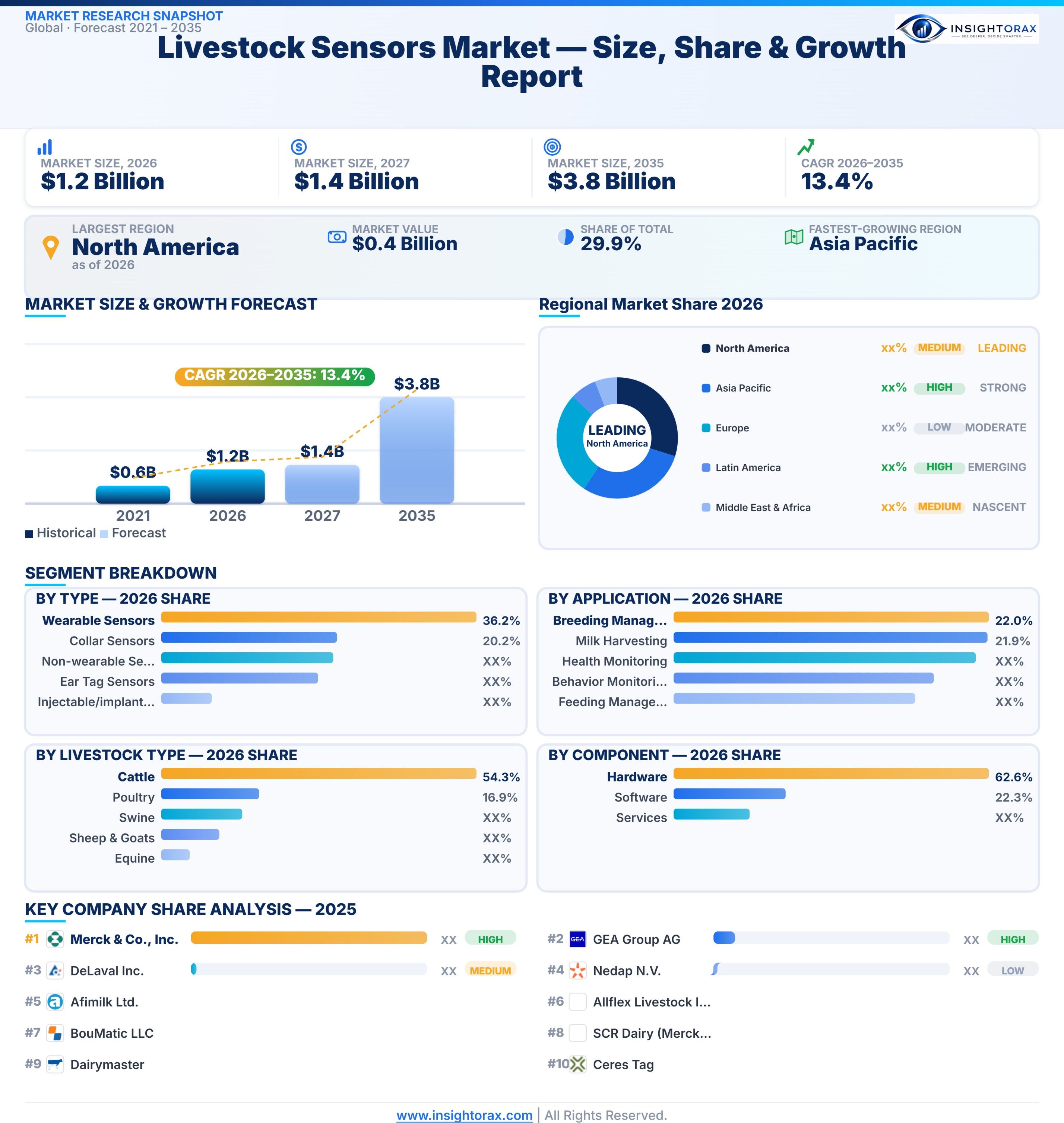
According to data analyzed by Insightorax, the global livestock sensors market size was valued at USD 1.2 billion in 2026 and is projected to grow from USD 1.4 billion in 2027 to USD 3.8 billion by 2033, registering a CAGR of 13.4% during the 2026–2033 forecast period. North America accounted for the largest revenue share of 36.4% in 2026. Market growth is driven by increasing adoption of precision livestock farming, rising demand for real-time animal health monitoring, and growing use of connected technologies to improve farm productivity and operational efficiency. Key demand factors include disease and illness detection, livestock tracking, reproductive monitoring, feed and nutrition management, environmental monitoring, and early identification of abnormal animal behavior. Increasing automation, IoT integration, and data-driven herd management are further supporting adoption across commercial livestock operations.
2. Market Overview:
The Livestock Sensors Market comprises sensing devices, connected monitoring systems, and related technologies used to collect, transmit, and analyze real-time information about livestock health, behavior, location, reproduction, nutrition, and environmental conditions. These solutions support precision livestock farming by enabling farmers, veterinarians, and livestock operators to monitor individual animals or herds continuously. The market covers hardware, software, connectivity, data platforms, and associated monitoring services used across cattle, swine, poultry, sheep, goats, and other commercially managed livestock.
Key components include wearable sensors, ear tags, collars, rumination and activity monitors, temperature sensors, location and positioning devices, environmental sensors, and automated identification systems. Sensor-generated data can be integrated with IoT platforms, cloud-based analytics, mobile applications, and farm-management systems to identify health abnormalities, optimize feeding, monitor reproductive cycles, improve herd management, and support timely intervention. The market spans dairy, meat, breeding, and other livestock production applications.
3. Market Size & Forecast:
The Livestock Sensors Market has evolved from basic animal identification and tracking devices toward integrated monitoring solutions capable of collecting continuous health, behavioral, reproductive, and environmental data. Historically, adoption was concentrated among technologically advanced commercial farms, while improvements in wireless connectivity, sensor miniaturization, battery efficiency, and cloud-based platforms have broadened practical applications. Increasing awareness of precision livestock farming has further encouraged producers to use sensor-generated data for more efficient herd management and timely intervention.
Future market expansion is expected to be supported by rising livestock production, growing emphasis on animal health and welfare, labor shortages, and the need to improve farm productivity and resource efficiency. Increasing adoption of IoT-enabled monitoring, artificial intelligence-based analytics, automated identification, and connected farm-management platforms is expected to strengthen demand. Greater focus on disease prevention, reproductive performance, feed optimization, traceability, and early detection of health abnormalities will further encourage sensor deployment across commercial livestock operations.
Key Market Trends & Insights
- By type: Wearable Sensors segment dominated the market with a 36.2% share in 2026.
- By application: Breeding Management segment led the market in terms of share, accounting for 22.0% in 2026.
- By livestock type: Cattle segment commanded the largest market share at 54.3% in 2026.
- By component: Hardware segment accounted for the highest market share of 62.6% in 2026.
Regional Highlights
- Largest regional market: North America (29.9% revenue share, 2026)
- Fastest-growing regional market: Asia Pacific Highest CAGR, 2026–2035
- By country: The United States held the largest market share in 2026
Market Size & Forecast
- Market size in 2026: USD 1.2 Billion
- Estimated market size in 2027: USD 1.4 Billion
- Projected market size by 2035: USD 3.8 Billion
- CAGR (2026-2035): 13.4%
4. Market Drivers, Restraints & Opportunities:
The Livestock Sensors Market is driven by the growing adoption of precision livestock farming, increasing demand for real-time animal health monitoring, and the need to improve productivity, breeding efficiency, and feed utilization. Sensors enable continuous tracking of body temperature, activity, rumination, heart rate, location, and behavioral changes, helping farmers identify illness, estrus, lameness, and other conditions earlier. Rising livestock populations, pressure to improve food production efficiency, labor shortages, and expanding use of connected farm-management platforms are further supporting adoption. Advances in wireless connectivity, IoT, cloud computing, artificial intelligence, and low-power sensor technologies are also improving monitoring capabilities.
However, high upfront costs for sensor hardware, connectivity infrastructure, software, and system integration can limit adoption, particularly among small and medium-sized farms. Battery life, sensor durability, environmental exposure, data accuracy, connectivity gaps in rural areas, and compatibility with existing farm-management systems remain practical challenges. Farmers may also face difficulties interpreting large volumes of sensor-generated data and integrating automated alerts into daily operations. Concerns surrounding data ownership, cybersecurity, privacy, and interoperability can further slow deployment across fragmented livestock production systems.
Significant opportunities are emerging through AI-enabled predictive analytics, wearable and implantable monitoring devices, smart ear tags, connected collars, and automated identification systems. Integration of sensor data with robotic milking, automated feeding, breeding-management, and veterinary platforms can create broader precision-livestock ecosystems. Emerging markets offer opportunities as governments and agribusinesses promote digital agriculture and sustainable livestock production. Demand for early disease detection, reduced antibiotic use, improved animal welfare, methane monitoring, and resource-efficient farming is also creating new applications for advanced sensor technologies.
5. Market Trends:
Livestock Sensors Market trends are shifting toward continuous, individual-animal monitoring rather than periodic herd observation. Wearable collars, ear tags, accelerometers, RFID devices, thermal cameras, microphones, and environmental sensors increasingly track activity, rumination, feeding, location, temperature, reproduction, lameness, and disease indicators. North America and Europe are important adoption centers, especially in dairy, while Asia Pacific is gaining momentum as producers pursue productivity, labor efficiency, climate resilience, and digital farm management.
Technology development is moving toward multimodal sensing, sensor fusion, edge computing, cloud platforms, and AI analytics. Deep-learning models increasingly process accelerometer, video, acoustic, and physiological data for behavior classification, estrus detection, calving prediction, lameness identification, and health monitoring. Non-contact computer vision and thermal imaging are gaining attention because they monitor animals without attached devices. Hardware development emphasizes wireless, low-power, durable wearables, although battery life, robustness, interoperability, and model generalization remain challenges.
Regulatory and industry trends increasingly connect sensor deployment with animal welfare, traceability, sustainability, and livestock management. Global policy discussions emphasize animal welfare, One Health, and sustainability. European producers face welfare and environmental reporting pressures, while technology providers develop systems supporting auditable farm records. Across regions, integration with automated feeding, milking, breeding, veterinary, and farm management platforms is becoming a key direction, enabling predictive rather than reactive livestock management.
6. Technology Landscape:
Livestock sensor technology increasingly combines wearable and implanted sensors, RFID identification, computer vision, thermal imaging, microphones, load cells, and environmental monitoring. Connected architectures integrate physical sensors with network, edge, and cloud layers for data collection, processing, storage, and AI-based analytics. Applications include monitoring body temperature, activity, respiration, rumen conditions, location, feeding, and behavior.
Technology development is emphasizing sensor fusion, machine learning, edge analytics, wireless connectivity, and interoperability across farm-management systems. Standards are also advancing: ISO 11785:2026 specifies the technical concept for animal RFID transponders, while ISO 6881:2023 defines code structures for UHF animal-identification transponders. WOAH standards provide international guidance for animal identification and traceability, including technology compatibility, durability, animal welfare, and performance considerations.
7. Innovation & R&D Analysis:
R&D is advancing livestock sensors from wearable accelerometers, temperature and rumen-pH devices toward integrated, non-contact monitoring using computer vision, GNSS, IoT connectivity and AI-based behavioral analysis. Recent research highlights systems capable of identifying animals, assessing morphology, tracking behavior, monitoring vital signs and supporting earlier disease detection without physical contact. European Commission research also identifies GNSS/IoT ear tags, accelerometers and physiological sensors as increasingly mature technologies for livestock identification, traceability and extensive-farming applications. Key challenges remain sensor durability, battery life, connectivity, miniaturization, data interoperability, algorithm performance and validation across different farming environments.
Industry and academic initiatives increasingly emphasize standardized validation of sensor accuracy, precision, bias and reproducibility. A 2025 review found substantial gaps in validation practices for dairy-cattle behavior sensors, strengthening the need for consistent performance criteria. Standards development is also progressing: ISO 24631-3:2025 specifies performance evaluation for animal RFID transponders, while ISO 11785:2026 defines the technical concept for animal RFID transponder activation and data transfer.
8. Livestock Sensors Market Segmentation Analysis:
9. By Type:
Wearable Sensors represent the leading type in 2026, accounting for 36.20% of the Livestock Sensors Market. Their broad deployment supports continuous collection of animal activity, health, location, and behavioral indicators, making them valuable for precision livestock operations. Demand is supported by the need for real-time visibility, earlier intervention, productivity optimization, and data-driven herd management. Wearable devices also provide practical monitoring across dairy and meat production environments, strengthening their significance as sensor adoption expands.
Collar Sensors rank second in 2026 with a 20.20% market share. Their ability to capture movement, activity, and behavioral patterns supports applications spanning health assessment, reproductive management, feeding oversight, and behavior monitoring. Non-wearable Sensors, Ear Tag Sensors, and Injectable/implantable Sensors also contribute to the market by addressing identification, tracking, physiological measurement, and specialized monitoring requirements. Together, these technologies broaden sensor deployment across livestock systems and support increasingly connected farm-management practices.
10. By Application:
Breeding Management holds the highest 2026 application share at 22.00%. Sensors support estrus identification, reproductive timing, activity analysis, and herd-level decision-making, helping producers improve reproductive efficiency and reduce missed breeding opportunities. Demand is reinforced by the need for automated observation and continuous animal-level data, particularly where larger herds make manual monitoring less efficient. This application therefore remains important to precision livestock management and the integration of sensor-generated information into routine production workflows.
Milk Harvesting follows with a 21.90% share in 2026, reflecting the importance of sensor-enabled measurement and monitoring in dairy operations. Sensor systems can support production oversight and provide data relevant to milking performance, animal condition, and operational efficiency. Feeding Management, Behavior Monitoring & Detection, and Health Monitoring further extend sensor use across daily livestock management. These applications strengthen demand for connected monitoring technologies by linking animal-level information with productivity, welfare, resource management, and timely operational decisions.
11. By Livestock Type:
Cattle account for 54.26% of the Livestock Sensors Market in 2026, giving this livestock category the strongest position in sensor deployment. Extensive dairy and beef management requirements create demand for continuous monitoring of activity, health, reproduction, feeding, and production-related indicators. Sensor adoption can improve herd visibility, support earlier identification of changes in animal condition, and facilitate data-driven management. The category is therefore central to the market’s commercial relevance across increasingly technology-enabled livestock operations.
Poultry represents the second-highest livestock category in 2026, with a 16.86% share. Sensor applications in poultry production support monitoring of environmental and behavioral conditions, flock management, feeding, and health-related indicators, helping operators manage intensive production systems more systematically. Swine, Sheep & Goats, and Equine also contribute to market demand through species-specific monitoring needs involving health, behavior, reproduction, identification, and productivity. These categories broaden the addressable opportunity for sensor technologies beyond cattle-focused deployments and support wider adoption of precision livestock practices.
12. By Component:
Hardware commands the component landscape in 2026 with a 62.63% market share. Sensors, connected devices, identification equipment, and associated physical infrastructure form the foundation for collecting animal-level data across livestock operations. Demand is driven by wider deployment of wearable and other sensor technologies, requirements for continuous monitoring, and the expansion of connected farm-management systems. Hardware remains commercially significant because reliable data capture is essential for health, reproduction, feeding, behavior, and production-related applications across diverse livestock environments.
Software holds the second-highest component position in 2026 at 22.26%. Software platforms convert sensor-generated information into actionable insights for monitoring, analytics, alerts, visualization, and operational decision-making. Services complement these capabilities through implementation, integration, support, maintenance, and related technical assistance. Together, Software and Services increase the utility of sensor hardware by connecting collected data with practical management workflows. Their growing role reflects the market’s transition from standalone sensing devices toward integrated, data-enabled livestock monitoring ecosystems.
13. Regional Analysis:
Asia Pacific represented 29.72% of the global Livestock Sensors Market in 2026. Growth is supported by expanding livestock production, greater attention to animal health, and interest in data-based herd management. Producers are adopting sensors to monitor temperature, activity, feeding behavior, location, and health indicators. Applications across dairy, cattle, poultry, and other operations encourage wider use for productivity, traceability, and resource efficiency. Technology adoption is benefiting from connected devices, wireless monitoring, cloud platforms, and analytics tools. Large agricultural markets and digital infrastructure support broader adoption across livestock enterprises.
North America accounted for 29.74% of the Livestock Sensors Market in 2026, making it the leading regional contributor. The market benefits from established commercial livestock operations, precision agriculture adoption, and demand for technologies that improve herd health, productivity, and visibility. Sensors monitor activity, temperature, rumination, feeding patterns, movement, and reproductive conditions, helping producers make timely decisions. Dairy and cattle operations provide important application areas, while connected platforms support centralized farm data. Adoption is reinforced by wireless connectivity, cloud analytics, automated management systems, and established agricultural technology ecosystems. The region remains strategically important for continuous monitoring and efficient, data-driven management decisions.
Europe held a 27.41% share of the Livestock Sensors Market in 2026. Regional demand is supported by emphasis on animal welfare, sustainable livestock production, productivity improvement, and precision farming. Operators use sensors to monitor health, behavior, feeding, movement, environmental conditions, and reproductive performance, supporting herd management. Dairy farming is an important application environment, as other livestock operations adopt connected monitoring. Technology adoption is strengthened by farm management software, wireless networks, data platforms, and decision tools. Producers also face pressure to improve resource efficiency and maintain production standards, encouraging investment in monitoring technologies. These factors position Europe as a significant market for digital livestock management and farming.
Middle East & Africa represented 6.03% of the Livestock Sensors Market in 2026. Demand is shaped by the need to improve livestock productivity, animal health management, and operational oversight across production environments. Where climate conditions place additional pressure on animals, monitoring technologies help producers observe health, activity, location, and environmental conditions. Sensors support cattle, sheep, goats, poultry, and other applications. Adoption is linked to agricultural modernization, connected farm technologies, and resource utilization. Wireless devices, remote monitoring, and cloud-enabled data access can benefit dispersed farms. Although technology penetration varies, the region offers meaningful opportunities as livestock enterprises explore digital tools for management.
Latin America accounted for 7.10% of the Livestock Sensors Market in 2026. Demand is supported by its livestock production base and increasing focus on productivity, animal health, traceability, and farm management. Sensors can monitor activity, location, temperature, feeding behavior, and health indicators, supporting herd supervision. Cattle production is an important application environment, while dairy, poultry, and other livestock activities can benefit from connected monitoring. Adoption is encouraged by mobile connectivity, wireless devices, cloud platforms, and digital agricultural services. Producers and agribusinesses are evaluating technologies that improve operational visibility and resource efficiency. The region holds importance as precision livestock management becomes more accessible across commercial farming operations across the region.
14. Competitive Landscape:
Competition is centered on sensor accuracy, real-time monitoring, interoperability, animal identification, and actionable analytics. Leading players such as MSD Animal Health through Allflex Livestock Intelligence differentiate with RFID identification, monitoring tags, collars, cloud analytics, and integrated traceability platforms. Allflex combines electronic identification with monitoring and software, while its products are designed for regulatory traceability and data-driven herd management. Geographic expansion is supported by manufacturing, technology, distribution, and service networks across major livestock-producing regions.
Partnerships, acquisitions, investments, and recurring-service models are important competitive strategies. MSD Animal Health has invested in digital traceability and monitoring businesses, including LeeO Precision Farming, while its Animal Health Ventures unit actively invests in emerging technologies. Subscription-based livestock monitoring is also being used to lower adoption barriers and strengthen customer relationships. Product differentiation increasingly incorporates ISO-compliant RFID technologies, cloud connectivity, AI-enabled analytics, and integration with farm-management systems. Companies are also emphasizing sustainability, traceability, animal welfare, and productivity as commercial differentiators.
15. Livestock Sensors Company Insights:
Afimilk, DeLaval, GEA, BouMatic and Lely compete through dairy automation, milking intelligence, herd-management platforms and sensor-enabled monitoring. Allflex Livestock Intelligence and Datamars focus on electronic identification, traceability and connected animal monitoring, while Merck Animal Health, Antelliq and SCR provide digitally integrated identification, health, fertility and behavior solutions. Nedap differentiates through SmartTags, RFID identification, heat detection, health monitoring, cow locating and AI-enabled software integration.
Dairymaster, Moocall, Cowlar, Smartbow, ICE Robotics and Icerobotics specialize in fertility, calving, wearable and behavior-monitoring technologies, while Ceres Tag emphasizes connected smart ear tags; Quantified Ag focuses on cattle health analytics and Vytelle on data-enabled livestock genetics. Companies increasingly pursue partnerships, platform integration, international distribution and subscription-enabled digital services. Certification and interoperability remain important, particularly ISO-compliant RFID identification, while product strategies emphasize durable sensors, real-time analytics, automation, traceability, animal welfare and productivity.
16. Key Livestock Sensors Companies:
· Afimilk Ltd.
· Delaval Inc.
· Gea Group Ag
· Allflex Livestock Intelligence
· Merck & Co., Inc.
· Nedap N.v.
· Boumatic Llc
· Scr Dairy (merck Animal Health)
· Dairymaster
· Ceres Tag
· Cowlar Inc.
· Antelliq Group
· Smartbow Gmbh
· Quantified Ag
· Ice Robotics
· Vytelle
· Moocall Ltd.
· Lely Holding
· Icerobotics Ltd.
· Datamars Sa
17. Recent Developments:
· February 13, 2025 – Ceres Tag: Announced a U.S. distribution partnership with Jeffers Inc. to expand access to CERES TAG livestock-monitoring devices.
· May 23, 2025 – BouMatic: Released the BROLIS MilkGenius In-Line Milk Analyzer for the Gemini UP milking robot and other BouMatic milking systems through a partnership with BROLIS.
· June 10, 2025 – Nedap N.V.: Launched SmartSight – Locomotion Monitoring, an AI-driven computer-vision solution for early detection of dairy-cow lameness, initially targeting the United States and Ireland.
· December 18, 2025 – BouMatic: Introduced automated cow-care capabilities in the Gemini UP milking robot using MilkGenius, including automated response to (sub)clinical ketosis and intelligent mastitis indication.
· December 2025 – BouMatic/BROLIS: The BROLIS BHL01 in-line milk analyzer received a positive validation report from the International Committee for Animal Recording (ICAR).
· 2025 – GEA Group AG: Reported €5.495 billion in 2025 revenue, with its portfolio continuing to include dairy technology and automation solutions.
· 2025 – Lely Holding: Reported €1.014 billion in total 2025 revenue and disclosed that R&D represented 8% of investment, supporting continued development of automated dairy technologies.
· 2025 – Merck & Co., Inc.: Reported $6.354 billion in Animal Health sales, including $3.896 billion in livestock sales, with livestock sales increasing 13% year over year.
18. Future Outlook:
The Livestock Sensors Market is expected to maintain a positive growth trajectory as livestock producers increasingly adopt connected monitoring technologies to improve animal health, productivity, breeding outcomes, and farm efficiency. Opportunities will expand through the integration of wearable sensors, smart collars, RFID-based identification, temperature and activity monitoring, and IoT-enabled platforms. Advancements in real-time analytics, cloud connectivity, artificial intelligence, and automated alerts will strengthen precision livestock management while supporting earlier detection of disease, stress, reproductive issues, and abnormal behavior.
Future development will increasingly focus on smaller, more durable, energy-efficient, and cost-effective sensors suitable for diverse livestock environments. Key challenges include high initial investment, connectivity limitations in rural areas, data-management complexity, interoperability, and concerns regarding sensor reliability. Nevertheless, rising demand for sustainable livestock production, improved traceability, and data-driven farm management is expected to accelerate technology adoption and encourage continued innovation across the market.
19. Methodology Overview
Extensive research from reliable academic sources, industry reports, and publications.
Interviews with industry experts, opinion leaders, and key stakeholders.
Validation of data through top-down and bottom-up approaches.