Orbital Compute Market Research Report
Global Market Size, Share & Trends Analysis Report, 2026-2035
Segmentation Analysis By Type: By Application: By End Use: By Component: By Region and Industry Forecast
1. Market Summary:
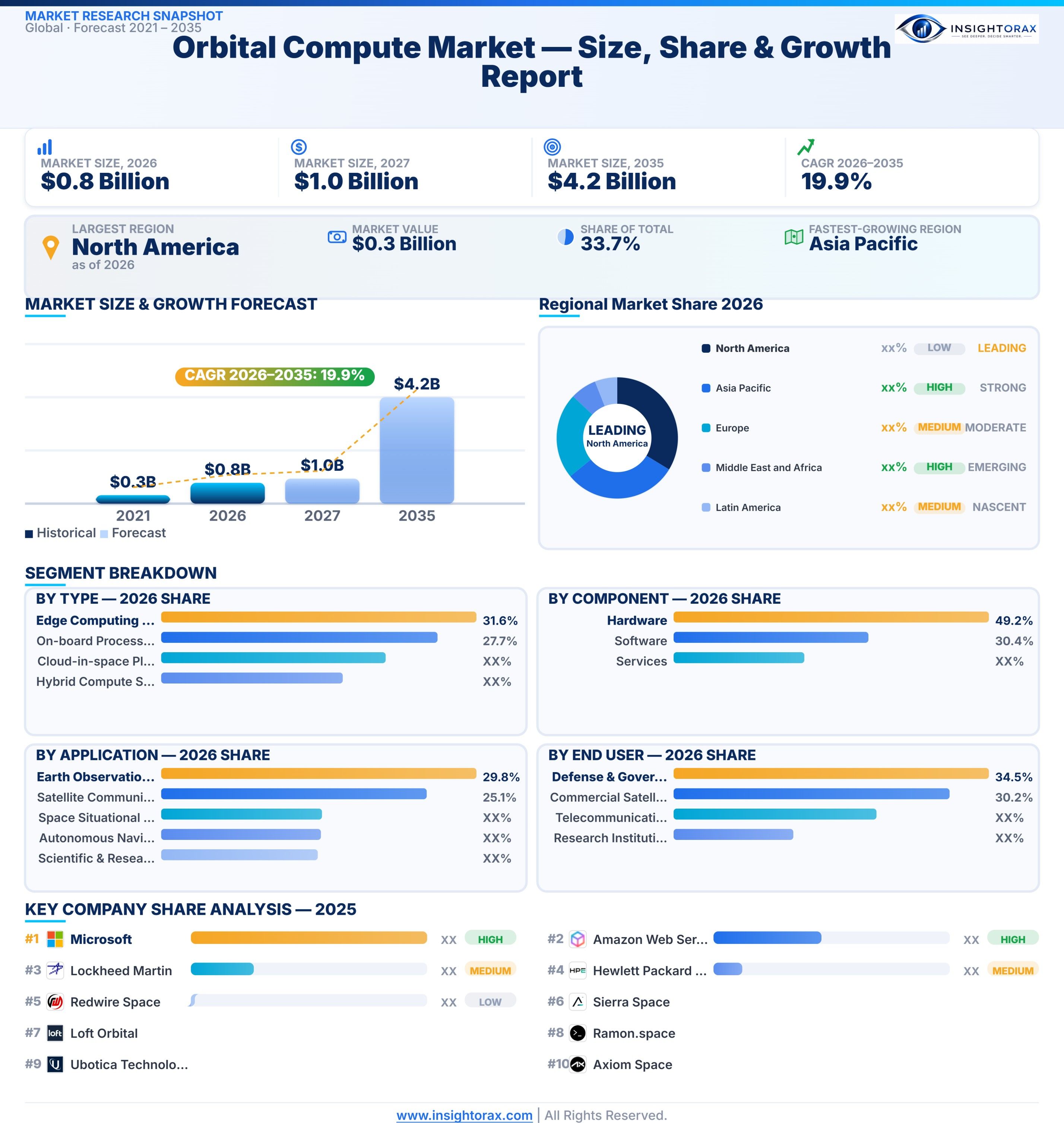
According to data analyzed by Insightorax, the global orbital compute market size was valued at USD 690.0 million in 2026 and is projected to grow from USD 820.0 million in 2027 to USD 4.2 billion by 2035, registering a CAGR of 19.9% during the 2026–2035 forecast period. North America accounted for the largest revenue share of 33.7% in 2026. Global growth is driven by rising demand for in-orbit data processing, satellite autonomy, edge computing, and reduced dependence on ground-based infrastructure. Increasing satellite deployments, high-volume Earth observation data, space-based artificial intelligence, and real-time analytics are strengthening demand. Additional factors include advances in radiation-tolerant processors, onboard networking, inter-satellite communications, and commercial space infrastructure, while defense, telecommunications, Earth observation, and emerging space applications support broader market adoption.
2. Market Overview:
The Orbital Compute Market encompasses computing hardware, software, and integrated systems designed to process, analyze, store, and manage data directly aboard satellites and other spacecraft in orbit. Unlike traditional architectures that transmit most raw data to ground stations, orbital computing enables processing closer to where data is generated. The market covers onboard processors, accelerators, memory and storage systems, networking components, operating software, artificial intelligence and machine-learning platforms, and related integration and support services.
The market scope includes computing solutions deployed across low Earth orbit, medium Earth orbit, geostationary orbit, and other orbital environments. Key applications include Earth observation, satellite communications, remote sensing, space-based AI, defense and intelligence, navigation, scientific missions, and autonomous spacecraft operations. Major market considerations include radiation tolerance, power efficiency, thermal management, processing performance, reliability, cybersecurity, and interoperability with satellite platforms and ground infrastructure.
3. Market Size & Forecast:
The Orbital Compute Market has evolved from basic onboard processing systems toward increasingly capable computing architectures that can perform complex data handling directly in space. Historically, satellite systems relied heavily on ground infrastructure for processing and analysis, but advances in space-qualified processors, memory, networking, and power-efficient computing have expanded onboard capabilities. Current market development is being supported by growing satellite deployments, increasing data volumes from Earth observation and remote-sensing missions, and greater adoption of autonomous spacecraft technologies.
Future expansion is expected as satellite operators seek faster data processing, lower communication requirements, improved operational efficiency, and greater autonomy. Artificial intelligence and machine learning are enabling real-time analytics and decision-making in orbit, while advances in radiation-hardened computing, edge processing, optical communications, and advanced spacecraft architectures are broadening applications. Rising commercial space activity, defense requirements, satellite communications, and demand for timely Earth intelligence are also expected to strengthen long-term market development.
Key Market Trends & Insights
- By type: Edge Computing Satellites segment dominated the market with a 31.6% share in 2026.
- By component: Hardware segment led the market in terms of share, accounting for 49.2% in 2026.
- By application: Earth Observation & Imaging segment commanded the largest market share at 29.8% in 2026.
- By end user: Defense & Government segment accounted for the highest market share of 34.5% in 2026.
- By organization size: Large Enterprises segment maintained a leading position in the market, holding a 54.3% share in 2026.
Regional Highlights
- Largest regional market: North America (33.7% revenue share, 2026)
- Fastest-growing regional market: Asia Pacific Highest CAGR, 2026–2035
- By country: The United States held the largest market share in 2026
Market Size & Forecast
- Market size in 2026: USD 0.8 Billion
- Estimated market size in 2027: USD 1 Billion
- Projected market size by 2035: USD 4.2 Billion
- CAGR (2026-2035): 19.9%
4. Market Drivers, Restraints & Opportunities:
The Orbital Compute Market is being driven by the rapid expansion of satellite constellations, increasing volumes of Earth observation and remote-sensing data, and growing demand for real-time processing in space. Onboard computing reduces the need to transmit raw data to ground stations, supporting lower latency, improved bandwidth utilization, and greater spacecraft autonomy. Rising adoption of artificial intelligence, machine learning, edge computing, and autonomous satellite operations is further increasing demand for advanced processing capabilities. Defense, telecommunications, navigation, scientific research, and commercial space applications are also contributing to market expansion.
However, the market faces challenges including high development and launch costs, stringent reliability requirements, radiation exposure, limited spacecraft power and thermal capacity, and difficulties in upgrading computing systems after deployment. Space-qualified processors and other components can require lengthy development and testing cycles, while cybersecurity and interoperability concerns add technical complexity. Limited standardization across spacecraft platforms can also increase integration requirements and deployment costs.
Significant opportunities are emerging from advanced space-based AI, specialized accelerators, radiation-tolerant processors, and energy-efficient computing architectures. Increasing commercial satellite deployments create demand for scalable onboard processing solutions. Opportunities are also developing in real-time Earth observation analytics, autonomous navigation, inter-satellite data processing, space-based communications, defense applications, and next-generation satellite architectures, while improved optical connectivity can further enhance distributed orbital computing capabilities.
5. Market Trends:
Orbital computing is shifting from experimental onboard processing toward edge intelligence as satellite constellations generate larger data volumes and require faster decisions. In 2026, NASA demonstrated deployment of the Prithvi geospatial foundation model on in-orbit platforms, while India’s TakeMe2Space prepared its MOI-1A orbital computing mission with commercial edge processors. These developments highlight growing interest in processing Earth-observation data, AI workloads, and analytics directly in space, reducing unnecessary data transmission and latency.
Technological trends include higher-performance space processors, AI accelerators, reconfigurable computing, onboard machine learning, and improved space-to-ground and inter-satellite networking. NASA is advancing high-performance spaceflight computing for autonomous missions, while ESA’s OPS-SAT program has demonstrated onboard AI, FPGA processing, software reconfiguration, and cybersecurity technologies. Operators are increasingly exploring distributed orbital computing and space-based data-center architectures, although thermal management, power availability, radiation tolerance, and launch economics remain significant constraints.
Regulatory and industry attention is also increasing. The U.S. FCC began reviewing applications for orbital data-center constellations in 2026, while ESA emphasizes debris mitigation and sustainable orbital operations. Europe is strengthening strategic computing infrastructure for Earth-observation data, reflecting broader digital-sovereignty priorities. Rising commercial LEO activity, defense requirements, Earth observation, telecommunications, and autonomous spacecraft are creating demand for scalable, secure, and energy-efficient orbital computing solutions.
6. Technology Landscape:
Orbital compute technologies combine radiation-tolerant processors, high-performance onboard computing, specialized ASICs and FPGAs, high-speed memory, autonomous software, and advanced thermal and power-management systems. NASA is advancing high-performance spaceflight computing to support greater processing capability, autonomy, resilience, artificial intelligence, machine learning, robotics, and sensor fusion. Radiation-hardened and radiation-tolerant architectures remain important because orbital systems must operate reliably under space radiation and constrained power conditions. Optical communications are also advancing orbital data-processing capabilities by enabling substantially higher data-transfer rates than conventional radio-frequency links.
Technology development is increasingly guided by established space standards covering hardware, software, communications, data exchange, security, and qualification. CCSDS provides internationally coordinated standards for space data systems, including optical communications, space data links, file delivery, security, and delay/disruption-tolerant networking. ESA and ECSS provide engineering and product-assurance requirements for ASICs, FPGAs, and IP cores, alongside radiation-mitigation guidance. NASA also uses international interoperability standards covering avionics, communications, software, power, and other spacecraft interfaces. These frameworks support interoperability, reliability, testing, and qualification of orbital computing systems.
7. Regulatory Framework:
The regulatory framework for orbital compute systems is shaped by international space law, national licensing regimes, spectrum rules, and spacecraft safety requirements. The Outer Space Treaty establishes state responsibility for national space activities, including those conducted by non-governmental entities, which require authorization and continuing supervision by the appropriate state. The ITU Radio Regulations govern international use of radio-frequency spectrum and associated orbital resources, with national administrations responsible for licensing satellite systems and coordinating frequency assignments.
Safety and sustainability requirements increasingly address orbital debris, collision avoidance, spacecraft disposal, and responsible operations. NASA's NPR 8079.1 establishes conjunction-analysis and collision-avoidance requirements for applicable NASA missions, while NASA-STD-8719.14 provides requirements for limiting orbital-debris generation. The Artemis Accords further promote interoperability, registration, deconfliction, and orbital-debris mitigation among participating nations. Industry compliance also draws on established space technical standards covering system safety, reliability, compatibility, communications, and mission operations.
8. Orbital Compute Market Segmentation Analysis:
9. By Type:
Edge Computing Satellites represented the highest-share type in 2026 at 31.2%. Their position reflects the market’s emphasis on processing data closer to where it is generated, reducing dependence on continuous ground transmission and supporting faster operational responses. Demand is associated with onboard analytics for Earth observation, communications, navigation, and other data-intensive orbital activities. Edge architectures can support more efficient handling of growing satellite data volumes while strengthening responsiveness for time-sensitive applications. Their role is significant as orbital computing increasingly incorporates localized processing capabilities rather than relying entirely on terrestrial infrastructure. Continued adoption supports computing functions across increasingly sophisticated satellite missions and contributes to the broader transition toward distributed processing architectures in space.
On-board Processing Units held the second-highest 2026 share at 27.4%. These units provide the computational foundation required for processing information directly within spacecraft systems, supporting operational autonomy and reducing reliance on external computing resources. Demand is linked to satellite communication, Earth observation, autonomous navigation, space situational awareness, and scientific missions requiring reliable onboard computation. Cloud-in-space Platforms and Hybrid Compute Systems also form important parts of the type landscape, extending computing flexibility and enabling combinations of localized and distributed processing. Together, these technologies broaden orbital computing capabilities and support increasingly complex mission requirements, making the type segment central to the development of responsive, scalable, and application-oriented space computing infrastructure.
10. By Application:
Earth Observation & Imaging accounted for the highest application share in 2026 at 29.6%. The segment benefits from increasing computational requirements associated with processing, interpreting, and managing large volumes of imagery and observational information generated in orbit. Orbital computing can enable more immediate processing of collected information, supporting applications where rapid data availability is valuable. Demand is connected with imaging-intensive satellite missions and the broader need to improve the efficiency of space-based data workflows. This application therefore represents an important use case for distributed computing architectures, particularly where processing information before transmission can support operational responsiveness and data-management efficiency. Its role reinforces the connection between orbital computing capabilities and increasingly data-intensive Earth observation activities.
Satellite Communication held the second-highest 2026 application share at 25.2%. Computing resources support communication payload operations, data handling, network management, and increasingly sophisticated processing requirements associated with satellite connectivity. Demand is shaped by the need for efficient information handling and responsive communications infrastructure across orbital networks. Autonomous Navigation & Guidance, Space Situational Awareness, and Scientific & Research Missions also contribute to application demand, covering navigation intelligence, orbital monitoring, and scientific computation. These applications broaden the functional scope of orbital computing beyond communications and imaging, supporting a more diversified market in which processing capabilities are integrated into different mission architectures and operational requirements.
11. By End Use:
Defense & Government accounted for the highest end-use share in 2026 at 34.0%. Demand reflects the computing requirements of government and defense-oriented space activities where timely processing, mission responsiveness, and operational autonomy can be important. Orbital computing can support data-intensive functions including observation, communications, navigation, and space situational awareness. Processing capabilities positioned within orbital infrastructure can also reduce dependence on continuous data transmission for certain workloads. The segment therefore represents a significant application environment for computing technologies designed for demanding space missions. Its scale underscores the importance of computational infrastructure in supporting government and defense space operations as satellite systems incorporate more sophisticated onboard and distributed processing capabilities.
Commercial Satellite Operators represented the second-highest end-use share in 2026 at 30.4%. Their demand is connected with the growing computational requirements of commercially operated satellite fleets and mission platforms. Orbital computing can support data processing, communications, autonomous functions, and operational optimization across commercial systems. Telecommunications and Research Institutions also contribute to market activity, with telecommunications applications requiring computing support for connectivity-oriented operations and research organizations using orbital computing for scientific and experimental missions. Together, these end users demonstrate the expanding breadth of orbital computing demand across government, commercial, communications, and research environments. The distribution also reflects the market’s transition toward computing capabilities integrated across diverse spacecraft operating models.
12. By Component:
Hardware represented the highest component share in 2026 at 48.4%. Hardware forms the physical computing foundation of orbital systems, encompassing the processing infrastructure required to execute workloads within spacecraft and related orbital platforms. Demand is closely connected with the deployment of increasingly capable computing architectures able to operate under space-specific operational requirements. Hardware supports applications spanning Earth observation, communications, navigation, situational awareness, and research missions. Its substantial position reflects the fundamental requirement for physical processing infrastructure before software and service capabilities can be deployed. The component is therefore central to the development of orbital computing systems and provides the platform on which increasingly sophisticated computational workloads can be executed in space-based environments.
Software held the second-highest component share in 2026 at 30.8%. Software enables computing hardware to execute workloads, manage processing resources, support applications, and facilitate operational functionality across orbital platforms. Demand is associated with increasingly sophisticated computational requirements and the need to make available hardware resources useful for mission-specific activities. Services represent the remaining component category, supporting implementation, operation, integration, and other activities surrounding orbital computing systems. Together, software and services complement physical computing infrastructure by enabling functional deployment and ongoing utilization. The component structure consequently reflects an ecosystem in which hardware provides the processing foundation while software and services help convert that infrastructure into operational capabilities across different orbital applications and end-user environments.
13. Regional Analysis:
Asia Pacific accounts for 30.8% of the Orbital Compute Market in 2026, reflecting regional participation in space-based computing adoption. Demand is supported by requirements for faster processing of satellite-generated information and greater computational capability closer to orbital assets. Earth observation and imaging, satellite communication, autonomous navigation, space situational awareness, and scientific missions provide applications. Technology adoption includes edge computing satellites, on-board processing units, cloud-in-space platforms, and hybrid compute systems, supported by hardware, software, and services. The region’s market significance is reinforced by localized processing across mission types, enabling efficient handling of orbital data and computational workloads while supporting space infrastructure.
North America holds a 33.4% share in 2026, representing the highest position in the market structure. Demand is associated with orbital processing requirements across defense and government activities, commercial satellite operations, telecommunications, and research institutions. Applications span Earth observation and imaging, satellite communication, autonomous navigation and guidance, space situational awareness, and scientific missions. Adoption of edge computing satellites and on-board processing units supports localized computation, while cloud-in-space platforms and hybrid compute systems broaden architecture choices. Hardware provides the physical foundation, complemented by software and services. North America remains significant because participation covers end-use requirements and technology configurations within orbital computing.
Europe represents 22.8% of the Orbital Compute Market in 2026. Regional demand reflects the need to process satellite data and support space applications across government, telecommunications, and research environments and missions. Earth observation and imaging and satellite communication are application areas, while autonomous navigation and guidance, space situational awareness, and scientific missions extend use cases. Technology adoption includes edge computing satellites, on-board processing units, cloud-in-space platforms, and hybrid compute systems, supported by software and services. The market is significant because orbital computing places processing capabilities closer to satellite operations, supporting handling of mission data and workloads across orbital architectures.
Middle East and Africa account for 7.0% of the market in 2026. demand links to satellite-based computing for communication, observation, navigation, situational awareness, and research applications. Defense and government activities, commercial satellite operators, telecommunications, and research institutions represent end-use environments. Adoption encompasses edge computing satellites and on-board processing units alongside cloud-in-space platforms and hybrid compute systems, with hardware, software, and services contributing to the technology structure. The region’s market significance lies in supporting computational functions within orbital systems rather than relying on ground-based processing. As satellite missions incorporate demanding data workflows, localized computing provides a technology pathway for handling information.
Latin America holds a 6.0% regional share in 2026. Market demand is associated with applications requiring computational capabilities for processing information in orbit. Earth observation and imaging, satellite communication, autonomous navigation and guidance, space situational awareness, and scientific missions form its landscape. Defense and government organizations, commercial satellite operators, telecommunications providers, and research institutions provide end-use requirements. Adoption includes edge computing satellites, on-board processing units, cloud-in-space platforms, and hybrid compute systems, supported by hardware, software, and services. Latin America is significant because orbital computing extends processing capabilities into satellite environments, creating a base for handling orbital data and computational workloads closer to mission assets.
14. Competitive Landscape:
The orbital compute market is evolving around specialized space-based AI infrastructure, with competition spanning dedicated compute satellites, in-orbit data processing, storage, and satellite platforms. Starcloud differentiates through GPU-based orbital computing, while Google’s Project Suncatcher focuses on custom TPU infrastructure and solar-powered AI processing. TakeMe2Space is developing edge-computing satellites for processing Earth-observation data in orbit, while Orbital is pursuing large-scale AI compute infrastructure and has partnered with Germany’s Reflex Aerospace for its satellite platform.
Companies are expanding through strategic partnerships, launch-provider relationships, satellite manufacturing, and vertically integrated hardware development. Technology adoption centers on high-performance GPUs and TPUs, optical communications, advanced thermal management, radiation protection, and solar-power systems. Starcloud is scaling manufacturing following significant funding, while Orbital is combining U.S. compute development with German spacecraft engineering. Certification and qualification efforts remain focused primarily on spaceflight reliability, radiation tolerance, thermal performance, and mission-specific testing rather than mature market-wide certifications.
15. Orbital Compute Market Company Insights:
Competition in orbital computing is increasingly centered on radiation tolerance, processing performance, power efficiency, fault tolerance, AI capability, and compact system design. NASA’s 2026 small-spacecraft technology assessment identifies products from companies including EnduroSat, GomSpace, Ibeos, Innoflight, and KP Labs, demonstrating diverse processor, SoC, FPGA, and DPU architectures for LEO, MEO, and GEO applications. Product differentiation increasingly comes from integrating high-performance commercial processors with radiation-mitigation techniques and specialized accelerators.
Partnerships and technology adoption remain important competitive strategies. NASA and Microchip are jointly advancing the High Performance Spaceflight Computing processor, while NASA’s industry partnership programs support commercial technology maturation and mission infusion. The HPSC ecosystem also incorporates interoperability efforts through NASA’s SOSA Space Subcommittee. Companies are pursuing geographic and market expansion by adapting space-qualified computing technologies for commercial aerospace and other mission-critical edge applications. Certification and qualification, including radiation, thermal, shock, reliability, and functional testing, remain important differentiators before deployment on operational spacecraft.
16. Key Orbital Compute Market Companies:
· Hewlett Packard Enterprise
· Microsoft
· Amazon Web Services
· Lockheed Martin
· Redwire Space
· Sierra Space
· Loft Orbital
· Ramon.space
· Ubotica Technologies
· Axiom Space
· Thales Alenia Space
· Airbus Defence And Space
· Planet Labs
· Spacex
· Blue Origin
· Palantir Technologies
· Nvidia
· Google Cloud
· Sidus Space
· Xplore
17. Recent Developments:
· October 1, 2026: Google launched its first Project Suncatcher prototype satellite carrying four Tensor Processing Units (TPUs). The mission is testing whether AI processors can operate reliably under space radiation, thermal extremes, and launch conditions.
· October 1, 2026: Google published research outlining a potential 81-satellite orbital data-center architecture. The concept uses satellites equipped with computing hardware and optical links, while lau1nch capacity and deployment costs remain major challenges.
· August 21, 2026: Starcloud announced a $250 million Series A extension at a $2.3 billion valuation. The funding supports development and scaling of its orbital data-center technology and related infrastructure.
· September 10, 2026: Orbital selected Reflex Aerospace as its satellite-platform partner for its planned orbital data-center constellation. Orbital's first Pathfinder mission is planned for 2027 aboard a SpaceX Falcon 9.
18. Future Outlook:
The Orbital Compute Market is expected to move toward higher-performance, autonomous and energy-efficient processing as spacecraft generate increasing volumes of sensor, Earth-observation and scientific data. NASA’s HPSC program is advancing radiation-tolerant, fault-tolerant computing designed for AI, machine learning, real-time processing and autonomous operations, while commercial providers are developing processors and platforms for LEO and deep-space missions.
Emerging opportunities include onboard AI inference, distributed satellite computing, orbital data centers, edge analytics and space-based machine-learning infrastructure. Google’s Project Suncatcher has progressed to an in-orbit prototype with Planet, providing an early test of TPU-based computing under radiation and thermal conditions. Key challenges will remain radiation protection, thermal management, power availability, reliability, communications, cybersecurity and space qualification. Continued government-industry partnerships and advances in high-performance, scalable architectures are expected to support commercialization.
19. Methodology Overview
Extensive research from reliable academic sources, industry reports, and publications.
Interviews with industry experts, opinion leaders, and key stakeholders.
Validation of data through top-down and bottom-up approaches.