Critical Infrastructure Defense Market Research Report
Global Market Size, Share & Trends Analysis Report, 2026-2035
Segmentation Analysis By Type: By Application: By End Use: By Deployment Mode: By Region and Industry Forecast
1. Market Summary:
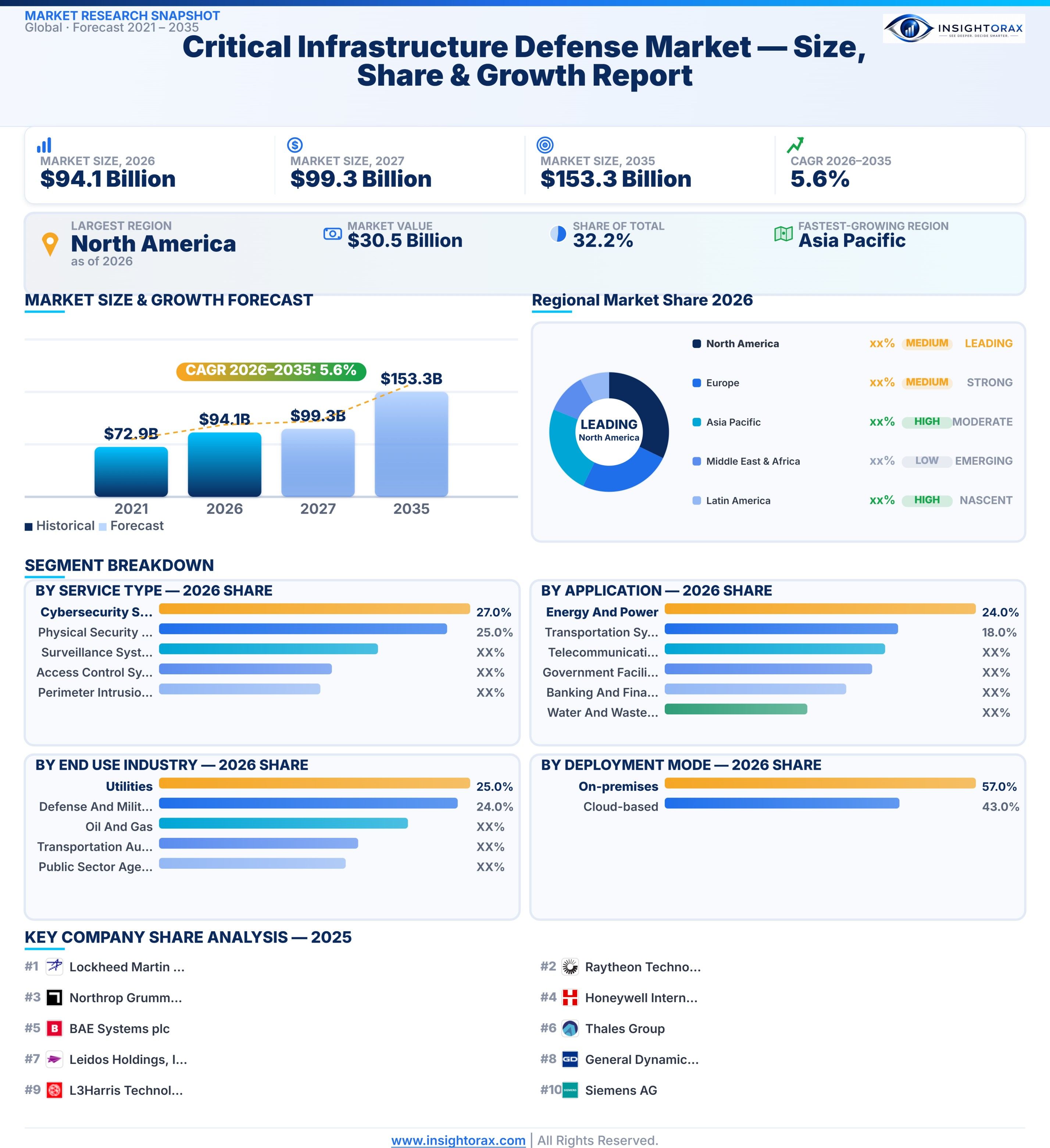
According to data analyzed by Insightorax, the global critical infrastructure defense market size was valued at USD 94.1 billion in 2026 and is projected to grow from USD 99.3 billion in 2027 to USD 153.3 billion by 2035, registering a CAGR of 5.6% during the 2026–2035 forecast period. North America accounted for the largest revenue share of 32.2% in 2026. Global market growth is driven by increasing cyberattacks, geopolitical tensions, aging critical infrastructure, and the growing digitization of essential services. Rising investments in cybersecurity, physical security, surveillance, threat detection, and resilient infrastructure are strengthening demand across energy, transportation, telecommunications, healthcare, water, and government sectors. Adoption of AI-enabled threat monitoring, advanced analytics, zero-trust security, and integrated defense platforms further supports market expansion as organizations prioritize continuity, risk reduction, and protection of critical assets.
2. Market Overview:
The Critical Infrastructure Defense Market encompasses technologies, solutions, and services designed to protect essential infrastructure from cyberattacks, physical threats, operational disruptions, and emerging security risks. It covers assets and networks supporting energy, utilities, transportation, telecommunications, healthcare, financial services, water systems, manufacturing, and government operations. The market includes integrated security frameworks that help organizations detect, prevent, respond to, and recover from threats while maintaining operational continuity and resilience.
Key components include cybersecurity platforms, network and endpoint security, physical security systems, surveillance, access control, intrusion detection, threat intelligence, incident response, risk assessment, and security monitoring services. Coverage also extends to industrial control systems (ICS), supervisory control and data acquisition (SCADA) environments, operational technology (OT), cloud infrastructure, and connected devices. Solutions increasingly incorporate artificial intelligence, machine learning, automation, zero-trust architectures, and real-time analytics to strengthen infrastructure protection.
3. Market Size & Forecast:
The critical infrastructure defense market has evolved from traditional physical protection and emergency-response measures toward integrated security and resilience frameworks. Historically, governments and infrastructure operators focused on safeguarding essential facilities, networks, utilities, and transportation assets against physical disruption. Increasing interdependence among energy, communications, water, transportation, healthcare, and other critical sectors has expanded the focus toward coordinated cyber-physical protection and risk management.
The market is expanding as critical infrastructure becomes increasingly connected and exposed to cyberattacks, supply-chain vulnerabilities, terrorism, aging assets, and other systemic risks. Current security strategies emphasize stronger threat intelligence, vulnerability assessment, resilience planning, and collaboration between public and private stakeholders. Future growth is expected to be supported by digitalization, modernization of aging infrastructure, rising cybersecurity requirements, and greater adoption of integrated monitoring, detection, access-control, and incident-response technologies.
Key Market Trends & Insights
- By service type: Cybersecurity Solutions segment dominated the market with a 27.0% share in 2026.
- By application: Energy And Power segment led the market in terms of share, accounting for 24.0% in 2026.
- By end user: Utilities segment commanded the largest market share at 25.0% in 2026.
- By deployment mode: On-premises segment accounted for the highest market share of 57.0% in 2026.
Regional Highlights
- Largest regional market: North America (32.2% revenue share, 2026)
- Fastest-growing regional market: Asia Pacific (24.0% revenue share, 2026)
Market Size & Forecast
- Market size in 2026: USD 94.1 Billion
- Estimated market size in 2027: USD 99.3 Billion
- Projected market size by 2035: USD 153.3 Billion
- CAGR (2026-2035): 5.6%
4. Market Drivers, Restraints & Opportunities:
The critical infrastructure defense market is driven by the growing frequency and sophistication of cyberattacks targeting energy, transportation, telecommunications, healthcare, water, and other essential systems. Increasing digitalization, interconnected operational technologies, cloud adoption, remote monitoring, and industrial automation are expanding the potential attack surface. Governments and infrastructure operators are therefore increasing investments in cybersecurity, physical security, surveillance, threat intelligence, incident response, and resilience programs. Regulatory requirements, national security priorities, and the need to maintain uninterrupted essential services are also encouraging organizations to strengthen protection measures.
Despite strong demand, market expansion faces several challenges. Aging infrastructure and legacy operational technology can be difficult and costly to modernize, while integrating advanced security solutions with existing systems may create compatibility and operational risks. Limited cybersecurity expertise, fragmented security environments, complex procurement processes, and constrained budgets can delay deployment. Organizations must also balance stronger security controls with operational continuity, data protection, interoperability, and compliance requirements. The increasing sophistication of attacks further requires continuous investment rather than one-time security upgrades.
Significant opportunities are emerging through artificial intelligence, machine learning, zero-trust architectures, predictive analytics, digital twins, automated threat detection, and integrated cyber-physical security platforms. Cloud-based security and security-as-a-service models can support organizations with limited internal capabilities. Public-private partnerships, smart-city development, infrastructure modernization programs, and cross-sector information sharing can further expand adoption. Demand for unified platforms that combine physical security, cybersecurity, monitoring, risk assessment, and rapid incident response is also creating opportunities for technology providers and specialized defense solution companies.
5. Market Trends:
Critical Infrastructure Defense Market Trends are increasingly shaped by converging cyber and physical security requirements. In 2025–2026, ransomware, DDoS, supply-chain attacks, and geopolitical activity continued affecting essential infrastructure, increasing demand for integrated threat monitoring and resilience capabilities. AI is emerging as both a defensive and offensive technology, supporting automated detection and response while creating new attack and manipulation risks.
Regionally, North America is emphasizing cross-border infrastructure dependencies, supply-chain resilience, and public-private coordination, while Europe is strengthening cybersecurity maturity across critical sectors through NIS2 implementation. ENISA reported improvements in the cybersecurity maturity of EU critical sectors in 2026. The EU is also pursuing greater coordination around 5G security, ICT supply chains, and cyber-crisis response.
Regulatory requirements are becoming a major market trend as organizations face stronger risk-management, incident-reporting, supervision, and accountability obligations. In 2026, the European Commission proposed targeted NIS2 amendments alongside broader cybersecurity-framework changes intended to simplify compliance and strengthen ICT supply-chain security. Meanwhile, organizations are shifting security spending toward technology, managed services, recovery capabilities, and specialized expertise. These developments are accelerating adoption of zero-trust architectures, continuous monitoring, vulnerability management, security automation, and integrated cyber-physical protection across energy, transportation, healthcare, telecommunications, manufacturing, and public-sector infrastructure.
6. Technology Landscape:
Critical Infrastructure Defense Market technology is increasingly centered on integrated cyber-physical protection, combining network security, endpoint protection, identity and access management, security information and event management, intrusion detection, video surveillance, threat intelligence, and automated incident response. AI and machine learning are being applied to security analytics and anomaly detection, while zero-trust architectures strengthen authentication and authorization across distributed environments. NIST’s CSF 2.0 emphasizes governance, supply-chain risk, and cybersecurity risk management, while its zero-trust guidance supports protection based on users, assets, and resources rather than network location.
Operational technology security is receiving greater attention as utilities, transportation, manufacturing, and other infrastructure sectors modernize industrial control systems. IEC 62443 standards address IACS security programs, service providers, system requirements, and component-level controls; the 2025 IEC PAS 62443-2-2 further addresses security protection schemes. ISO/IEC 27001:2022 provides requirements for information-security management systems, while CISA’s Cybersecurity Performance Goals provide prioritized baseline practices for critical-infrastructure IT and OT environments. NIST’s 2026 draft SP 800-82 Rev. 4 further aligns OT security guidance with CSF 2.0 and zero-trust principles.
7. Regulatory Framework:
The Critical Infrastructure Defense Market is governed by increasingly comprehensive cybersecurity, resilience, and safety requirements. In the EU, the NIS2 Directive establishes cybersecurity risk-management and incident-reporting obligations across critical sectors, while the Critical Entities Resilience (CER) Directive addresses resilience against natural hazards, terrorism, sabotage, insider threats, and public-health emergencies. The CER framework covers 11 sectors, including energy, transport, health, water, digital infrastructure, banking, food, and space.
Regulatory frameworks are increasingly emphasizing supply-chain security, risk assessment, business continuity, information sharing, and coordinated incident response. The EU's 2024 NIS2 implementing regulation specifies technical and methodological cybersecurity requirements for several digital and ICT service providers. In 2025, the European Commission issued guidance supporting identification and resilience assessment of critical entities, while its 2026 cybersecurity package proposed further measures covering certification, ICT supply-chain security, vulnerability management, and regulatory alignment. These initiatives complement national cybersecurity strategies and sector-specific safety requirements.
8. Critical Infrastructure Defense Market Segmentation Analysis:
9. By Type:
Cybersecurity Solutions accounted for a 27% market share in 2026, reflecting the increasing importance of protecting interconnected infrastructure, operational networks, digital assets, and essential services. Demand is supported by expanding digitalization, connected control environments, evolving cyber threats, and requirements for continuous monitoring and threat detection. Cybersecurity solutions are increasingly relevant across energy and power, transportation systems, telecommunications, government facilities, water and wastewater, and banking and finance. The segment contributes to integrated critical infrastructure defense by supporting network protection, incident monitoring, access security, and operational resilience. Physical Security Systems, Perimeter Intrusion Detection, Access Control Systems, and Surveillance Systems complement cybersecurity capabilities by addressing facility-level protection and coordinated infrastructure security requirements.
Physical Security Systems represented a 25% market share in 2026, supported by continued requirements to safeguard critical facilities, equipment, personnel, and restricted operational areas. Applications include infrastructure sites, utility facilities, transportation assets, government locations, telecommunications facilities, and other essential service environments. Demand is influenced by the need for controlled physical environments, monitoring, facility protection, and coordinated security operations. Perimeter Intrusion Detection, Access Control Systems, Surveillance Systems, and Cybersecurity Solutions contribute complementary capabilities, enabling organizations to combine physical safeguards with digital protection. Together, these technologies support layered infrastructure defense, asset protection, operational continuity, and security management across diverse critical infrastructure environments.
10. By Application:
Energy And Power accounted for a 24% market share in 2026, reflecting substantial security requirements across power generation, transmission, distribution, and related infrastructure. Demand is supported by the importance of uninterrupted energy services, extensive physical assets, interconnected operational systems, and requirements for continuous facility monitoring. Critical infrastructure defense applications include cybersecurity, physical security, perimeter protection, access management, and surveillance across energy facilities. Transportation Systems, Water And Wastewater, Telecommunications, Government Facilities, and Banking And Finance also contribute to market demand through their requirements for secure operations and resilient infrastructure. The application landscape demonstrates the need for coordinated protection across physical facilities, operational environments, and digitally connected systems supporting essential services.
Transportation Systems represented an 18% market share in 2026, supported by security requirements across transportation infrastructure, operational facilities, networks, and access-controlled environments. Demand is associated with protecting transportation assets, monitoring facilities, managing authorized access, and securing connected operational systems. Energy And Power, Water And Wastewater, Telecommunications, Government Facilities, and Banking And Finance provide additional application environments requiring critical infrastructure defense capabilities. Physical security systems, cybersecurity solutions, perimeter intrusion detection, access control, and surveillance support protection across these applications. The segment is significant because transportation infrastructure relies on interconnected facilities and operational technologies where disruption can affect essential services, mobility, communications, and broader infrastructure continuity.
11. By End Use:
Utilities accounted for a 25% market share in 2026, reflecting extensive requirements for protecting essential infrastructure, operational facilities, connected systems, and service delivery environments. Demand is supported by the need to secure electricity, water, communications, and other infrastructure operations against physical and digital security risks. Critical infrastructure defense technologies support facility monitoring, cybersecurity, access management, perimeter protection, and surveillance across utility environments. Oil And Gas, Defense And Military, Transportation Authorities, and Public Sector Agencies also represent important end-use areas, creating diversified requirements for infrastructure protection. The segment’s significance is linked to the essential nature of utility services and the need for resilient security capabilities spanning physical assets, operational technology, networks, and controlled facilities.
Defense And Military represented a 24% market share in 2026, supported by requirements for protecting military facilities, operational assets, restricted environments, communications systems, and connected infrastructure. Demand encompasses cybersecurity solutions, physical security systems, surveillance, access control, and perimeter intrusion detection across defense-related facilities and operations. Utilities, Oil And Gas, Transportation Authorities, and Public Sector Agencies provide additional end-use environments where critical infrastructure protection is required. Increasing integration between physical facilities and digital operational systems reinforces demand for layered security capabilities. The segment holds important market significance because defense and military infrastructure requires coordinated protection of sensitive facilities, operational networks, equipment, personnel, and essential supporting infrastructure.
12. By Deployment Mode:
On-premises deployment accounted for a 57% market share in 2026, reflecting continued requirements for infrastructure security systems operated within an organization’s own facilities and controlled technology environments. Demand is supported by organizations seeking direct control over security infrastructure, operational data, access management, monitoring systems, and integration with existing facilities. On-premises deployment is relevant across energy and power, transportation systems, telecommunications, government facilities, water and wastewater, and banking and finance. Cloud-based deployment provides an alternative model for organizations requiring scalable infrastructure security capabilities and remote accessibility. Both approaches support cybersecurity, physical security, surveillance, perimeter protection, and access control requirements across critical infrastructure environments.
Cloud-based deployment represented a 43% market share in 2026, supported by growing adoption of scalable, remotely accessible, and digitally integrated security infrastructure. Demand is associated with organizations seeking centralized monitoring, flexible deployment, connectivity across multiple facilities, and integration with evolving digital environments. Cloud-based capabilities can support cybersecurity, surveillance, access management, and security monitoring across distributed critical infrastructure operations. On-premises deployment continues to serve organizations requiring localized infrastructure control and facility-based security management. Across Energy And Power, Transportation Systems, Water And Wastewater, Telecommunications, Government Facilities, and Banking And Finance, deployment requirements increasingly reflect the need to coordinate physical and digital protection while maintaining operational visibility and infrastructure resilience.
13. Regional Analysis:
Asia Pacific accounted for an exact 24% market share in 2026. The region represents an important market for critical infrastructure defense as governments and infrastructure operators strengthen protection across energy and power, transportation systems, water and wastewater, telecommunications, government facilities, and banking and finance. Demand is supported by expanding infrastructure networks, increasing reliance on connected systems, and the need to address both physical and digital security requirements. Cybersecurity solutions, physical security systems, surveillance, access control, and perimeter intrusion detection contribute to regional deployment needs. Technology adoption is also shaped by increasing integration of digital infrastructure and security monitoring capabilities. The region’s market significance is reinforced by the presence of major infrastructure economies and continuing requirements for resilient protection across essential services. These factors support sustained demand for coordinated security capabilities spanning physical assets, network environments, operational facilities, and critical service infrastructure.
North America represented an exact 32% market share in 2026. Regional demand is associated with extensive critical infrastructure networks and the requirement to protect essential operations across energy and power, transportation, telecommunications, water and wastewater, government facilities, and banking and finance. Security requirements encompass cybersecurity solutions alongside physical security systems, perimeter intrusion detection, access control systems, and surveillance systems. The regional environment supports technology adoption where organizations require integrated protection for physical facilities and digitally connected infrastructure. Demand also extends across utilities, oil and gas, defense and military, transportation authorities, and public sector agencies. Increasing dependence on interconnected infrastructure contributes to the need for continuous monitoring, controlled access, threat detection, and infrastructure protection. North America therefore represents a significant geographic component of the market, supported by broad application coverage and established requirements for infrastructure security across multiple critical sectors and operating environments.
Europe held an exact 25% market share in 2026. Regional demand is distributed across energy and power, transportation systems, water and wastewater, telecommunications, government facilities, and banking and finance, creating a broad requirement for critical infrastructure protection. Infrastructure operators require security capabilities addressing both physical assets and digital environments, including cybersecurity solutions, physical security systems, surveillance, access control, and perimeter intrusion detection. Technology adoption is linked to the protection of interconnected infrastructure and operational facilities where security monitoring and controlled access are important components of infrastructure management. Utilities, oil and gas organizations, defense and military entities, transportation authorities, and public sector agencies contribute to demand across the region. Europe’s market significance is supported by the breadth of critical infrastructure applications and the continuing need to safeguard essential services and facilities. These requirements create a diversified environment for deployment of integrated infrastructure defense technologies.
Middle East & Africa represented an exact 11% market share in 2026. The regional market is supported by security requirements across energy and power, transportation systems, water and wastewater, telecommunications, government facilities, and banking and finance. Infrastructure protection is particularly relevant across environments where essential services, physical assets, operational facilities, and connected systems require coordinated security measures. Demand encompasses physical security systems, cybersecurity solutions, perimeter intrusion detection, access control systems, and surveillance systems. Utilities, oil and gas, defense and military, transportation authorities, and public sector agencies provide important areas of application. Technology adoption reflects the need for monitoring, access management, perimeter protection, and cybersecurity capabilities across critical facilities. The region’s market significance is linked to the breadth of infrastructure assets requiring protection and the role of security technologies in supporting continuity and safeguarding essential operational environments across diverse countries and infrastructure settings.
Latin America accounted for an exact 8% market share in 2026. Regional demand spans energy and power, transportation systems, water and wastewater, telecommunications, government facilities, and banking and finance. Infrastructure operators require protection covering physical facilities as well as increasingly connected digital environments, supporting demand for cybersecurity solutions, physical security systems, surveillance systems, access control systems, and perimeter intrusion detection. Technology adoption is associated with the need to monitor critical facilities, manage authorized access, strengthen perimeter protection, and secure digitally connected infrastructure. Utilities, oil and gas, defense and military, transportation authorities, and public sector agencies form key areas within the regional end-use structure. Latin America’s market significance comes from the diversity of infrastructure applications requiring security capabilities and the continued need to protect essential services and operational assets. This creates a broad base for deployment of critical infrastructure defense technologies across the region.
14. Competitive Landscape:
Competition in the Critical Infrastructure Defense Market is increasingly centered on integrated cyber-physical security, OT protection, AI-enabled monitoring, and managed security services. Vendors differentiate through interoperability, sector-specific solutions, threat intelligence, automation, resilience capabilities, and compliance support. Strategic partnerships are strengthening market reach: in 2026, Siemens and Palo Alto Networks introduced a verified cybersecurity solution for industrial private 5G, while Siemens and NCC Group announced a UK critical-infrastructure cybersecurity collaboration.
Companies are pursuing geographic expansion through global alliances, channel networks, local delivery capabilities, and public-private initiatives. Technology adoption increasingly includes AI, zero-trust architectures, continuous monitoring, and integrated IT/OT security. Certifications and qualified expertise also support differentiation and customer assurance; industry programs recognize the importance of third-party certifications in cybersecurity supply chains. Organic growth strategies include R&D, product integration, workforce development, and managed-service expansion, while partnerships provide access to complementary technologies and specialized capabilities.
15. Critical Infrastructure Defense Market Company Insights:
Competition spans defense primes, industrial vendors, cybersecurity specialists, and mission-communications providers. Lockheed Martin, RTX, Northrop Grumman, BAE Systems, General Dynamics, L3Harris, Airbus, Elbit Systems, Leonardo, and Leidos combine defense platforms, cyber, intelligence, communications, and security services, differentiating through mission integration, R&D, government relationships, and support. Thales adds cyber detection, threat intelligence, SOC, and digital security, while Booz Allen Hamilton provides national-security services. Expansion includes contracts, alliances, acquisitions, and partnerships.
Siemens, Honeywell, Cisco, IBM, Palo Alto Networks, Motorola Solutions, Bosch, and Honeywell Building Technologies extend competition into OT, networking, AI, cloud, automation, surveillance, access control, and security. Siemens advances IT/OT monitoring and NIS2-aligned services; Palo Alto Networks applies AI-driven protection across OT, 5G, and IoT; Thales operates eight SOCs; Bosch integrates security and monitoring. Certifications, compliance, partnerships, and R&D support differentiation.
16. Key Critical Infrastructure Defense Market Companies:
· Lockheed Martin Corporation
· Raytheon Technologies Corporation
· Northrop Grumman Corporation
· Honeywell International Inc.
· Bae Systems Plc
· Thales Group
· Leidos Holdings, Inc.
· General Dynamics Corporation
· L3harris Technologies, Inc.
· Siemens Ag
· Cisco Systems, Inc.
· Ibm Corporation
· Booz Allen Hamilton Inc.
· Palo Alto Networks, Inc.
· Honeywell Building Technologies
· Airbus Se
· Elbit Systems Ltd.
· Leonardo S.p.a.
· Motorola Solutions, Inc.
· Bosch Sicherheitssysteme Gmbh
17. Recent Developments:
· May 23, 2025 – Booz Allen Hamilton: Reported FY2025 revenue of $12.0 billion, up 12.4% year over year, with $37.0 billion total backlog, up 15.3%.
· August 18, 2025 – Palo Alto Networks: Reported FY2025 revenue of $9.2 billion, up 15%, while Next-Generation Security ARR reached $5.6 billion, up 32%.
· November 13, 2025 – Siemens: Reported FY2025 revenue of €78.9 billion, representing 4% reported growth and 6% growth on a comparable basis.
· January 7, 2026 – Honeywell: The U.S. Army selected Honeywell to modernize building automation systems at Fort Benning, including lighting controls, occupancy sensors, building controls, and power conditioning.
· January 27, 2026 – RTX: Reported FY2025 sales of $88.6 billion and a record $268 billion backlog, including $107 billion in defense.
· January 28, 2026 – IBM: Reported FY2025 revenue of $67.5 billion, up 8%, with software revenue up 11% and infrastructure revenue up 12%.
· February 17, 2026 – Leidos: Reported FY2025 revenue of $17.17 billion, up 3%, driven in part by demand for integrated air defense, Intelligence Community support, and cyber.
· February 18, 2026 – BAE Systems: Reported FY2025 sales of £30.662 billion and record order backlog of £83.6 billion.
· February 19, 2026 – Airbus: Reported FY2025 revenue of €73.4 billion; Airbus Defence and Space revenue increased 11% to €13.4 billion.
· May 7, 2026 – L3Harris: Selected by the U.S. Air Force to develop secure and resilient digital infrastructure supporting the Advanced Battle Management System (ABMS) network.
· June 2, 2026 – Cisco: Unveiled Cisco Cloud Control, a unified platform using humans and AI agents to manage, monitor, and defend critical IT infrastructure.
· July 29, 2026 – L3Harris: Reported Q2 2026 revenue of $5.9 billion and record backlog of $42 billion.
· August 4, 2026 – Thales: Launched Luna 8, a next-generation hardware security module designed for quantum-resistant security and post-quantum cryptography readiness.
· August 25, 2026 – Cisco: Launched Sovereign Critical Infrastructure in Canada, supporting configurable on-premises and air-gapped deployments for critical infrastructure organizations.
· September 14, 2026 – Thales: Launched UK-hosted Luna Cloud HSM services supporting UK data residency, sovereignty, cryptographic-key control, high availability, and disaster recovery.
· September 22, 2026 – Honeywell: Published its 2026 OT Cybersecurity Benchmark Report, based on a survey of more than 600 global industrial cybersecurity leaders; it reported that 88% considered their OT cybersecurity programs mature, while only 21% reported complete OT asset inventories.
18. Future Outlook:
The Critical Infrastructure Defense Market is expected to maintain steady growth as governments and infrastructure operators increase investments in cyber defense, physical security, operational technology protection, and resilience. Rising digitization of energy, transportation, water, communications, healthcare, and government systems is expanding the attack surface, while ransomware, supply-chain vulnerabilities, geopolitical risks, and increasingly sophisticated cyberattacks are strengthening demand for integrated protection.
Future opportunities will center on AI-enabled threat detection, continuous monitoring, zero-trust architectures, secure IT/OT integration, automated incident response, and advanced surveillance. Regulatory requirements and resilience programs are also encouraging modernization and coordinated security investments. However, legacy infrastructure, interoperability issues, cybersecurity skills shortages, implementation costs, and rapidly evolving threats may constrain adoption. Emerging defense strategies are increasingly shifting toward intelligence-led, resilience-focused protection supported by AI, automation, and cross-sector collaboration.
19. Methodology Overview
Extensive research from reliable academic sources, industry reports, and publications.
Interviews with industry experts, opinion leaders, and key stakeholders.
Validation of data through top-down and bottom-up approaches.