Bioplastic Resins Market Research Report
Global Market Size, Share & Trends Analysis Report, 2026-2035
Segmentation Analysis By Type: By Application: By End Use: By Material: By Region and Industry Forecast
1. Market Summary:
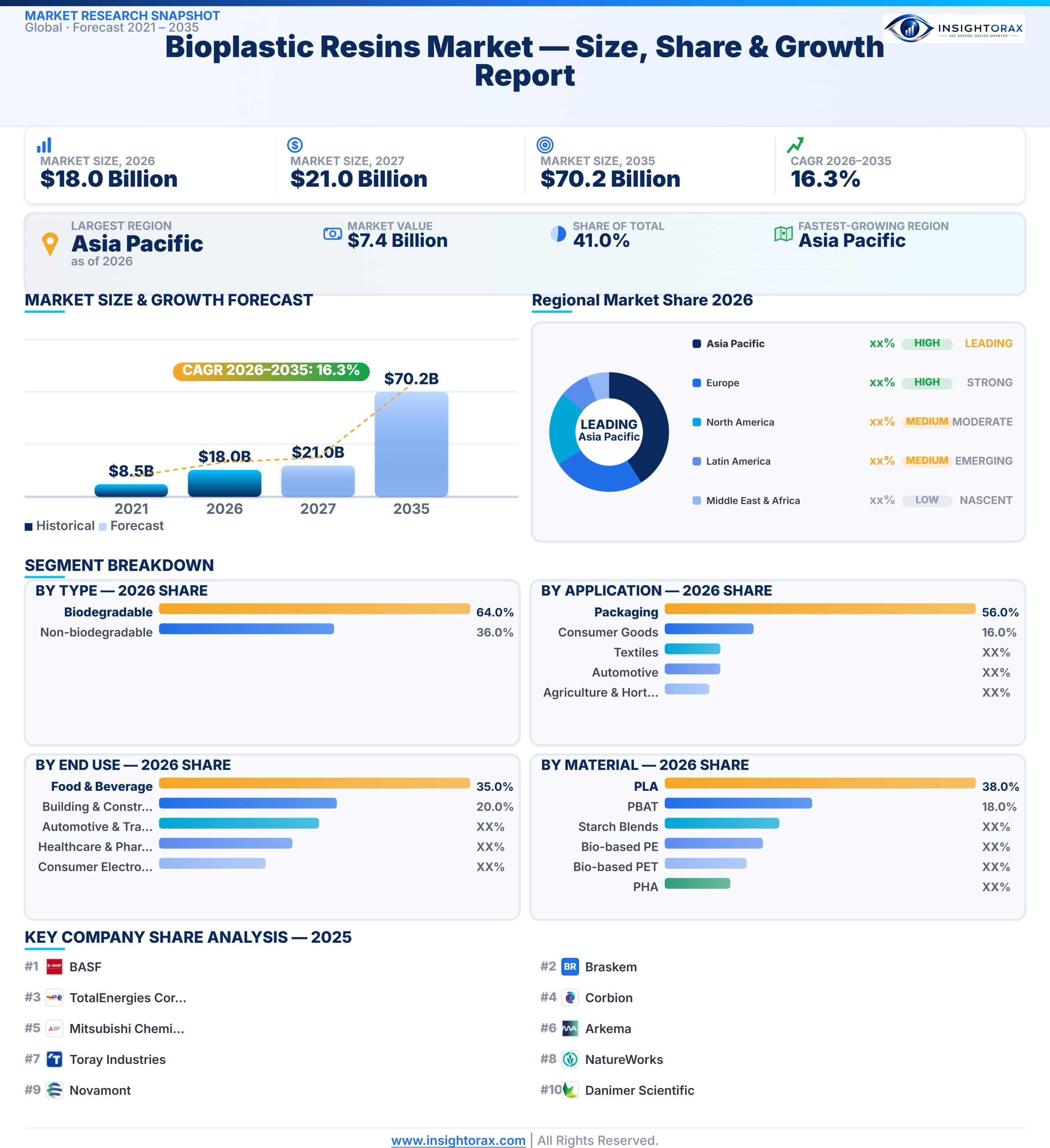
According to data analyzed by Insightorax, the global bioplastic resins market size was valued at USD 18.0 billion in 2026 and is projected to grow from USD 21.0 billion in 2027 to USD 70.2 billion by 2035, registering a CAGR of 16.3% during the 2026–2035 forecast period. Asia Pacific accounted for the largest revenue share of 41.0% in 2026. Growth is driven by increasing environmental concerns, stricter regulations on conventional plastics, rising demand for sustainable materials, and corporate commitments toward reducing plastic waste and carbon emissions. Major demand factors include the expansion of biodegradable and compostable packaging, growing adoption of bio-based polymers in consumer goods, food and beverage packaging, agriculture, automotive, and electronics, and advances in resin performance, processing technologies, and renewable feedstock availability.
2. Market Overview:
The Bioplastic Resins Market comprises bio-based and/or biodegradable polymer resins manufactured from renewable biological feedstocks or designed to provide improved end-of-life characteristics compared with conventional petroleum-based plastics. The market covers resins supplied in forms suitable for conversion into packaging, consumer products, agricultural materials, automotive components, electronics, textiles, and other applications. Major resin categories include polylactic acid (PLA), polyhydroxyalkanoates (PHA), bio-based polyethylene (Bio-PE), bio-based polyethylene terephthalate (Bio-PET), polybutylene succinate (PBS), and starch-based resins.
Market scope encompasses resin production, formulation, processing compatibility, feedstock sourcing, application development, and commercialization across major end-use industries and geographic regions. Key components include renewable feedstocks, polymerization and compounding technologies, additives, performance-enhancing formulations, and biodegradable or compostable material solutions. Coverage also considers manufacturers, technology providers, converters, packaging companies, regulatory influences, sustainability requirements, and evolving demand for lower-impact alternatives to conventional plastic resins.
3. Market Size & Forecast:
The Bioplastic Resins Market has evolved from a niche segment focused on biodegradable and bio-based materials into an increasingly commercialized alternative to conventional plastic resins. Early development was supported by advances in renewable feedstocks, polymer processing, and applications such as packaging and agricultural films. More recently, manufacturers have expanded resin portfolios and production capabilities, while research has improved material performance and processing compatibility.
Future expansion is expected to accelerate as governments, packaging producers, consumer-goods companies, and other industries pursue lower fossil-resource dependence and improved circularity. Regulatory initiatives, sustainability commitments, investment in biomanufacturing capacity, and greater use of agricultural residues and organic waste are supporting commercialization. Packaging remains a major opportunity, while automotive, consumer goods, agriculture, and other applications are broadening demand. Continued technology development, economies of scale, and improved feedstock availability should strengthen competitiveness despite current cost and scalability challenges.
Key Market Trends & Insights
- By type: Biodegradable segment dominated the market with a 64.0% share in 2026.
- By application: Packaging segment led the market in terms of share, accounting for 56.0% in 2026.
- By end user: Food & Beverage segment commanded the largest market share at 35.0% in 2026.
- By material: PLA segment accounted for the highest market share of 38.0% in 2026.
Regional Highlights
- Largest regional market: Asia Pacific (41.0% revenue share, 2026)
- Fastest-growing regional market: Asia Pacific Highest CAGR, 2026–2035
- By country: United States held the largest market share in 2026
Market Size & Forecast
- Market size in 2026: USD 18 Million
- Estimated market size in 2027: USD 21 Million
- Projected market size by 2035: USD 70.2 Million
- CAGR (2026-2035): 16.3%
4. Market Drivers, Restraints & Opportunities:
The Bioplastic Resins Market is driven by growing environmental concerns, increasing plastic-waste generation, and government measures promoting sustainable materials and reducing dependence on fossil-based plastics. Rising corporate sustainability commitments and consumer preference for environmentally responsible products are encouraging packaging, food and beverage, agriculture, automotive, electronics, and consumer-goods manufacturers to adopt bio-based and biodegradable resin solutions. Advances in polymer engineering, renewable feedstocks, compounding, and processing technologies are also improving material performance and expanding potential applications.
Despite strong demand prospects, high production costs, limited economies of scale, feedstock availability, and inconsistent performance across certain bioplastic grades remain important restraints. Competition from established petroleum-based plastics is significant because conventional resins generally offer mature supply chains, predictable processing characteristics, and cost advantages. In addition, differences in biodegradability, composting requirements, recycling compatibility, and regional regulatory frameworks can create challenges for manufacturers and end users. Limited collection and industrial composting infrastructure may also restrict effective end-of-life management.
Opportunities are emerging through investments in production capacity, advanced bio-based polymers, waste-derived feedstocks, and improved recycling and composting systems. Packaging offers particularly strong potential as brands seek lower-impact materials and comply with evolving plastic regulations. Emerging applications in automotive components, agriculture, medical products, electronics, and durable consumer goods can further diversify demand. Strategic partnerships among resin producers, technology developers, packaging converters, and brand owners can accelerate commercialization, while improved material performance and scale can gradually strengthen cost competitiveness.
5. Market Trends:
The Bioplastic Resins Market is trending toward broader material diversification, with PLA, PHA, bio-PE, and bio-PP gaining attention as producers expand alternatives across packaging, consumer goods, automotive, agriculture, textiles, and electronics. Packaging remains the leading application, while automotive and transport uses are gaining traction. Globally, production capacity is expanding alongside investments in material performance and application development. Europe is emphasizing bio-PP, bio-PE, and PHA capacity additions, while Asia remains important for manufacturing expansion and supply-chain development.
Technological development is increasingly focused on improving mechanical performance, heat resistance, processability, barrier properties, and compatibility with existing conversion equipment. Producers are also exploring renewable feedstocks, agricultural residues, organic waste, and more efficient fermentation and polymerization routes. A key industry trend is diversification beyond conventional biodegradable packaging toward durable applications, including automotive components and consumer products. Rising production utilization and expanding commercial-scale capacity indicate improving industrial maturity, although performance and cost competitiveness remain important adoption considerations.
Regulation is increasingly shaping resin selection and product design. In Europe, the Packaging and Packaging Waste Regulation began applying in August 2026, strengthening requirements around packaging recyclability, material composition, labeling, and circularity. The EU also emphasizes accurate distinctions between bio-based, biodegradable, and compostable plastics and supports sustainable feedstock sourcing. Consequently, manufacturers are increasingly prioritizing certified materials, traceable feedstocks, application-specific compostability, recyclability, and credible environmental claims. These regulatory developments are encouraging innovation while increasing the importance of end-of-life infrastructure and consistent standards.
6. Regulatory Framework:
The Bioplastic Resins Market is shaped by environmental, packaging, chemical-safety, and food-contact requirements. In the EU, the Policy Framework on Bio-based, Biodegradable and Compostable Plastics establishes guidance on sustainable feedstocks, application-specific biodegradability and compostability, labeling, and environmental claims. The EU Packaging and Packaging Waste Regulation (PPWR) entered into application in August 2026 and introduces broader packaging recyclability and circularity requirements.
In the United States, bioplastic resins intended for food-contact applications must comply with applicable FDA requirements, including authorization through Food Contact Substance Notifications, food-additive regulations, GRAS status, or applicable exemptions. China’s plastic-pollution policies promote source reduction, alternative products, recycling, and standards for degradable materials and labeling. Industry compliance increasingly emphasizes verified biodegradability or compostability claims, appropriate end-of-life conditions, feedstock traceability, and documented material safety.
7. Sustainability & Environmental Impact:
Sustainable sourcing is becoming central to bioplastic resin production, with greater emphasis on renewable feedstocks, agricultural residues, organic waste, and responsible biomass management. The European Commission highlights sustainable biomass supply, circular resource use, and reduced dependence on fossil resources as priorities for the bioeconomy. Manufacturers are also investing in improved fermentation, polymerization, and processing efficiency to reduce resource consumption. Across the supply chain, expanding production capacity and diversification into packaging, automotive, agriculture, textiles, and consumer goods are encouraging broader industrial adoption.
Environmental challenges remain significant because bio-based materials can involve land-use, biodiversity, feedstock competition, and end-of-life trade-offs. The European Commission stresses that bio-based plastics are not automatically biodegradable or compostable and recommends life-cycle assessment. Compostable materials require appropriate collection and industrial composting infrastructure, while incorrect disposal can contaminate conventional recycling streams. Industry initiatives increasingly emphasize sustainable biomass criteria, recycling, circularity, traceability, and credible environmental claims. The EU’s 2025 Bioeconomy Strategy further supports scaling bio-based materials and sustainable biomass supply chains, strengthening long-term sustainability efforts across production and distribution networks.
8. Bioplastic Resins Market Segmentation Analysis:
9. By Type:
Biodegradable resins led the type landscape in 2026, with a market share of 64%. Their position reflects rising efforts to limit persistent plastic waste and increase the use of materials with improved end-of-life characteristics. Packaging remains a key area of consumption, while agriculture, consumer products, and other applications are also creating opportunities. Environmental policies, sustainability commitments, and changing material preferences are encouraging manufacturers to evaluate biodegradable alternatives. Advances in resin formulation and processing are also helping improve functional suitability, supporting wider commercial adoption across applications where environmental performance has become an important purchasing consideration.
Non-biodegradable resins accounted for the second-highest portion in 2026, at 36%. These materials continue to attract demand where manufacturers require established processing behavior, durability, and dependable physical performance. Packaging, consumer goods, textiles, automotive uses, and agriculture-related products provide avenues for continued utilization. Market opportunities are also supported by ongoing development of bio-derived resin technologies that can reduce reliance on conventional fossil-based inputs while retaining application-specific performance. Their continued presence adds flexibility to material selection as producers balance sustainability objectives with technical and manufacturing requirements.
10. By Application:
Packaging was the leading application in 2026, representing 56% of market activity. High consumption of films, containers, trays, and other packaging formats creates substantial opportunities for bioplastic resin adoption. Manufacturers are responding to environmental commitments, plastic-waste concerns, and evolving packaging preferences by evaluating renewable and biodegradable material options. Improvements in processing characteristics and product performance are helping expand practical applications. The sector also benefits from sustainability initiatives across consumer-goods supply chains, where packaging decisions increasingly consider material sourcing, environmental impact, and end-of-life characteristics alongside conventional requirements such as strength and functionality.
Consumer Goods followed as the second most significant application in 2026, holding 16%. Demand is being encouraged by producers seeking alternative materials for household products and other consumer-oriented items. Textiles, Automotive, and Agriculture & Horticulture provide additional avenues for resin consumption, each presenting distinct requirements related to flexibility, strength, durability, and environmental performance. Increasing corporate sustainability programs are encouraging product developers to assess bioplastic materials across a broader range of applications. Formulation improvements and greater manufacturing familiarity can further facilitate adoption, particularly where bioplastic resins can satisfy both product-performance expectations and evolving environmental priorities.
11. By End Use:
Food & Beverage constituted the foremost end-use category in 2026, contributing 35% of the market. Extensive packaging requirements create a strong foundation for resin consumption across containers, films, coatings, and related formats. Producers are increasingly considering materials that align with waste-reduction objectives and changing sustainability expectations. Regulatory developments and environmental commitments within the packaging value chain are reinforcing this shift. Material improvements that address processing efficiency, functional performance, and application suitability can further support adoption. The sector therefore remains an important commercial outlet for bioplastic resins as food and beverage companies pursue packaging solutions with improved environmental attributes.
Building & Construction occupied the next position in 2026, with a 20% market share. Interest in lower-impact materials is encouraging construction-related manufacturers to examine bioplastic options for suitable products and components. Automotive & Transportation, Healthcare & Pharmaceuticals, and Consumer Electronics also generate demand, although their material requirements differ considerably. Automotive applications can emphasize durability and weight considerations, while healthcare uses place greater importance on functional consistency and application suitability. Electronics require materials compatible with precise manufacturing needs. Expanding sustainability targets across industrial procurement can create additional opportunities as developers seek resin solutions capable of meeting technical specifications while supporting environmental objectives.
12. By Material:
PLA held the strongest position among the listed materials in 2026, representing 38% of the market. Its established commercial presence, renewable feedstock potential, and compatibility with various processing methods support widespread use. Packaging and consumer-oriented products provide important outlets, while continued formulation development is helping address application-specific performance requirements. Interest in reducing dependence on conventional plastics further supports its commercial relevance. Manufacturers can utilize PLA where its characteristics align with product requirements and sustainability objectives. Ongoing improvements in material performance, processing, and product design may broaden its applicability across additional end-use categories.
PBAT ranked second among materials in 2026, accounting for 18%. Its flexibility and biodegradation characteristics make it useful for applications requiring a balance between functional performance and environmental considerations. PHA, Starch Blends, Bio-based PE, and Bio-based PET broaden the material portfolio by offering different combinations of renewable content, mechanical properties, processing behavior, and end-use suitability. Their development supports greater flexibility for manufacturers evaluating alternatives to conventional plastics. Advances in blends, formulations, and processing technologies can strengthen application opportunities and allow producers to select materials according to specific performance, sustainability, and manufacturing requirements.
13. Regional Analysis:
Asia Pacific held the strongest regional position in the Bioplastic Resins Market in 2026, representing 41% of the market. Expansion is supported by manufacturing activity, and interest in renewable and biodegradable materials. China, India, Japan, South Korea, Thailand, Indonesia, and other markets provide an industrial base. Packaging remains an important application, while consumer products, automotive uses, and agriculture create additional demand across manufacturing value chains. Technology adoption is advancing through improved resin formulations, processing capabilities, and integration with established production systems. The region’s manufacturing strength and sustainability focus reinforce its strategic importance and provide favorable conditions for continued market development.
Europe accounted for 25% of the market in 2026, supported by environmental priorities and established demand for sustainable material alternatives. Regulatory attention to plastic waste, circularity, renewable feedstocks, and resource efficiency encourages producers to assess bioplastic resins across applications. The United Kingdom, Germany, France, Spain, Italy, the Netherlands, Belgium, and other markets contribute to demand. Packaging is a key application, while consumer goods, textiles, automotive products, agriculture, and construction provide opportunities. Technology adoption is strengthened by formulation development and improved processing methods. Europe remains influential in innovation, and substitution of conventional plastic materials across suitable applications.
North America represented 20% of the Bioplastic Resins Market in 2026. Demand is supported by sustainability programs, packaging requirements, and evaluation of lower-impact materials. The United States forms the principal market, with Canada and Mexico contributing to activity. Packaging provides an important outlet, while consumer goods, automotive and transportation, agriculture, textiles, and industrial uses support diversification. Producers focus on resin performance, processing efficiency, renewable feedstock use, and compatibility with existing manufacturing infrastructure. Advances in PLA, bio-based polymers, biodegradable formulations, and processing technologies can broaden applications. Industrial capabilities and research activity give the region significance in the transition toward alternative plastic materials.
Middle East & Africa held a 6% share of the market in 2026. Development is supported by sustainability awareness, and consideration of materials that can reduce dependence on conventional plastics. Saudi Arabia, South Africa, the United Arab Emirates, and other markets contribute to regional demand. Packaging offers an important application pathway, while consumer goods, agriculture, construction, automotive, and industrial activities provide opportunities. Technology adoption is developing through greater awareness of biodegradable and bio-based resin options, improved material availability, and sustainable production practices. Infrastructure development and industrial modernization influence regional demand. The region’s evolving material choices and sustainability objectives support commercial relevance.
Latin America accounted for 8% of the market in 2026, with demand shaped by agricultural activity, packaging consumption, consumer products, and resource-efficient materials. Brazil represents a key regional market, while Argentina and other economies contribute to demand. Bioplastic resins serve packaging, agriculture and horticulture, consumer goods, textiles, automotive applications, and suitable uses. Technology adoption is encouraged by access to bio-based feedstocks, improved resin processing, and interest in materials with enhanced environmental characteristics. Producers evaluate alternatives according to performance, availability, cost, and sustainability objectives. Agricultural resources and environmental awareness provide a foundation for development where renewable material solutions align with specific industrial needs.
14. Competitive Landscape:
The Bioplastic Resins Market is competitive and increasingly differentiated by resin performance, renewable content, biodegradability, processing compatibility, and application-specific formulations. Major producers are expanding PLA, PHA, bio-PE, and bio-PP portfolios while targeting packaging, automotive, agriculture, textiles, and consumer goods. Geographic expansion is supported by new production capacity, particularly in Europe and Asia. Companies are also using certified renewable feedstocks and third-party schemes to substantiate biobased or compostability claims.
Partnerships and technology adoption are becoming important competitive strategies, particularly for scaling advanced materials and improving processing performance. Recent collaborations include TotalEnergies Corbion and Useon on expanded PLA applications, while EU-funded projects such as Be-UP and GRECO bring resin producers, converters, technology developers, research institutions, and certification bodies together. Companies are increasingly investing in advanced polymerization, compounding, recycling, digital modelling, and waste-derived feedstocks. These strategies support product differentiation, regulatory compliance, commercialization, and expansion into higher-performance applications.
15. Key Bioplastic Resins Market Company Insights:
Leading companies compete through differentiated resin portfolios, renewable feedstocks, application-specific performance, and production expansion. BASF markets ecovio® compostable materials, while Braskem’s I’m green™ portfolio includes bio-based polyethylene. TotalEnergies Corbion supplies Luminy® PLA, supported by Corbion’s lactic-acid expertise. NatureWorks develops Ingeo™ PLA, and Novamont produces Mater-Bi® starch-based biodegradable and compostable materials. Danimer Scientific focuses on PHA-based biodegradable resins. These companies emphasize processing performance, renewable content, compostability, and application development across packaging and durable products.
Specialty and diversified producers broaden competition through advanced bio-based materials. Mitsubishi Chemical Group develops sustainable resin technologies; Arkema supplies bio-based Rilsan® PA11 and Pebax® Rnew®; and Toray Industries markets Ecodear™ biomass-derived materials. Competitive strategies include technology development, renewable feedstock integration, certification, customer partnerships, geographic expansion, and higher-value applications. These approaches strengthen differentiation while supporting regulatory compliance and the transition toward lower-fossil-resource material solutions.
16. Key Bioplastic Resins Market Companies:
· Natureworks Llc
· Basf Se
· Novamont S.p.a.
· Braskem S.a.
· Totalenergies Corbion
· Mitsubishi Chemical Group Corporation
· Eastman Chemical Company
· Danimer Scientific
· Fkur Kunststoff Gmbh
· Biome Bioplastics Limited
· Plantic Technologies Limited
· Green Dot Bioplastics
· Novozymes A/s
· Toray Industries, Inc.
· Natureflex (futamura Group)
· Kaneka Corporation
· Cardia Bioplastics
· Synbra Technology Bv
· Biopak
· Avantium N.v.
17. Recent Developments:
· March 26, 2025: The companies announced a collaboration to expand low-carbon Luminy® PLA-based compounds for durable applications including automotive, healthcare and medical, cosmetics packaging, appliances, and electronics.
· April 15, 2025: The companies announced a strategic partnership to advance the development and global commercialization of EPLA (Expanded PLA) molded products, using Useon’s direct bead-foaming technology and Luminy® PLA.
· May 6, 2025: Braskem announced that its green ethylene production capacity at the Triunfo unit had reached 275,000 tonnes per year, a 37% expansion compared with the initial 2010 project capacity, supporting its I’m green™ bio-based polyethylene portfolio.
· June 2025: BASF announced its planned K 2025 sustainability showcase, including certified compostable and soil-biodegradable ecovio® and ecoflex® BMB biopolymers using the Biomass Balance approach. The supplied date of June 1 should therefore not be presented as the event date; the official announcement was issued in June ahead of K 2025.
· July 9, 2025: Arkema announced an approximately US$20 million investment in a new Rilsan® Clear transparent polyamide unit at its Singapore platform. The project was expected to triple global Rilsan® Clear capacity, with start-up planned for Q1 2026.
· July 2025: Toray received a Green and Sustainable Chemistry Awards Encouragement Award for developing bio-adipic acid and nylon 66 derived from non-edible biomass-based sugars. Toray also received recognition for mass production and commercialization of 100% biomass nylon Ecodear™ N510.
· October 7, 2025: Braskem released updated Life Cycle Assessment studies for its I’m green™ bio-based HDPE, EVA, and PE Wax. The LCAs were conducted according to ISO 14040/44 and ISO 14071, using updated datasets and the Environmental Footprint 3.1 methodology.
· November 12, 2025: At Sustainable Material Expo 2025 in Tokyo, Arkema showcased its bio-based Rilsan® PA11, Rilsan® Clear, and Pebax® Rnew® materials. The company highlighted Rilsan® PA11 derived from renewable castor oil and its Singapore Rilsan® Clear capacity expansion.
· February 26, 2026: Corbion reported 2025 annual sales of €1,267.4 million, with organic sales growth of 2.2% and adjusted EBITDA of €204.3 million. Its results also highlighted growth in lactic acid sales to the PLA joint venture.
· April 29, 2026: BASF expanded its certified home-compostable ecovio® portfolio with new flexible-packaging grades offering barrier properties against grease, liquids, oxygen, and moisture, with applications across food, beverage, personal care, healthcare, and pet-food packaging.
· May 2026: Mitsubishi Chemical Group reported FY2025 sales revenue of ¥3,704.0 billion and identified a stable supply platform for green chemicals among its five business focus areas. The supplied date of May 1 is not supported as the precise publication date; official May 2026 company materials report these figures
18. Future Outlook:
The Bioplastic Resins Market is positioned for continued expansion as manufacturers, brands, and converters seek alternatives to conventional petroleum-based plastics. Rising environmental awareness, plastic-waste reduction initiatives, sustainability commitments, and regulatory support are creating opportunities across packaging, consumer goods, automotive, agriculture, textiles, and other applications. Growing interest in biodegradable and bio-based materials is also encouraging product development and broader commercial adoption.
Future opportunities will depend on improving resin performance, processing efficiency, feedstock availability, and cost competitiveness. Challenges include higher production costs for some materials, limited infrastructure for collection and appropriate end-of-life treatment, and performance requirements in demanding applications. Emerging developments in advanced formulations, material blends, renewable feedstocks, and improved processing technologies are expected to strengthen application potential and support wider integration into established manufacturing systems.
19. Methodology Overview
Extensive research from reliable academic sources, industry reports, and publications.
Interviews with industry experts, opinion leaders, and key stakeholders.
Validation of data through top-down and bottom-up approaches.