Thermal Bricks Market Research Report
Global Market Size, Share & Trends Analysis Report, 2026-2035
Segmentation Analysis By Type: By Application: By End Use: By Material: By Region and Industry Forecast
1. Market Summary:
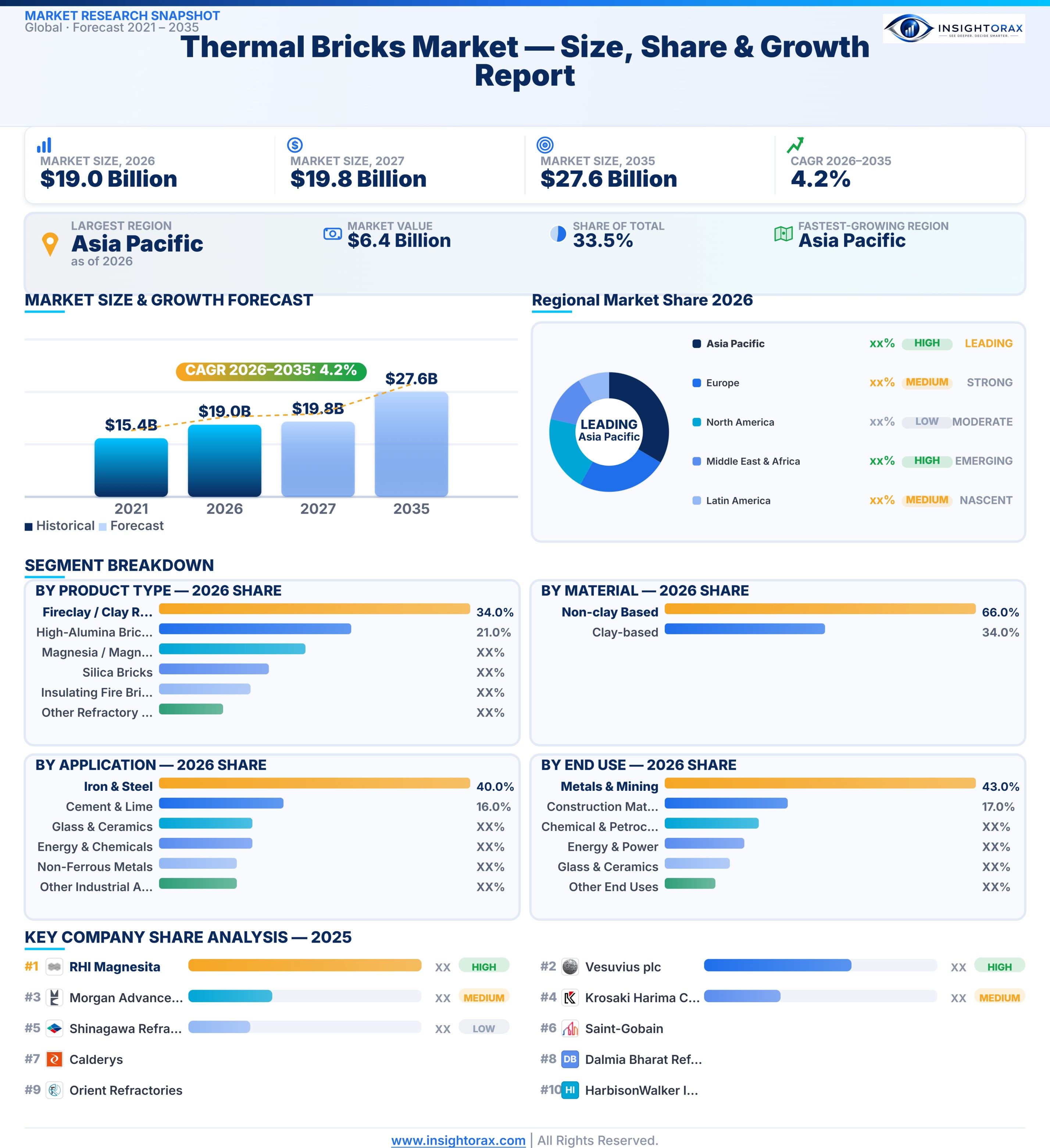
According to data analyzed by Insightorax, the global thermal bricks market size was valued at USD 19.0 billion in 2026 and is projected to grow from USD 19.8 billion in 2027 to USD 27.6 billion by 2035, registering a CAGR of 4.2% during the 2026–2035 forecast period. Asia Pacific accounted for the largest revenue share of 33.5% in 2026. Market growth is driven by rising demand for energy-efficient thermal insulation, industrial heat management, and durable construction materials that improve temperature control and reduce heat loss. Increasing industrialization, infrastructure development, and investments in energy-efficient buildings are strengthening adoption worldwide. Major demand factors include expanding steel, glass, cement, and ceramic industries, stricter energy-efficiency requirements, growing construction activity, and the need for high-temperature-resistant materials in industrial furnaces, kilns, and heat-intensive processing applications.
2. Market Overview:
The Thermal Bricks Market encompasses refractory and heat-resistant brick products designed to withstand elevated temperatures while providing thermal insulation and structural protection in demanding environments. These bricks are manufactured using heat-resistant mineral and ceramic materials and are engineered to minimize heat transfer, maintain thermal stability, and resist chemical and mechanical degradation. The market covers products used across industrial, commercial, and specialized high-temperature applications where efficient heat retention and equipment protection are essential.
The market scope includes thermal bricks supplied in different compositions, shapes, densities, and performance grades to meet specific operating conditions. Key components include raw materials, manufacturing technologies, product types, insulation and refractory properties, and distribution channels. Major application areas span furnaces, kilns, boilers, industrial heating systems, steel and metal processing, glass manufacturing, cement production, ceramics, and other heat-intensive industries. Market coverage also considers regional demand, end-use industries, technological developments, competitive activity, and evolving energy-efficiency requirements.
3. Market Size & Forecast:
Historically, the Thermal Bricks Market developed alongside the expansion of high-temperature industrial processing, with refractory and insulating brick solutions becoming essential for furnaces, kilns, boilers, and other thermal equipment. Increasing steel, cement, glass, ceramics, and metal-processing activity supported steady adoption, while improvements in material formulations enhanced resistance to thermal shock, chemical attack, and prolonged heat exposure. Replacement and maintenance requirements across established industrial facilities have also provided a recurring demand base.
Currently, market expansion is being supported by industrial modernization, energy-efficiency initiatives, and greater demand for advanced thermal insulation solutions. Future growth is expected as manufacturers upgrade high-temperature equipment, seek to reduce heat loss and energy consumption, and adopt longer-lasting refractory materials to minimize maintenance downtime. Rising industrial capacity in emerging economies, furnace and kiln retrofits, and specialized requirements from energy-intensive industries are expected to further broaden applications and sustain demand.
Key Market Trends & Insights
- By type: Fireclay / Clay Refractory Bricks segment dominated the market with a 34.0% share in 2026.
- By material: Non-clay Based segment led the market in terms of share, accounting for 66.0% in 2026.
- By application: Iron & Steel segment commanded the largest market share at 40.0% in 2026.
- By end user: Metals & Mining segment accounted for the highest market share of 43.0% in 2026.
Regional Highlights
- Largest regional market: Asia Pacific (33.5% revenue share, 2026)
- Fastest-growing regional market: Asia Pacific Highest CAGR, 2026–2035
- By country: The United States held the largest market share in 2026
Market Size & Forecast
- Market size in 2026: USD 19.0
- Estimated market size in 2027: USD 19.8
- Projected market size by 2035: USD 27.6
- CAGR (2026-2035): 4.2%
4. Market Drivers, Restraints & Opportunities:
Rising industrialization and expansion of energy-intensive industries are major drivers of the Thermal Bricks Market. Growing steel, cement, glass, ceramics, and non-ferrous metal production is increasing the need for refractory and insulating materials capable of operating under extreme temperatures. Demand is also supported by industrial furnace modernization, energy-efficiency initiatives, and efforts to reduce heat loss and operating costs. Increasing infrastructure development and construction activity further support the use of thermal bricks in heating systems and high-temperature processing facilities.
However, the market faces challenges including fluctuations in raw-material prices, energy-intensive manufacturing processes, and competition from alternative refractory and insulation materials. Thermal bricks must also meet demanding requirements for thermal shock resistance, mechanical strength, dimensional stability, and chemical resistance, increasing manufacturing complexity. Equipment downtime during brick replacement and maintenance can further discourage adoption where alternative solutions offer longer service intervals.
Significant opportunities exist through the development of lightweight, high-performance, and energy-efficient thermal bricks with improved insulation and durability. Manufacturers can benefit from demand for advanced refractory solutions in modernized industrial facilities, particularly across emerging manufacturing economies. Recycling refractory materials, incorporating alternative raw materials, developing customized products for specialized furnaces and kilns, and integrating improved manufacturing technologies can create additional growth opportunities. Growing emphasis on industrial decarbonization and energy conservation is also encouraging users to adopt materials that improve thermal efficiency and reduce overall energy consumption.
5. Market Trends:
The Thermal Bricks Market is increasingly shaped by the global shift toward energy-efficient, high-performance refractory solutions. Asia-Pacific remains a major demand center because of its large steel, cement, glass, and metal-processing base, while India is seeing stronger refractory demand alongside steel capacity expansion and industrial modernization. In Europe and North America, decarbonization pressures and higher energy costs are encouraging industrial users to prioritize longer-lasting linings that improve thermal efficiency, furnace uptime, and total cost of ownership.
Technological development is moving toward lightweight, high-insulation, thermally stable bricks and formulations capable of withstanding repeated thermal cycling and aggressive operating environments. Electric arc furnace expansion is also changing refractory requirements, increasing demand for specialized materials with improved thermal-shock and corrosion resistance. Manufacturers are simultaneously exploring digital monitoring, robotic installation, and performance-based maintenance models to extend lining life and reduce downtime. Cement producers are likewise emphasizing advanced refractory designs as plants pursue efficiency improvements and lower operating emissions.
Sustainability and circularity are becoming increasingly important industry trends. Refractory producers and industrial users are investigating recycled refractory materials, alternative raw materials, and lower-impact manufacturing processes to reduce waste and embodied emissions. Recent research demonstrates growing interest in incorporating industrial wastes and spent refractories into high-temperature ceramics while maintaining performance. Regulatory pressure around industrial emissions, energy efficiency, waste management, and carbon reduction is reinforcing these developments, encouraging suppliers to combine durability, thermal performance, recyclability, and lower lifecycle environmental impact in next-generation thermal brick solutions.
6. Technology Landscape:
The Thermal Bricks Market is advancing through improved refractory formulations, controlled firing processes, optimized porosity, and material engineering designed to balance thermal insulation, strength, thermal-shock resistance, and service life. Modern product development increasingly focuses on tailoring alumina-silica, high-alumina, silica, insulating, and specialty refractory compositions for specific furnace and kiln conditions. ASTM maintains dedicated test methods for refractory thermal conductivity, including ASTM C201-24 and ASTM C202-19, supporting standardized evaluation of heat-transfer performance and specification acceptance.
Technology validation also relies on internationally recognized classification standards. ISO 10081-1:2003, confirmed current in 2025, classifies and designates dense alumina-silica refractory products, while ISO 10081-4 covers special dense refractory products. ASTM additionally maintains classifications for insulating firebrick and various refractory brick compositions. These standards support consistent product classification, testing, specification, and quality evaluation across international applications.
7. Regulatory Framework:
Thermal bricks and refractory products are governed by national standards covering composition, thermal performance, dimensional quality, and safe use. In India, the Bureau of Indian Standards (BIS) maintains specifications including IS 8:1994 for high-heat-duty fireclay refractories, IS 2042:2006 for insulating bricks, and IS 195:2005 for fireclay mortar. Manufacturers and industrial users must also address workplace exposure risks associated with refractory materials, including respirable crystalline silica, under applicable occupational-safety requirements.
In the European Union, Regulation (EU) 2024/3110 establishes the current harmonized framework for construction products, including applicable performance, conformity, environmental-information, and CE-marking requirements where harmonized specifications apply. The regulation became fully applicable on January 8, 2026, while product-specific migration from the previous CPR framework continues. Industry compliance increasingly incorporates environmental performance, life-cycle assessment information, market surveillance, and digital product documentation, reflecting broader EU sustainability and circular-economy objectives.
8. Thermal Bricks Market Segmentation Analysis:
9. By Type:
Fireclay / Clay Refractory Bricks accounted for 34.0% of the Thermal Bricks Market in 2026, representing the leading product category in the ME model. Their established thermal resistance, cost efficiency, and suitability for demanding high-temperature environments support continued use across industrial furnaces and processing equipment. Demand is reinforced by iron and steel production, cement manufacturing, and other heat-intensive operations requiring durable refractory protection. Their established manufacturing base and broad application compatibility also strengthen their market significance.
High-Alumina Bricks represented 21.0% in 2026, positioning them as the second-most significant product category. Their high-temperature performance, chemical stability, and resistance to slag and abrasion make them valuable for demanding furnace environments. Silica Bricks, Magnesia / Magnesia-Carbon Bricks, Insulating Fire Bricks, and Other Refractory Bricks also contribute to the market across specialized thermal applications. Together, these product categories address varying operating temperatures, corrosion conditions, insulation requirements, and service-life expectations across industrial users.
10. By Application:
Iron & Steel represented 40.0% of the Thermal Bricks Market in 2026, making it the leading application in the ME model. Continuous furnace operation, elevated processing temperatures, and the need for reliable thermal containment support recurring refractory-brick consumption across steelmaking processes. Thermal bricks are important for protecting high-temperature equipment, extending operating life, reducing heat loss, and supporting production continuity. Expansion and modernization of metallurgical capacity further reinforce demand for specialized refractory solutions.
Cement & Lime accounted for 16.0% in 2026, establishing it as the second-highest application category. Kiln operations require materials capable of maintaining structural integrity under sustained thermal exposure, chemical interaction, and mechanical stress. Glass & Ceramics, Non-Ferrous Metals, Energy & Chemicals, and Other Industrial Applications also contribute to demand through furnaces, reactors, kilns, and other high-temperature systems. These applications broaden the market beyond conventional metallurgical operations and support demand for differentiated thermal-performance characteristics.
11. By End Use:
Metals & Mining represented 43.0% of the Thermal Bricks Market in 2026, giving it the highest position among the end-use categories in the ME model. High-temperature metallurgical processes require refractory materials capable of withstanding intense heat, chemical exposure, mechanical loading, and repeated thermal cycling. The category benefits from ongoing steel and metals production, capacity expansion, maintenance requirements, and replacement demand. Its substantial contribution highlights the importance of thermal bricks in maintaining operational reliability and furnace performance.
Construction Materials accounted for 17.0% in 2026, making it the second-leading end-use category. Cement and related material-processing operations rely on refractory solutions for high-temperature equipment where thermal stability and service durability are essential. Chemical & Petrochemical, Energy & Power, Glass & Ceramics, and Other End Uses also generate demand through diverse high-temperature industrial processes. These applications expand the market's industrial reach and create requirements for thermal bricks with appropriate resistance to heat, chemical attack, abrasion, and operating-cycle stresses.
12. By Material:
Non-clay Based materials represent the leading material category in the Thermal Bricks Market, accounting for an exact 66% market share in 2026. This category encompasses high-alumina, silica, magnesia/magnesia-carbon, insulating fire bricks, and other refractory bricks. Demand is supported by high-temperature industrial operations requiring thermal stability, insulation, corrosion resistance, and durability. Applications across industrial furnaces, kilns, steelmaking, cement production, and other refractory environments reinforce its market significance. Its broad material portfolio enables manufacturers and industrial users to select performance characteristics according to operating temperatures and process requirements.
Clay-based materials constitute the second-ranking material category, with an exact 34% market share in 2026. This category includes fireclay and clay refractory bricks, which continue to serve established high-temperature applications where dependable thermal performance and refractory functionality are required. Demand is linked to industrial heating systems, furnaces, kilns, and related thermal-processing environments. Alongside these materials, the market also encompasses high-alumina, silica, magnesia/magnesia-carbon, insulating fire bricks, and other refractory bricks within the broader material landscape.
13. Regional Analysis:
Asia Pacific accounted for 33.50% of the Thermal Bricks Market in 2026, making it the leading regional market. Strong metallurgical activity, expanding cement and construction-material production, and continued industrialization support demand for refractory and thermal-brick solutions. Iron and steel facilities represent an important consumption base, while cement, glass, ceramics, non-ferrous metals, and energy-intensive manufacturing provide additional applications. Regional demand is also supported by modernization of furnaces, kilns, and other high-temperature processing equipment. Technology adoption is increasingly focused on improving thermal stability, service life, energy efficiency, and resistance to chemical and mechanical stresses. The region’s broad industrial base and ongoing investment in high-temperature production capacity reinforce its strategic importance for thermal-brick manufacturers and suppliers.
North America represented 20.50% of the Thermal Bricks Market in 2026. Demand is supported by established iron and steel, cement, non-ferrous metals, glass, chemical, and power-generation operations requiring reliable refractory protection. Replacement requirements for furnaces, boilers, kilns, and furnace linings remain important because thermal bricks help protect equipment exposed to sustained high temperatures and demanding operating conditions. Industrial modernization is also encouraging greater emphasis on refractory performance, thermal efficiency, durability, and maintenance optimization. Technology adoption increasingly involves engineered refractory materials designed for specific operating environments, helping industrial users improve equipment reliability and reduce unplanned downtime. The region therefore remains an important market for specialized thermal-brick products serving both maintenance and modernization requirements across high-temperature industrial applications.
Europe accounted for 24.50% of the Thermal Bricks Market in 2026, reflecting its substantial industrial and manufacturing base. Demand is linked to iron and steel production, cement and lime processing, glass manufacturing, non-ferrous metals, chemicals, and other thermal-intensive operations. European industrial users increasingly prioritize energy efficiency, longer refractory service life, reduced maintenance requirements, and improved furnace performance. These priorities encourage adoption of advanced thermal-brick formulations and engineered refractory solutions capable of maintaining performance under demanding temperature and chemical conditions. Modernization of industrial assets and the need to improve operational efficiency further support replacement and upgrade activity. Thermal bricks consequently remain significant for furnace linings, kilns, and other high-temperature equipment where thermal protection and durability are essential to continuous industrial production.
Middle East & Africa represented 13.00% of the Thermal Bricks Market in 2026. Regional demand is supported by cement production, metals and mining, energy and power operations, chemicals, and other industrial activities requiring high-temperature processing equipment. Cement and related construction-material manufacturing provide important applications for thermal bricks because kiln systems operate under sustained thermal and mechanical stresses. Metals and mining operations also require refractory materials for furnaces and associated processing equipment. Industrial expansion, infrastructure development, and modernization of production facilities can support demand for durable refractory solutions. Technology adoption is increasingly associated with improved heat resistance, service reliability, energy efficiency, and resistance to chemical attack. These requirements create opportunities for thermal-brick suppliers offering application-specific products for demanding operating environments.
Latin America accounted for 8.50% of the Thermal Bricks Market in 2026. Regional demand is supported by metals and mining, cement, glass, non-ferrous metals, power generation, and other industrial applications involving furnaces, kilns, boilers, and furnace linings. Steel and mineral-processing activities create recurring requirements for refractory materials capable of handling high temperatures, abrasion, chemical exposure, and thermal cycling. Cement and construction-material production also contributes to consumption through kiln-based processing. Industrial operators increasingly seek thermal-brick solutions that improve durability, thermal performance, equipment availability, and maintenance efficiency. Modernization of high-temperature equipment and continued development of industrial capacity provide additional demand opportunities. As a result, Latin America represents an important regional market for application-specific thermal-brick technologies and refractory products.
14. Competitive Landscape:
Competition in the thermal bricks market centers on thermal performance, service life, dimensional consistency, customized shapes, and application-specific formulations. Manufacturers are differentiating through advanced alumina and insulating products, tighter quality control, technical services, and certified management systems such as ISO 9001. Geographic expansion remains important, with companies establishing or upgrading production facilities closer to steel, cement, glass, and other high-temperature industries. Recent investments by Calderys in Odisha and Amar Ceramic Industries in Gujarat demonstrate capacity expansion and modernization strategies aimed at strengthening regional supply and serving export markets.
Partnerships and technology adoption are increasingly shaping competitive positioning. RHI Magnesita is combining automation, robotics, digital monitoring, process optimization, recycling, and technology transfer with long-term customer relationships through its solutions-led approach. Strategic supply partnerships are also emerging around advanced thermal-storage bricks, including Electrified Thermal Solutions’ partnership with HarbisonWalker International for E-Brick raw materials and U.S. supply-chain development. Companies are simultaneously emphasizing recycled inputs, energy-efficient manufacturing, emissions control, and sustainable resource utilization to differentiate products and strengthen environmental credentials.
15. Thermal Bricks Market Company Insights:
RHI Magnesita leads with refractory products, services, digitalization and ISO 9001-certified Indian plants; its MINPRO venture strengthens recycling. Vesuvius combines refractories, flow-control systems and services. Saint-Gobain supplies refractory solutions for high-temperature processes, while Morgan Advanced Materials focuses on ceramics and thermal products. Calderys is expanding India production of acidic/basic monolithics, bricks and shaped products. Krosaki Harima combines refractories, furnace engineering and thermal ceramics; Shinagawa supplies shaped/monolithic refractories and insulation, pursuing proximity expansion. Dalmia Bharat Refractories, Orient Refractories and HarbisonWalker International compete through portfolios and support for industrial customers.
Plibrico differentiates through monolithics, engineering and installation; Refratechnik supplies refractory systems. Chosun Refractories and KT Refractories serve applications, while Pyrotek provides materials, mastics and mortars. Competition emphasizes alumina, magnesia, insulation, thermal-shock resistance, formulations, process engineering, automation, R&D, sustainability, certifications and capacity expansion.
16. Key Thermal Bricks Market Companies:
· Rhi Magnesita
· Vesuvius Plc
· Morgan Advanced Materials
· Harbison-walker International
· Krosaki Harima Corporation
· Shinagawa Refractories
· Saint-gobain
· Imerys
· Resco Products
· Ifgl Refractories
· Calderys
· Puyang Refractories Group
· Minteq International
· Hwi Refractory Solutions
· Chosun Refractories
· Coorstek
· Refractory Intellectual Property
· A.p. Green Industries
· Allied Mineral Products
· Yaoshun Refractories
17. Recent Developments:
· February 20, 2025 – Krosaki Harima Corporation: Established KROSAKI VIETNAM COMPANY LIMITED in Ho Chi Minh City, Vietnam, with operations commencing in February 2025. The wholly owned subsidiary, with capital of US$139,000, was established to expand Krosaki Harima’s Southeast Asian sales network, strengthen customer support, conduct regional market research, and develop new business opportunities in the steel and refractory markets.
· February 28, 2025 – Vesuvius plc: Completed the acquisition of a 61.65% stake in PiroMET, a Turkish refractory company, for €26.2 million. The transaction strengthened Vesuvius’ Advanced Refractories business in the EEMEA region and added PiroMET’s expertise in robotics and gunning technologies.
· May 30, 2025 – Shinagawa Refractories Co., Ltd.: Completed the acquisition of a 60% stake in Reframax Engenharia Ltda. in Brazil. Reframax specializes in refractory installation and engineering services across multiple industrial markets. The transaction valued Reframax at BRL 1 billion on a debt-free, cash-free basis and expanded Shinagawa’s global refractory engineering capabilities.
· June 21, 2025 – Refratechnik Group: Celebrated its 75th anniversary, marking 75 years since the company’s founding in 1950. Refratechnik highlighted its global activities in refractory products, services, process know-how, and high-grade magnesia products serving industries including cement, steel, aluminum, glass, ceramics, and non-ferrous metals.
· October 2, 2025 – Saint-Gobain: Completed the acquisition of FOSROC, strengthening Saint-Gobain’s construction chemicals portfolio and presence across Asia and emerging markets.
· January 2026 – Morgan Advanced Materials: Commenced a formal strategic review of its Thermal Products division, evaluating strategic options including significant performance improvements and a potential disposal. The company explicitly stated that no decision had been made at the time of the review announcement.
· March 2, 2026 – RHI Magnesita: Reported 2025 revenue of €3.366 billion and highlighted a strong second-half recovery supported by cost-control measures, plant-network optimization and improved operational performance. The company also reported continued Resco integration and further rollout of its 4PRO business model, including expansion into industrial segments and four new Green Steel contracts.
· June 19, 2026 – Plibrico Company: Opened its new state-of-the-art refractory production facility in Oak Hill, Ohio, highlighting increased manufacturing capabilities and the company’s focus on innovation, growth and development in refractory solutions.
· June 22, 2026 – Plibrico Company: Acquired TFL, a Houston-based refractory distributor, service provider and precast-shape manufacturer. The acquisition expanded Plibrico’s precast manufacturing capabilities, technical resources and operational capacity across Texas and the Southern United States.
· July 21, 2026 – Plibrico Company: Acquired F.S. Sperry Company, a refractory materials and services supplier serving the Mid-Southern United States. The transaction expanded Plibrico’s regional capabilities, technical resources and customer support for high-temperature industrial operations.
· July 30/31, 2026 – Vesuvius plc: Reported its H1 2026 results, noting that Advanced Refractories performance was significantly below expectations because of operational challenges in North America and India and difficult pricing conditions in EMEA. Vesuvius also reported continued structural cost reductions and a 21.0% New Product Sales ratio, above its 20% target. The company’s official investor materials date the results announcement to July 30, 2026, with the analyst presentation held July 31.
18. Future Outlook:
The thermal bricks market is expected to maintain steady expansion as steel, cement, glass, non-ferrous metals, and other high-temperature industries invest in capacity, energy efficiency, and process modernization. Stronger steel demand in India and the United States is supporting refractory consumption, while the transition toward electric arc furnaces is increasing demand for application-specific refractory mixes.
Future opportunities will center on high-performance insulating products, longer service life, recycled raw materials, digital process optimization, and lower-carbon manufacturing. Refractory producers are advancing recycling systems, hydrogen-ready kilns, and other decarbonization technologies. However, volatile energy and raw-material costs, emissions requirements, recycling limitations, and capital-intensive production remain challenges. Circular-material adoption and energy-efficient technologies are likely to become increasingly important competitive differentiators.
19. Methodology Overview
Extensive research from reliable academic sources, industry reports, and publications.
Interviews with industry experts, opinion leaders, and key stakeholders.
Validation of data through top-down and bottom-up approaches.