Enhanced Rock Weathering Market Research Report
Global Market Size, Share & Trends Analysis Report, 2026-2035
Segmentation Analysis By Type: By Application: By End Use: By Deployment Mode: By Region and Industry Forecast
1. Market Summary:
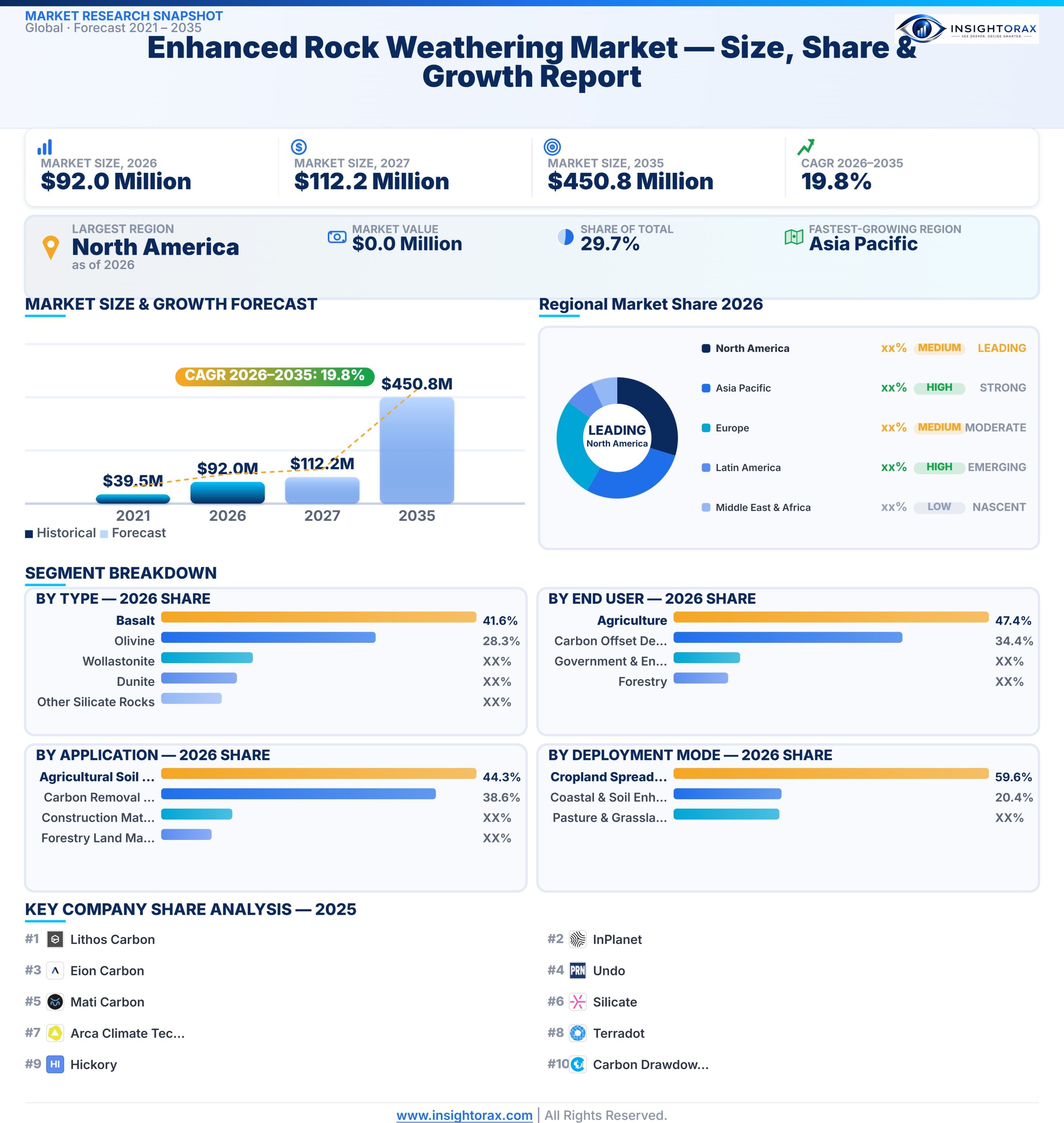
According to data analyzed by Insightorax, the global enhanced rock weathering market size was valued at USD 92.0 million in 2026 and is projected to grow from USD 112.2 million in 2027 to USD 450.8 million by 2035, registering a CAGR of 19.8% during the 2026–2035 forecast period. North America accounted for the largest revenue share of 29.7% in 2026. Market growth is driven by increasing demand for scalable carbon dioxide removal solutions, climate-change mitigation initiatives, carbon-credit development, and growing adoption of nature-based carbon sequestration technologies. Rising corporate net-zero commitments, government decarbonization programs, interest in durable carbon removal, and advances in mineral application and monitoring technologies are further supporting demand. Agricultural applications, enhanced soil properties, and opportunities to utilize suitable rock materials also contribute to expanding market adoption globally.
2. Market Overview:
The Enhanced Rock Weathering Market covers technologies, materials, services, and projects that accelerate the natural weathering of rocks to remove atmospheric carbon dioxide and store it in stable dissolved forms, primarily bicarbonate. The process generally involves crushing or processing suitable silicate-rich rocks and applying them to agricultural soils, managed land, or other suitable environments. The market encompasses the supply of rock materials, processing and transportation, field application, carbon-removal project development, monitoring, reporting and verification (MRV), and associated carbon-credit services.
Key market components include rock sourcing and preparation, spreading and application technologies, carbon-removal measurement systems, soil and environmental monitoring, project management, and carbon-credit commercialization. The market scope also covers deployment across agriculture, land restoration, and other potential carbon-removal applications, alongside research and development focused on improving weathering rates, measurement accuracy, environmental performance, and cost efficiency.
3. Market Size & Forecast:
Historically, Enhanced Rock Weathering (ERW) developed primarily through academic research and small-scale agricultural field trials investigating accelerated mineral weathering for carbon dioxide removal. Its application to croplands attracted attention because the approach can combine carbon removal with potential soil-health benefits. Increasing research activity, commercial project development, and carbon-removal procurement are now moving ERW from an experimental concept toward early commercial deployment.
Current expansion is supported by rising demand for durable carbon dioxide removal, growing corporate climate commitments, advances in monitoring, reporting and verification, and increasing investment in ERW projects. Future growth is expected to benefit from wider agricultural deployment, improved measurement methodologies, better feedstock and application logistics, and stronger policy frameworks. However, scaling will depend on addressing feedstock availability, lifecycle emissions, environmental monitoring, carbon-accounting consistency, and project economics.
Key Market Trends & Insights
- By type: Basalt segment dominated the market with a 41.6% share in 2026.
- By end user: Agriculture segment led the market in terms of share, accounting for 47.4% in 2026.
- By application: Agricultural Soil Amendment segment commanded the largest market share at 44.3% in 2026.
- By deployment mode: Cropland Spreading segment accounted for the highest market share of 59.6% in 2026.
Regional Highlights
- Largest regional market: North America (29.7% revenue share, 2026)
- Fastest-growing regional market: Asia Pacific Highest CAGR, 2026–2035
- By country: United States held the largest market share in 2026
Market Size & Forecast
- Market size in 2026: USD 92 Million
- Estimated market size in 2027: USD 112.2 Million
- Projected market size by 2035: USD 450.8 Million
- CAGR (2026-2035): 19.8%
4. Market Drivers, Restraints & Opportunities:
The Enhanced Rock Weathering Market is driven by rising demand for durable carbon dioxide removal solutions and increasing efforts to reduce atmospheric greenhouse-gas concentrations. Growing corporate net-zero commitments, expansion of voluntary carbon-removal procurement, government climate initiatives, and increased investment in carbon-removal technologies are supporting commercial development. ERW also benefits from its potential integration with agriculture, where suitable mineral applications may improve soil properties while contributing to carbon removal. Advances in rock processing, spreading technologies, geochemical modeling, and monitoring, reporting and verification are further improving deployment prospects.
Market expansion faces challenges related to the availability, quality, and transportation of suitable silicate rock feedstocks. Crushing and grinding can require substantial energy, creating concerns about lifecycle emissions and project economics. Measuring carbon removal accurately across diverse soils and climatic conditions remains technically complex, while uncertainty around weathering rates, environmental impacts, permanence, and carbon-credit methodologies can affect project financing and market confidence. Regulatory requirements, land access, farmer participation, and fragmented MRV approaches may also slow large-scale implementation.
Significant opportunities exist through agricultural partnerships, regional ERW projects, carbon-removal offtake agreements, and integration with existing mining, quarrying, fertilizer, and agricultural supply chains. Development of standardized MRV frameworks, improved field sensors, remote monitoring, and geochemical models can strengthen verification. Opportunities also include utilizing suitable industrial mineral residues where environmentally appropriate, reducing transportation distances, developing low-energy processing methods, and expanding ERW deployment in regions with favorable geology, agricultural land availability, and supportive carbon-removal policies.
5. Market Trends:
Enhanced Rock Weathering is shifting from research trials toward commercial deployment, with agricultural applications remaining central. In 2025, research emphasized long-term field trials, robust monitoring, reporting and verification, and clearer policy support. Commercial developers are raising capital and securing carbon-removal offtakes, while interest is expanding across North America, Europe, Latin America, India, and agricultural regions. Regional suitability increasingly depends on rock availability, soil conditions, climate, logistics, and farmer participation.
Technology trends in 2025–2026 emphasize improved MRV, geochemical modeling, field sensors, soil sampling, and methods for tracking carbon and weathering products. Research increasingly examines cation-based accounting and total alkalinity alongside conventional carbon measurements. Processing efficiency, mineral feedstocks, application equipment, and integration with agricultural and mining supply chains are receiving attention. In the United States, DOE-supported field work is testing olivine across contrasting agricultural environments to improve MRV, agronomic understanding, and safety.
Regulatory and market frameworks are evolving but remain unsettled. Puro.earth updated its ERW methodology in November 2025, while Verra kept its agricultural ERW methodology on hold in March 2026 because of uncertainties in quantification, durability, and field performance. The EU is evaluating ERW within carbon-removal certification work. Corporate procurement, including a 2026 Brazil project, is accelerating commercialization and international deployment.
6. Technology Landscape:
Enhanced Rock Weathering (ERW) accelerates mineral weathering by applying finely ground silicate rocks, including basalt and olivine, to suitable soils. Key technologies cover rock crushing and grinding, field spreading, soil sampling and geochemical analysis, and measurement, reporting and verification (MRV). Digital monitoring, modeling, control plots, and sampling protocols are increasingly used to quantify carbon removal and assess weathering performance. DOE-supported projects are testing olivine and basalt applications across farms to improve MRV, agronomic understanding.
Technology-related standards are evolving alongside commercialization. Puro.earth’s 2025 ERW methodology specifies carbon-removal measurement approaches, soil sampling, control plots, uncertainty assessment, and third-party verification requirements. Its methodology was updated in 2025 and provides a certification pathway. Verra’s ERW methodology for agricultural lands remains on hold as of 2026 because of uncertainties in quantification, durability, and performance.
7. Regulatory Framework:
Enhanced rock weathering (ERW) is increasingly addressed through emerging carbon-removal certification, environmental-safety, and monitoring frameworks rather than a single dedicated global regulation. In the EU, Regulation (EU) 2024/3012 establishes a voluntary certification framework based on quantification, additionality, long-term storage, liability, and sustainability criteria. The European Commission identifies ERW as a potential future permanent carbon-removal pathway and states that activities must be safe for terrestrial and marine ecosystems.
In the UK, government policy is developing greenhouse-gas-removal standards emphasizing regulated monitoring, reporting and verification (MRV), environmental safeguards, and credible quantification. A 2025 Environment Agency assessment specifically examined ERW's environmental and social impacts to inform future regulation. The UK government also supports development of GGR standards and has identified ERW as a technology requiring further methodological development. Industry initiatives such as Puro.earth's ERW methodology apply third-party verification, carbon-removal quantification, and monitoring of environmental stressors.
8. Enhanced Rock Weathering Market Segmentation Analysis:
9. By Type:
Basalt held the highest 2026 share among the type categories at 41.6%, supported in the dataset by its role as a volcanic silicate rock used as a mineral feedstock for enhanced weathering. Its application relevance connects directly with agricultural soil amendment and carbon removal activities, making basalt important for projects seeking both soil-related benefits and measurable carbon dioxide removal. Demand can expand as early commercial scaling develops and ERW deployments increase. The workbook identifies basalt as the principal feedstock category within the type structure, giving it substantial significance for market development and project deployment. The modeled market expands from early commercial activity, and the workbook notes that forecast values reflect commercialization ramp and later normalization. Within the type mix, Basalt’s position therefore provides a clear material base for scaling ERW projects, while other silicate feedstocks contribute complementary options as deployment requirements and project configurations develop.
Olivine represented the second-highest 2026 type share at 28.3%. Defined as a magnesium/iron silicate mineral used for accelerated weathering, it provides another established feedstock route for ERW projects and supports the broader commercialization of mineral-based carbon removal. Wollastonite, Dunite, and Other Silicate Rocks also form part of the type landscape, providing additional material options for project developers and deployment models. Their inclusion broadens the feedstock base available to the market, while olivine’s sizeable share highlights continued relevance of alternative silicate minerals in accelerating weathering activity and supporting expanding ERW applications. Its defined use in accelerated weathering makes it relevant to projects where mineral selection is an important part of deployment planning. The wider type mix also includes materials suited to different project requirements, helping developers maintain flexibility across applications. As ERW commercialization progresses, the presence of several silicate feedstocks supports a broader and more adaptable market structure.
10. By Application:
Agricultural Soil Amendment accounted for the highest 2026 application share at 44.3%. The workbook defines this use as ERW deployment intended to improve soil properties while accelerating CO2 removal, linking market demand with agricultural deployment and carbon-removal objectives. Its substantial share indicates that soil-oriented projects are a central application pathway as the market moves through early commercial scaling. Agricultural use also connects directly with the Agriculture end-use category and Cropland Spreading deployment mode, reinforcing the importance of practical land-based implementation for ERW commercialization and project development. The market definition also includes mineral or feedstock preparation when directly tied to ERW projects, making agricultural deployment an important commercial connection between material supply and field implementation. Carbon removal objectives further strengthen the relevance of this application. As modeled commercialization advances, agricultural soil use remains a key pathway for translating ERW technology into operational projects.
Carbon Removal Credits held the second-highest 2026 application share at 38.6%. The dataset defines this application around ERW projects monetized through verified carbon-removal credits, emphasizing the commercial role of credit generation alongside physical weathering deployment. Forestry Land Management and Construction Material Enhancement provide additional application pathways, extending ERW activity beyond agricultural soil use. Together, these applications broaden the market’s addressable project base and create routes for ERW deployment across land management, carbon markets, and construction-linked uses. The strong position of carbon-removal credits highlights the importance of commercialization mechanisms in supporting project activity and market development. This structure makes credit-oriented applications important to the market’s commercial development, particularly where projects require mechanisms for validating and monetizing removal outcomes. The market definition specifically includes carbon-removal credit commercialization when directly tied to ERW projects. As the modeled market moves through its commercialization ramp, credit-based activity can support project development alongside physical deployment across agricultural, forestry, and construction-related settings.
11. By End Use:
Agriculture represented the highest 2026 end-use share at 47.4%. The dataset’s allocation places agriculture at the center of ERW demand, consistent with the defined role of agricultural soil amendment as an application that combines soil improvement with accelerated CO2 removal. This end-use category is closely connected with Cropland Spreading, the leading deployment mode, supporting practical field-based implementation. Its market significance reflects the concentration of ERW activity in agricultural settings during the modeled commercialization period and indicates that farm and soil-management applications are an important route for scaling mineral weathering projects. The market definition includes revenue associated with ERW deployment and mineral or feedstock preparation when directly tied to projects, so agricultural end use remains closely tied to the commercial activity captured in the market. The modeled forecast reflects an early commercialization phase, making agricultural deployment an important context for interpreting demand, implementation, and market expansion during the forecast period.
Carbon Offset Developers recorded the second-highest 2026 end-use share at 34.4%. This group is directly connected with the commercialization of carbon-removal credits, providing an end-user pathway for projects seeking to monetize ERW-based carbon removal. Forestry, and Government & Environmental Agencies represent additional end-use categories, extending demand across land management and institutional or environmental activities. The presence of these groups broadens the market beyond direct agricultural users and supports a diversified end-use structure. Carbon Offset Developers therefore hold substantial significance within the market because their activities connect ERW deployment with carbon-removal project development and credit-oriented commercialization. Their role is particularly relevant to the market definition because carbon-removal credit commercialization is included when directly tied to ERW projects. This creates a connection between project development and the economic mechanisms used to commercialize removal outcomes. As the modeled market progresses through commercialization, this end-use group can support project activity while Agriculture, Forestry, and Government & Environmental Agencies maintain demand channels across institutional settings.
12. By Deployment Mode:
Cropland Spreading held the highest 2026 deployment-mode share at 59.6%. This mode represents a direct land-based route for applying ERW materials across cropland and aligns closely with the market’s strong Agriculture end-use position and Agricultural Soil Amendment application. Its substantial share indicates that field deployment on cropland is a central mechanism for converting mineral feedstocks into practical weathering projects. Demand is therefore linked with agricultural implementation, soil-focused applications, and the broader commercialization of carbon removal through ERW. The deployment structure underscores the importance of scalable land application for expanding project activity. The market definition includes ERW deployment and directly related mineral or feedstock preparation, making the practicality of field application important to commercial activity. Cropland Spreading also connects the deployment structure with Agricultural Soil Amendment and Agriculture, creating a consistent pathway from material preparation to field use. As commercialization develops, this mode provides a straightforward framework for expanding project implementation across agricultural land.
Coastal & Soil Enhancement Projects represented the second-highest 2026 deployment-mode share at 20.4%. This category provides a broader implementation pathway alongside Cropland Spreading and Pasture & Grassland Application, covering projects designed around coastal or soil enhancement activities. Its presence demonstrates that ERW deployment is not limited to a single agricultural field model and can extend into other land or environmental settings. The dataset’s deployment allocation gives this mode a meaningful position in the 2026 structure, supporting diversification of project configurations as commercialization progresses. Pasture & Grassland Application remains another defined route for deploying ERW materials across managed land systems. Its role is relevant to the market’s broader deployment structure because ERW activity can be organized around different environmental and land-based project settings. The market definition captures deployment directly tied to ERW projects, while the modeled forecast reflects commercialization ramp. This mode therefore contributes to diversification in how projects are implemented, complementing agricultural and pasture-based approaches as the market develops.
13. Regional Analysis:
Asia Pacific accounted for 28.6% of the market in 2026, making it a regional contributor to ERW development. Its expansion reflects commercialization of accelerated silicate weathering for carbon removal and agricultural benefits. Demand is linked with terrestrial soil deployment, mineral feedstock preparation, and carbon-removal projects. Agricultural Soil Amendment and Cropland Spreading provide pathways, while Carbon Removal Credits add a commercial mechanism. Technology adoption includes field application, monitoring, reporting, verification, and assessment of weathering performance. The region’s significance is reinforced by its modeled growth trajectory and activity. Regional figures are modeled allocations rather than independently audited revenues.
North America represented 29.7% of the market in 2026, supporting strong ERW commercialization and project development. Activity is associated with accelerated weathering of finely ground silicate rocks, durable carbon removal, and agricultural deployment. Demand factors include field projects, carbon-removal credit commercialization, and measurement. Agricultural Soil Amendment provides a practical pathway, while Cropland Spreading connects feedstock preparation with terrestrial deployment. Technology adoption encompasses ERW process development, mineral handling, monitoring, and MRV practices. The region’s significance is supported by its substantial modeled allocation and commercialization activity. The regional estimate is a structured modeled allocation rather than independently audited revenue.
Europe held a 26.8% market share in 2026, maintaining a position within the emerging ERW industry. Demand is connected with durable CO2 removal, agricultural soil applications, carbon-credit commercialization, and field deployment. Agricultural Soil Amendment provides a pathway, while Carbon Removal Credits support commercial project structures. Cropland Spreading and other land-based approaches enable silicate feedstocks to support terrestrial weathering. Technology adoption includes mineral preparation, field implementation, monitoring, reporting, verification, and assessment. Europe’s significance reflects the need to connect ERW deployment with credible measurement practices and project economics. Its regional figure is a modeled allocation, not independently observed revenue.
Middle East & Africa represented 6.9% of the market in 2026. Regional activity involves accelerated weathering, mineral preparation, carbon removal, and environmental applications. Demand is linked with project deployment, soil-focused implementation, carbon-removal credit commercialization, and environmental programs. Agricultural Soil Amendment and land-based deployment provide pathways, while Carbon Removal Credits support project structures. Technology adoption encompasses feedstock handling, weathering deployment, monitoring, and MRV activities used to establish performance. Government & Environmental Agencies add an institutional dimension alongside agriculture, forestry, and carbon-offset activities. The region contributes to geographic diversification within the five-region global structure. Its allocation is modeled rather than independently audited.
Latin America accounted for 8.0% of the market in 2026. Activity centers on terrestrial ERW deployment, with agriculture providing an important context because the technology can combine accelerated CO2 removal with soil-related applications. Agricultural Soil Amendment and Cropland Spreading offer pathways, while Carbon Removal Credits provide a mechanism for commercializing verified removal. Demand factors include field deployment, mineral feedstock preparation, carbon-removal project development, and ERW projects. Technology adoption includes deployment processes, project monitoring, MRV, and verification activities supporting removal claims. Forestry Land Management and other applications broaden configurations beyond agriculture. Latin America contributes to geographic diversification and expansion. The allocation is a modeled estimate, not audited revenue.
14. Competitive Landscape:
Competition is centered on scalable deployment, credible carbon removal, measurement, reporting and verification (MRV), and access to suitable agricultural land. Companies differentiate through proprietary monitoring technologies, feedstock selection, soil-data systems, application methods, and farmer networks. Major developers including Alt Carbon, Eion, InPlanet, UNDO, Terradot, and Mati are expanding across India, Brazil, Europe, Africa, and other agricultural regions. Local basalt and other silicate minerals are increasingly integrated into projects as organic and agricultural inputs, creating potential soil-health and nutrient co-benefits alongside carbon removal.
Partnerships with technology companies, commodity suppliers, carbon-removal buyers, research institutions, and certification platforms are shaping commercialization. Alt Carbon's agreements with Mitsubishi Corporation and Mitsui O.S.K. Lines demonstrate expansion through strategic partnerships and contracted demand. Certification and verification are becoming important differentiators, with developers using frameworks from Isometric and Puro.earth. Technology adoption increasingly focuses on direct soil and water measurements, sensors, modelling, and digital MRV to strengthen credit integrity.
15. Key Enhanced Rock Weathering Market Company Insights:
Lithos Carbon uses basalt deployment, soil modelling, machine learning and cradle-to-grave MRV; InPlanet combines Brazilian basalt, tropical agriculture and verified-credit MRV. Eion deploys its CarbonLock olivine amendment through U.S. agricultural networks, using patented direct measurement and Sibelco sourcing. UNDO applies silicate rock on farmland with GPS-tracked logistics, soil and porewater testing, while Mati Carbon focuses on basalt-based ERW, smallholder deployment and statistical MRV tools.
Terradot, Silicate, Arca Climate Technologies, Hickory, Carbon Drawdown Initiative and Future Forest Company participate across terrestrial ERW, mineral-carbon-removal development or research, while Vesta develops marine/coastal ERW using olivine. CarbonRun focuses on river alkalinity enhancement; Travertine and Capture6 pursue mineralization and water-linked carbon removal. Agoro Carbon Alliance and Yard Stick provide adjacent agricultural carbon and measurement capabilities, while Carbofex focuses on biochar. Partnerships, accredited measurement, third-party methodologies, farmer networks and geographic expansion remain central commercialization strategies.
16. Key Enhanced Rock Weathering Market Companies:
· Lithos Carbon
· Inplanet
· Eion Carbon
· Undo
· Mati Carbon
· Silicate
· Arca Climate Technologies
· Terradot
· Hickory
· Carbon Drawdown Initiative
· Future Forest Company
· Vesta
· Carbonrun
· Travertine
· Capture6
· Spoil
· Agoro Carbon Alliance
· Yard Stick Pbc
· Carbofex
· Addis Energy
17. Recent Developments:
· January 6, 2025: InPlanet and Isometric announced the first-ever delivery of verified carbon-removal credits generated through enhanced rock weathering (ERW). The credits were developed by InPlanet, verified by Isometric, delivered to Adyen, and facilitated by ClimeFi.
· March 25, 2025: Frontier announced $33 million of offtake agreements with Eion for 78,707 tonnes of CO₂ removal, scheduled for delivery between 2027 and 2030. Eion deploys olivine on agricultural fields and measures the resulting carbon removal.
· April 21, 2025: Eion and Perdue AgriBusiness announced a carbon-insetting agreement under which Perdue grain farmers would remove approximately 3,500 tonnes of CO₂ by applying optimized olivine to farmland in the Mid-Atlantic. Perdue described it as the first deployment of an ERW solution within its own supply chain.
· August 18, 2025: The Carbon Drawdown Initiative published results from a two-year enhanced-weathering greenhouse experiment, covering approximately 6,500 leachate samples, one million CO₂-efflux measurements, and more than 400 pots across 67 rock-soil variants.
· December 3, 2025: Lithos Carbon announced the issuance of 5,160 registry-certified tonnes of carbon dioxide removal, describing it as the largest enhanced-rock-weathering issuance at that time.
· December 17, 2025: InPlanet announced an agreement with Microsoft to remove more than 28,500 tonnes of CO₂ between 2026 and 2028 through ERW projects in Brazil.
· December 31, 2025: Mati reported that during 2025 it had worked across 500+ villages and engaged 30,000+ smallholder farmers across India, Africa, and Southeast Asia. It also reported 200,000+ tonnes of basalt deployed cumulatively and thousands of tonnes of durable CDR verified and contracted.
· September 16, 2026: Reuters reported that Google entered a major carbon-removal arrangement supporting Terradot's Brazil project in Rio Grande do Sul, covering more than 200,000 hectares. The project combines ERW with methane-abatement activities associated with rice farming.
18. Future Outlook:
The Enhanced Rock Weathering market is expected to move from pilot deployments toward larger agricultural applications as carbon-removal buyers, farmers, researchers, and governments develop scalable deployment models. Opportunities are emerging from basalt and other silicate feedstocks, integration with existing agricultural practices, soil-health benefits, and expansion across Brazil, India, the United States, and other major cropland regions. Recent research projects substantial long-term deployment potential, although outcomes vary considerably by region and adoption scenario.
Future development will depend heavily on lower-cost rock sourcing, efficient application logistics, field-scale measurement, and credible MRV systems. Key challenges include uncertainties in weathering rates, feedstock availability, environmental pathways, lifecycle emissions, and carbon-accounting methodologies. Emerging developments include improved sensor-based monitoring, cation and alkalinity accounting, standardized methodologies, and large agricultural partnerships. Verra continues evaluating the maturity of ERW methodology development, highlighting the need for stronger field evidence and verification frameworks.
19. Methodology Overview
Extensive research from reliable academic sources, industry reports, and publications.
Interviews with industry experts, opinion leaders, and key stakeholders.
Validation of data through top-down and bottom-up approaches.