Precision Longevity Market Research Report
Global Market Size, Share & Trends Analysis Report, 2026-2035
Segmentation Analysis By Type: By Application: By End Use: By Organization Size: By Region and Industry Forecast
1. Market Summary:
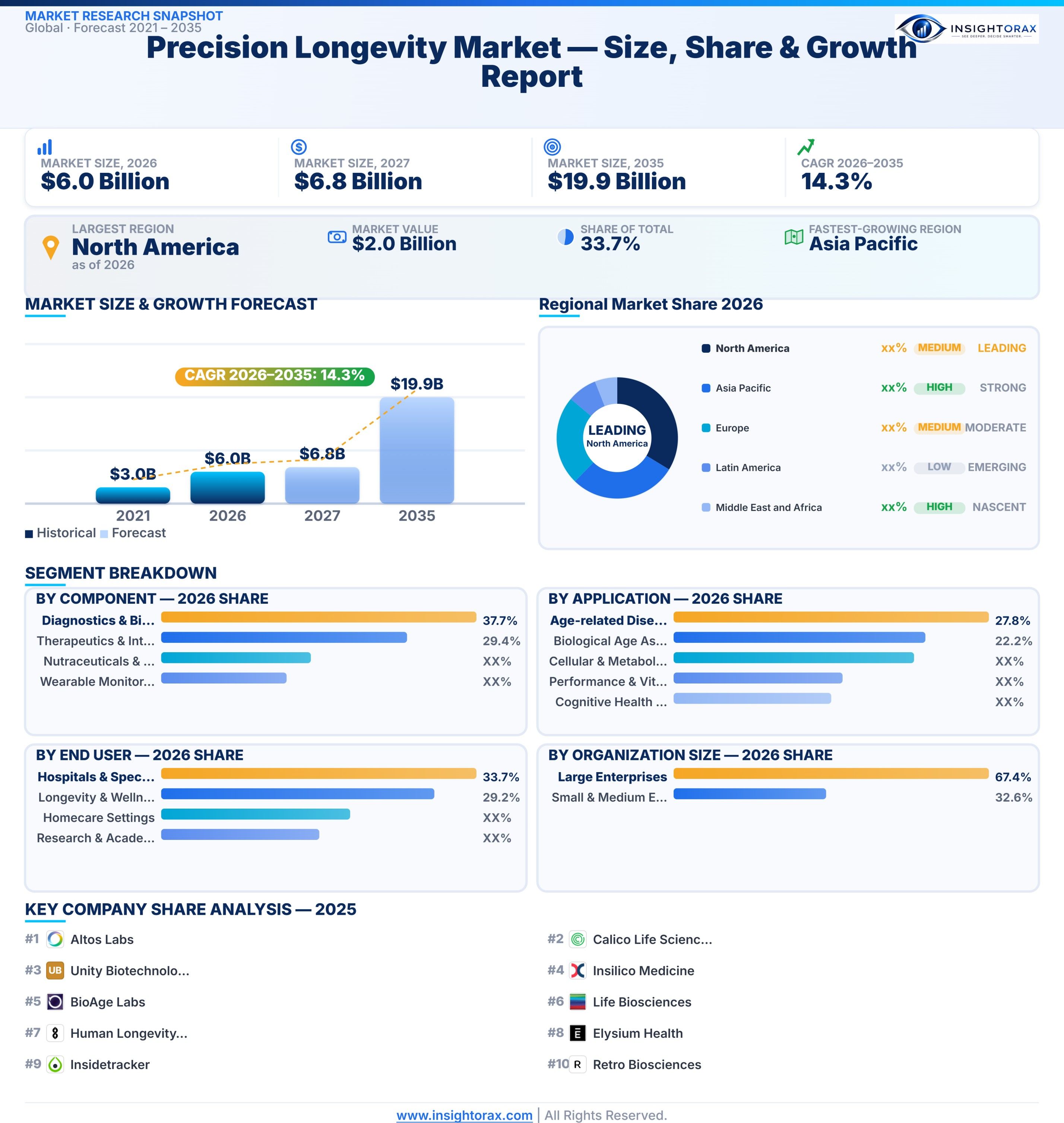
According to data analyzed by Insightorax, the global precision longevity market size was valued at USD 6.0 billion in 2026 and is projected to grow from USD 6.8 billion in 2027 to USD 19.9 billion by 2035, registering a CAGR of 14.3% during the 2026–2035 forecast period. North America accounted for the largest revenue share of 33.7% in 2026. Global growth is driven by advances in precision medicine, genomic sequencing, biomarker discovery, AI-powered health analytics, and personalized preventive care. Rising demand for early disease-risk identification, individualized wellness strategies, longevity-focused interventions, and continuous health monitoring is accelerating adoption. Increasing healthcare digitization, growing consumer interest in healthy aging, expanding investment in biotechnology, and improved access to personalized diagnostics are further supporting market development across healthcare, biotechnology, wellness, and life-sciences applications.
2. Market Overview:
The Precision Longevity Market encompasses technologies, services, diagnostics, and personalized healthcare approaches designed to extend healthy lifespan by identifying and addressing individual factors that influence aging and age-related health outcomes. The market combines precision medicine, genomics, epigenetics, biomarker analysis, artificial intelligence, digital health, and preventive healthcare to develop individualized longevity strategies. Its scope covers risk assessment, biological-age measurement, personalized nutrition, lifestyle optimization, early disease detection, and targeted interventions.
Key components include genomic and molecular testing, wearable and remote health monitoring, longevity-focused diagnostics, AI-driven health analytics, personalized wellness platforms, clinical decision-support tools, and data-driven preventive programs. The market also covers research and development in cellular health, metabolic optimization, regenerative approaches, and age-related disease management. End users include healthcare providers, research institutions, biotechnology companies, wellness organizations, and consumers seeking personalized healthy-aging solutions.
3. Market Size & Forecast:
Historically, the Precision Longevity Market developed through advances in preventive medicine, genetic testing, personalized healthcare, and research into biological aging. Early applications focused on genetic risk assessment, nutrition, lifestyle management, and age-related disease prevention. The market is now expanding as genomic technologies, biomarker testing, artificial intelligence, digital health platforms, and wearable devices enable more detailed and continuous assessment of individual health and aging patterns.
Looking ahead, market expansion is expected to be supported by rising interest in healthy aging, increasing healthcare personalization, growing availability of multi-omics data, and advances in AI-enabled health analytics. Greater emphasis on early disease detection and preventive interventions is encouraging healthcare providers and consumers to adopt precision-based longevity solutions. Continued biotechnology investment, improved diagnostic accessibility, integration of longitudinal health data, and development of targeted therapies are also expected to broaden applications across clinical, wellness, research, and personalized healthcare settings.
Key Market Trends & Insights
- By component: Diagnostics & Biomarker Testing segment dominated the market with a 37.7% share in 2026.
- By application: Age-related Disease Prevention segment led the market in terms of share, accounting for 27.8% in 2026.
- By end user: Hospitals & Specialty Clinics segment commanded the largest market share at 33.7% in 2026.
- By organization size: Large Enterprises segment accounted for the highest market share of 67.4% in 2026.
Regional Highlights
- Largest regional market: North America (33.7% revenue share, 2026)
- Fastest-growing regional market: Asia Pacific Highest CAGR, 2026–2035
- By country: The United States held the largest market share in 2026
Market Size & Forecast
- Market size in 2026: USD 6 Billion
- Estimated market size in 2027: USD 6.8 Billion
- Projected market size by 2035: USD 19.9 Billion
- CAGR (2026-2035): 14.3%
4. Market Drivers, Restraints & Opportunities:
The Precision Longevity Market is being driven by growing demand for personalized healthcare, preventive disease management, and healthy-aging solutions. Advances in genomics, epigenetics, biomarker discovery, multi-omics, artificial intelligence, and digital health are enabling more precise assessment of biological aging and individual health risks. Rising healthcare expenditure, increasing consumer awareness of longevity, and greater adoption of wearable monitoring technologies are further supporting market development. The shift from reactive treatment toward proactive health management is also creating demand for personalized nutrition, lifestyle optimization, and early intervention programs.
Despite strong potential, market development faces challenges including high costs associated with advanced testing and personalized interventions, limited standardization of longevity biomarkers, data privacy concerns, and differences in clinical validation across emerging technologies. Regulatory uncertainty surrounding certain longevity-focused products and interventions can also slow commercialization. In addition, limited long-term clinical evidence for some approaches may affect adoption among healthcare providers and consumers.
Significant opportunities are emerging through the integration of AI with longitudinal health data, precision diagnostics, digital biomarkers, and multi-omics platforms. Growing collaboration among biotechnology companies, healthcare providers, research institutions, and technology firms can accelerate innovation. Expansion into preventive healthcare, personalized wellness, corporate health programs, and age-related disease management may broaden the market. Advances in regenerative medicine, cellular health research, and individualized therapeutic development could further create new applications.
5. Market Trends:
The Precision Longevity Market is shifting from wellness toward measurable, personalized healthy-aging care. A 2025–2026 trend is the use of biological-age clocks and multimodal biomarkers, including epigenetic, proteomic, transcriptomic, metabolomic, and clinical measures, to characterize aging. Research is also emphasizing standardized biomarker evaluation because performance varies by population and intended outcome. AI and machine learning are increasingly being combined with multi-omics and longitudinal health data to support individualized risk assessment, monitoring, and intervention planning.
Technological development is also moving toward less invasive and continuous monitoring. Research highlights proteomic aging clocks and noninvasive biomolecular profiling using biofluids, while wearable biosensors support real-time physiological measurements. Regionally, adoption is linked with digital health infrastructure, aging populations, preventive-care models, and biotechnology investment, although implementation remains uneven. Industry activity is broadening from diagnostic testing into integrated longevity platforms combining laboratory data, digital monitoring, nutrition, lifestyle, and clinical services.
Regulatory and evidence standards are becoming important as longevity technologies move closer to clinical use. In 2026, the FDA issued final guidance on bioanalytical method validation for biomarkers and draft guidance addressing individualized therapies for specific genetic conditions. These developments reinforce the importance of analytical validation, safety, clinical evidence, data quality, and oversight for emerging longevity applications.
6. Technology Landscape:
The Precision Longevity Market is supported by next-generation sequencing (NGS), genomic and molecular testing, biomarker analysis, multi-omics, bioinformatics, artificial intelligence, and digital health technologies. NGS enables analysis of large genomic regions, while biomarkers can support disease-risk assessment, treatment response evaluation, and precision-health applications. AI and advanced analytics are increasingly used to interpret complex biological and longitudinal health data.
Technology-related quality and validation requirements are also becoming increasingly important. In April 2026, the FDA issued final guidance on bioanalytical method validation for biomarkers, covering methods used to evaluate biomarker concentrations. Clinical laboratory testing is subject to CLIA requirements in the United States, while ISO 15189:2022 specifies international requirements for medical-laboratory quality and competence. FDA guidance also emphasizes analytical and clinical validation for applicable genomic and laboratory-developed tests.
7. Regulatory Framework:
The Precision Longevity market is governed by regulations covering pharmaceuticals, biologics, diagnostics, medical devices, genetic technologies, and clinical research, depending on the product and intended use. In the United States, the FDA regulates cellular and gene therapy products under the Public Health Service Act and Federal Food, Drug, and Cosmetic Act. Its framework addresses product quality, manufacturing controls, nonclinical safety, clinical evaluation, and post-market oversight. FDA guidance issued in 2026 further addresses development and chemistry, manufacturing, and controls requirements for cellular and gene therapies.
Internationally, governance increasingly emphasizes genetic-data protection, ethical research, informed consent, clinical-trial oversight, and long-term safety monitoring. The WHO framework for human genome editing recommends institutional, national, regional, and global oversight, including registries and measures addressing unsafe or unethical research. For genome-editing therapies, FDA guidance also calls for evidence covering product design, manufacturing, testing, nonclinical safety, and clinical-trial considerations. These frameworks are particularly relevant to precision longevity applications involving gene editing, cell therapies, and personalized interventions.
8. Precision Longevity Market Segmentation Analysis:
9. By Type:
Diagnostics & Biomarker Testing held a 37.7% market share in 2026, representing the leading type within the Precision Longevity Market. Demand is supported by increasing emphasis on early risk identification, personalized health profiling, biomarker interpretation, and evidence-based longevity planning. Its applications span preventive assessments, biological aging evaluation, metabolic monitoring, and individualized health programs. Continued integration of laboratory testing with digital health platforms strengthens its relevance, while healthcare providers and longevity-focused organizations increasingly use diagnostic information to guide personalized interventions and ongoing health management.
Therapeutics & Interventions accounted for a 29.4% market share in 2026 and represented the second-highest type category. Growth is associated with increasing interest in targeted approaches designed to address age-related conditions, improve physiological resilience, and support individualized longevity strategies. Therapeutic approaches complement diagnostic insights by translating health-risk information into intervention pathways. Nutraceuticals & Supplements and Wearable Monitoring Devices also contribute to the market through nutritional support and continuous health tracking, respectively, broadening consumer and clinical adoption across preventive and personalized wellness applications.
10. By Application:
Age-related Disease Prevention represented a 27.8% market share in 2026, making it the leading application area. Demand reflects increasing attention to proactive health management and identification of risks associated with aging-related conditions. Precision approaches support individualized prevention strategies by combining health information, biomarker insights, and ongoing monitoring. Applications can include preventive assessment, risk management, and personalized wellness planning. Its significance is reinforced by the shift toward earlier intervention, helping healthcare and longevity-focused providers structure programs around maintaining health and reducing age-associated risks.
Biological Age Assessment accounted for a 22.2% market share in 2026 and represented the second-highest application. Demand is supported by interest in measuring biological aging beyond chronological age and using individualized indicators to inform health-management decisions. Assessment approaches can support personalized wellness programs, preventive strategies, and longitudinal monitoring of physiological changes. Cellular & Metabolic Health, Cognitive Health Management, and Performance & Vitality Optimization extend application coverage by addressing metabolic function, cognitive wellbeing, and individualized vitality objectives, creating broader use cases across preventive, clinical, research, and wellness settings.
11. By End Use:
Hospitals & Specialty Clinics accounted for a 33.7% market share in 2026, placing this end-use category at the forefront of adoption. These settings can integrate precision longevity approaches with diagnostic services, preventive assessments, individualized treatment planning, and monitoring programs. Demand is supported by the availability of clinical expertise, diagnostic infrastructure, and patient-management capabilities. Their significance also comes from connecting longevity-oriented assessments with established healthcare pathways, enabling personalized information to contribute to broader preventive and age-related care strategies across specialized medical services.
Longevity & Wellness Centers represented a 29.2% market share in 2026 and formed the second-highest end-use category. Demand is linked to expanding interest in personalized wellness programs, biological-age evaluation, lifestyle optimization, and proactive health monitoring. These centers can combine testing, individualized recommendations, nutritional approaches, and continuous monitoring within dedicated longevity-oriented services. Homecare Settings and Research & Academic Institutes further extend adoption by supporting individualized monitoring outside traditional facilities and advancing research, validation, and development of precision approaches relevant to healthy aging and personalized longevity management.
12. By Organization Size:
Large Enterprises accounted for a 67.4% market share in 2026, representing the leading organization-size category. Their participation is supported by greater organizational resources for adopting diagnostics, therapeutic approaches, monitoring technologies, and structured longevity programs. Larger organizations can integrate precision health initiatives across established healthcare, research, wellness, or corporate health infrastructures. Their market significance is also associated with broader implementation capacity, access to technology platforms, and ability to support data-driven health-management programs that require coordinated services, specialized expertise, and sustained investment.
Small & Medium Enterprises held a 32.6% market share in 2026 and represented the second-highest organization-size category. Their participation is supported by specialized offerings, focused innovation, and the ability to address emerging needs within personalized health and longevity services. Large Enterprises and Small & Medium Enterprises collectively encompass organizations developing, delivering, or adopting solutions across the market’s diagnostic, therapeutic, nutritional, monitoring, and wellness ecosystem. Smaller organizations can contribute through targeted services, technology development, specialized research activities, and flexible approaches to personalized longevity applications.
13. Regional Analysis:
Asia Pacific dominated the Precision Longevity Market with a 24.8% share in 2026, supported by expanding preventive healthcare, personalized health management, and technology-enabled longevity services. China, India, Japan, Australia, South Korea, and other Asia Pacific markets contribute demand for diagnostics, biomarker testing, biological age assessment, and wearable monitoring. Applications span age-related disease prevention, cellular and metabolic health, cognitive health management, and performance optimization. Longevity and wellness centers are increasing personalized assessments, while hospitals and specialty clinics apply diagnostic technologies for preventive care and assessment. Digital monitoring, connected wearables, and data-driven health platforms are strengthening technology adoption, supporting precision longevity solutions and services.
North America held the highest regional position, with a 31.6% share in 2026, making it the leading regional market by share. Demand is supported by personalized healthcare, preventive disease management, advanced diagnostics, and interest in personalized longevity strategies. The United States, Canada, and Mexico contribute across applications including age-related disease prevention, biological age assessment, cellular and metabolic health, cognitive health management, and performance optimization. Diagnostics and biomarker testing identify individual health characteristics, while therapeutics, nutraceuticals, and wearable monitoring support broader personalized longevity programs. Hospitals, specialty clinics, longevity centers, and homecare settings provide practical channels, with digital platforms expanding personalized health management.
Europe represented 27.2% of the market in 2026 and held the second-highest regional share, positioning it as a leading market for precision longevity solutions. The United Kingdom, Germany, France, Spain, Italy, and other European countries support demand through preventive healthcare, personalized assessment, and research-oriented health services. Applications include age-related disease prevention and biological age assessment, alongside cellular and metabolic health, cognitive health management, and performance optimization. Biomarker testing, diagnostics, therapeutic interventions, nutraceutical approaches, and wearable monitoring contribute to technology adoption. Hospitals and specialty clinics remain relevant channels, while longevity and wellness centers address individualized health management. Research institutes support development.
Middle East and Africa accounted for 8.7% of the market in 2026, reflecting demand for preventive healthcare, personalized assessments, and wellness services. Saudi Arabia, South Africa, and other markets contribute to use through hospitals and clinics, specialty clinics, wellness centers, homecare settings, and research institutions. Demand extends across age-related disease prevention, biological age assessment, cellular and metabolic health, cognitive health management, and performance optimization. Diagnostics and biomarker testing support individualized health evaluation, while wearable monitoring and digital technologies improve continuous tracking. Therapeutics and nutraceutical solutions contribute to longevity programs. Technology adoption increasingly supports personalized monitoring and preventive health management, strengthening regional market significance.
Latin America held a 7.7% share in 2026, with Brazil, Argentina, and other markets contributing to demand for longevity services and products. Applications include age-related disease prevention, biological age assessment, cellular and metabolic health, cognitive health management, and performance optimization. Diagnostics and biomarker testing support personalized health evaluation, while therapeutics, nutraceuticals, supplements, and wearable monitoring support these applications. Hospitals and specialty clinics remain important assessment settings, with longevity and wellness centers supporting personalized programs. Homecare adoption facilitates monitoring through connected devices and digital tools. Research institutes contribute to technology development and research. The region’s significance reflects interest in preventive, personalized, technology-enabled management.
14. Competitive Landscape:
Competition is developing across longevity therapeutics, precision diagnostics, biomarker platforms, digital health, and personalized wellness services. Companies differentiate through multi-omics profiling, AI-enabled analytics, biomarker discovery, personalized intervention programs, and clinically validated approaches. Technology adoption is increasingly supported by advances in AI, machine learning, and multimodal biological datasets. Partnerships between biotechnology companies, pharmaceutical firms, academic institutions, and healthcare providers are also becoming important for translational research and clinical development.
Geographic expansion is supported by collaborations and research networks spanning North America, Europe, and Asia-Pacific. Companies increasingly pursue disease-specific development pathways, strategic licensing, clinical partnerships, and access to large human datasets. Certifications and regulatory compliance are particularly relevant for diagnostics, medical devices, therapeutics, and digital-health products, while organic or naturally derived inputs are more prominent in consumer wellness and supplement-oriented offerings. Industry initiatives increasingly emphasize evidence generation, standardized biomarkers, real-world data, and responsible AI adoption to strengthen commercialization.
15. Precision Longevity Market Company Insights:
Leading companies span cellular rejuvenation, AI-enabled drug discovery, aging therapeutics, diagnostics, and personalized health. Altos Labs and Calico Life Sciences focus on cellular aging and therapeutic discovery, while Insilico Medicine applies generative AI and aging biomarkers to drug development. BioAge Labs targets aging-linked metabolic disease, and Life Biosciences advances epigenetic restoration, including ER-100 in Phase 1.
Retro Biosciences develops autophagy, cellular reprogramming and cell-therapy programs, while NewLimit uses AI and genomics for epigenetic medicines. Human Longevity and InsideTracker emphasize genomic, biomarker and health-data analysis; Elysium Health combines supplements with clinical research and university collaborations. Fountain Life uses AI-guided diagnostics and physician-led care, while MetroBiotech advances pharmaceutical NAD+ programs.
16. Key Precision Longevity Market Companies:
· Altos Labs
· Calico Life Sciences
· Unity Biotechnology
· Insilico Medicine
· Bioage Labs
· Life Biosciences
· Human Longevity Inc
· Elysium Health
· Insidetracker
· Retro Biosciences
· Newlimit
· Rejuvenate Bio
· Cambrian Bio
· Gero
· Deep Longevity
· Fountain Life
· Tally Health
· Function Health
· Metro International Biotech
· Cellularity
17. Recent Developments:
· April 22, 2025 – Metro International Biotech Initiated dosing in the first cohort of its Phase 1a clinical trial of MIB-725, an investigational NAD+ booster.
· April 22, 2025 – Fountain Life Announced expansion to its sixth flagship diagnostic and wellness center at One Thousand Museum in Miami.
· May 6, 2025 – NewLimit Raised $130 million in Series B financing to advance its epigenetic-reprogramming medicine programs.
· June 19, 2025 – Deep Longevity Partnered with ImagineHealth to bring biological-age testing to healthcare providers in Thailand.
· June 26, 2025 – Calico Life Sciences Entered an exclusive licensing agreement with Mabwell Bioscience for the IL-11-targeting monoclonal antibody 9MW3811.
· July 7, 2025 – Gero Entered a joint research and license agreement with Chugai Pharmaceutical to develop novel therapies for age-related diseases.
· August 25, 2025 – Human Longevity Announced a strategic collaboration with Alamar Biosciences for proteomic testing services supporting longevity research.
· August 22, 2025 – Retro Biosciences / OpenAI Announced collaboration using an experimental GPT model for protein engineering and cellular reprogramming research.
· March 24, 2026 – BioAge Labs Reported 2025 financial results and business updates for BGE-102, including planned Phase 2a studies in cardiovascular-risk and ophthalmology indications.
· April 21, 2026 – Insilico Medicine Announced formation of a Longevity Board to guide AI-enabled aging research and drug discovery.
· June 8, 2026 – Rejuvenate Bio Announced $6 million financing and a strategic R&D collaboration with Merck Animal Health.
· June 9, 2026 – Life Biosciences Announced first patient dosed in its Phase 1 trial of ER-100 for optic neuropathies.
· June 23, 2026 – Calico Life Sciences Announced FDA Breakthrough Therapy Designation for fosigotifator for vanishing white matter disease.
· Current – Altos Labs Its official website confirms its mission of restoring cell health and resilience through cell rejuvenation and its Institute of Computation focused on AI and computational biology.
18. Future Outlook:
The Precision Longevity Market is expected to move toward increasingly personalized, data-driven approaches to healthy aging, supported by advances in multi-omics, biological-age assessment, AI, digital biomarkers, and longitudinal health monitoring. Opportunities are emerging in precision prevention, biomarker-guided interventions, personalized nutrition, targeted therapeutics, and integrated longevity platforms. AI is increasingly being applied to biomarker discovery, aging-clock development, target identification, and treatment optimization.
Future development will depend on stronger clinical validation, standardized biomarkers, interoperable health-data infrastructure, and evidence demonstrating clinical utility. Key challenges include population bias, fragmented datasets, limited biological validation, privacy and governance concerns, and uncertainty around the interpretation of biological-age measures. Emerging research is increasingly combining AI with multi-omics and organ-specific aging assessments to support more precise, individualized longevity strategies.
19. Methodology Overview
Extensive research from reliable academic sources, industry reports, and publications.
Interviews with industry experts, opinion leaders, and key stakeholders.
Validation of data through top-down and bottom-up approaches.