Glp-1 Licensing Market Research Report
Global Market Size, Share & Trends Analysis Report, 2026-2035
Segmentation Analysis By Molecule Type: By Application: By Licensing Type: By End Use: By Region and Industry Forecast
1. Market Summary:
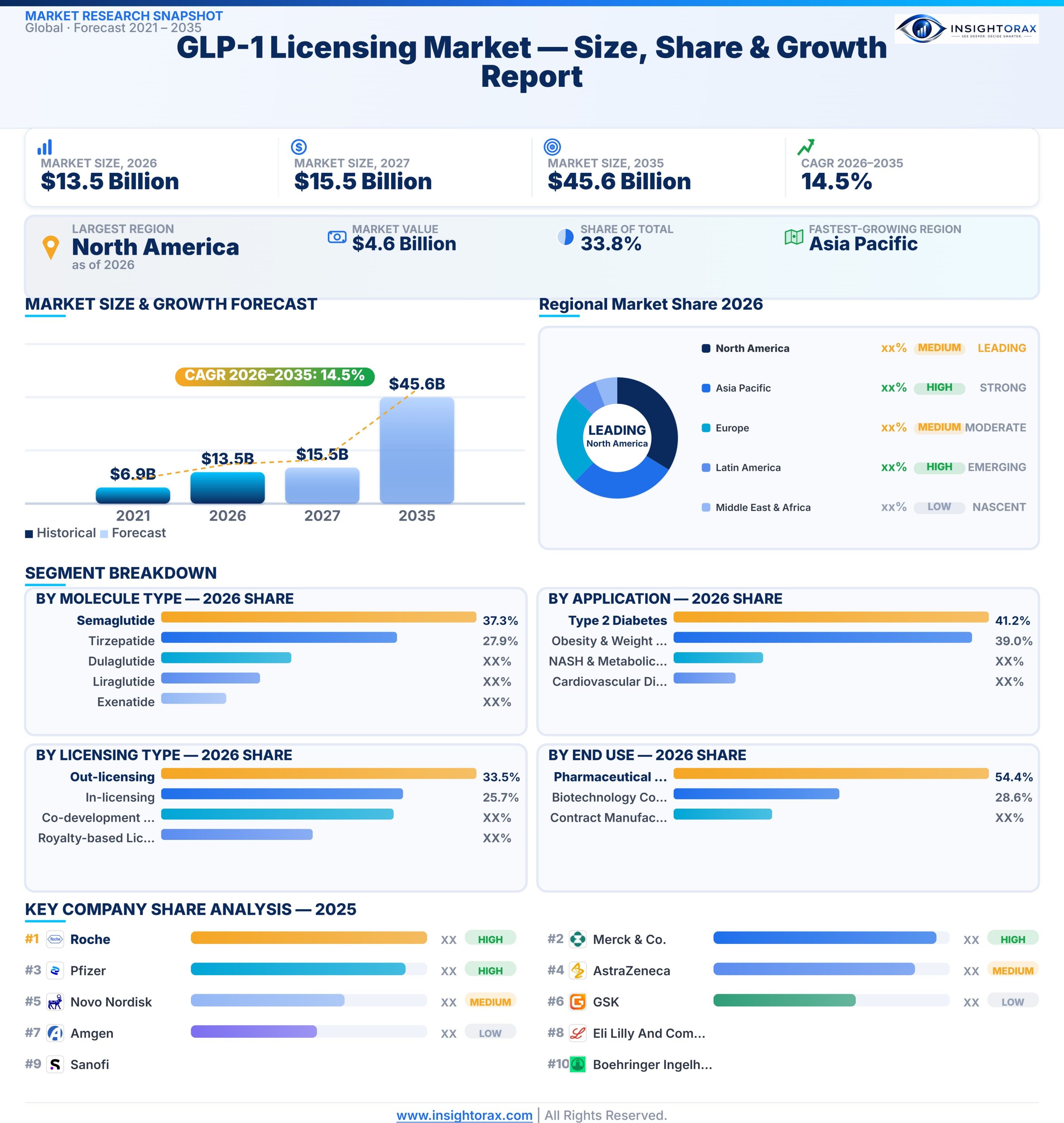
According to data analyzed by Insightorax, the global glp-1 licensing market size was valued at USD 13.5 billion in 2026 and is projected to grow from USD 15.5 billion in 2027 to USD 45.6 billion by 2035, registering a CAGR of 14.5% during the 2026–2035 forecast period. North America accounted for the largest revenue share of 33.8% in 2026. Market growth is driven by rising demand for GLP-1 therapies, increasing prevalence of obesity and metabolic disorders, expanding pharmaceutical pipelines, and growing strategic licensing partnerships. Major demand factors include the commercialization of innovative GLP-1 drugs, increasing investment in metabolic disease treatments, pharmaceutical companies seeking differentiated therapies, and expanding access to advanced weight-management and diabetes treatments across developed and emerging markets.
2. Market Overview:
The GLP-1 Licensing Market refers to the commercial ecosystem surrounding the licensing, partnering, and transfer of intellectual property, development rights, manufacturing rights, and commercialization rights associated with glucagon-like peptide-1 (GLP-1) therapies and related technologies. It covers agreements between pharmaceutical companies, biotechnology firms, research organizations, and other healthcare stakeholders to access or commercialize GLP-1 molecules, drug candidates, formulations, delivery technologies, and associated intellectual property.
The market scope includes licensing arrangements for diabetes, obesity, weight management, and other metabolic health applications. Key components include in-licensing and out-licensing agreements, co-development partnerships, regional commercialization rights, technology licensing, intellectual property transfers, manufacturing and supply rights, and milestone- or royalty-based agreements. Coverage also extends across different development stages, from early-stage drug candidates and clinical programs to approved therapies and established commercial products, supporting global pharmaceutical innovation and market expansion.
3. Market Size & Forecast:
The GLP-1 Licensing Market has evolved alongside advances in metabolic disease research, pharmaceutical innovation, and the development of therapies targeting diabetes and obesity. Historically, licensing activity focused on transferring drug candidates, intellectual property, and development rights between pharmaceutical and biotechnology companies. As GLP-1 therapies gained broader clinical and commercial recognition, licensing arrangements expanded to include regional commercialization, co-development, manufacturing, and technology partnerships.
The market is expected to maintain strong expansion as pharmaceutical companies seek access to validated GLP-1 assets, innovative formulations, delivery technologies, and complementary metabolic therapies. Rising obesity and diabetes prevalence, growing demand for weight-management treatments, expanding clinical pipelines, and increasing investment in next-generation therapies are encouraging strategic partnerships. Additionally, regional licensing can help companies accelerate market entry, strengthen portfolios, share development costs, and access specialized capabilities, supporting continued growth across developed and emerging markets.
Key Market Trends & Insights
- By molecule type: Semaglutide segment dominated the market with a 11.1% share in 2026.
- By application: Type 2 Diabetes segment led the market in terms of share, accounting for 12.3% in 2026.
- By licensing type: Out-licensing segment commanded the largest market share at 10.0% in 2026.
- By end user: Pharmaceutical Companies segment accounted for the highest market share of 16.2% in 2026.
Regional Highlights
- Largest regional market: North America (33.8% revenue share, 2026)
- Fastest-growing regional market: Asia Pacific Highest CAGR, 2026–2035
- By country: The United States held the largest market share in 2026
Market Size & Forecast
- Market size in 2026: USD 13.5 Billion
- Estimated market size in 2027: USD 15.5 Billion
- Projected market size by 2035: USD 45.6 Billion
- CAGR (2026-2035): 14.5%
4. Market Drivers, Restraints & Opportunities:
The GLP-1 Licensing Market is driven by rising demand for therapies addressing obesity, diabetes, and related metabolic conditions, alongside growing pharmaceutical investment in GLP-1 drug development. Increasing clinical validation of GLP-1-based therapies, expansion of product pipelines, and strong commercial interest in weight-management treatments are encouraging companies to secure licensing agreements. Partnerships also enable pharmaceutical and biotechnology companies to access specialized technologies, intellectual property, development capabilities, and established commercialization networks while reducing time required to build assets internally.
Despite these growth factors, the market faces challenges including high development and clinical trial costs, regulatory requirements, intellectual property complexities, and competition for commercially attractive GLP-1 assets. Companies may also face uncertainty surrounding licensing valuations, milestone structures, royalty obligations, manufacturing capacity, and long-term product differentiation. Regulatory changes, patent considerations, supply-chain constraints, and potential safety or efficacy concerns can further influence partnership decisions and increase due-diligence requirements.
Significant opportunities exist through next-generation GLP-1 molecules, combination therapies, novel delivery systems, and differentiated formulations designed to improve efficacy, convenience, and patient adherence. Emerging markets offer additional opportunities as healthcare infrastructure and access to metabolic treatments improve. Regional licensing and co-development agreements can help companies expand geographically while sharing investment and development responsibilities. Strategic collaborations involving biotechnology innovators, pharmaceutical manufacturers, and technology providers may further accelerate commercialization and portfolio diversification.
5. Market Trends:
Global GLP-1 licensing activity is focused on obesity, diabetes, and cardiometabolic portfolios, with companies seeking differentiated assets. Deal activity remains concentrated around GLP-1 receptor agonists and multi-agonists, including GLP-1/GIP and GLP-1/GIP/glucagon programs. In 2025, Novo Nordisk licensed UBT251 from The United Laboratories, while Regeneron licensed a GLP-1/GIP candidate from Hansoh Pharma, illustrating continued access to innovative Chinese assets.
Technology trends are shifting toward longer-acting, oral, and convenient therapies, alongside receptor combinations and delivery approaches. Licensing structures increasingly cover development, manufacturing, supply, and regional commercialization rights. In 2025, Lupin signed an exclusive agreement for fortnightly bofanglutide, while in March 2026 Lupin and Zydus agreed on Indian co-marketing and supply of semaglutide. Pfizer China also obtained exclusive Mainland China commercialization rights for Sciwind’s cAMP-biased GLP-1 in February 2026.
Regulatory and supply considerations are becoming central to licensing decisions. In April 2026, the FDA clarified compounding requirements as GLP-1 supply conditions stabilized, while enforcement actions addressed mass-marketed non-approved compounded products. Regional strategies are also diverging, with China and Japan attracting pharmaceutical investment while affordability remains a consideration in India. GLP-1, GLP-1R, and GIP-targeted partnerships reached $10.8 billion in disclosed deal value during 2025, according to DealForma data cited by JPMorgan.
6. Technology Landscape:
The GLP-1 licensing technology landscape covers peptide-based GLP-1 receptor agonists, oral and injectable delivery systems, long-acting formulations, and emerging multi-receptor approaches. Oral semaglutide demonstrates that GLP-1 therapies can be developed in tablet form, while pharmaceutical development increasingly incorporates advanced manufacturing approaches. FDA’s pharmaceutical-quality programs specifically recognize continuous manufacturing, process analytical technology, artificial intelligence, and other advanced manufacturing technologies as areas that can improve process reliability and product quality.
Technology transfer and licensing must also address pharmaceutical quality, analytical testing, process validation, and manufacturing controls. ICH Q7 establishes GMP principles for active pharmaceutical ingredients, while ICH quality guidelines cover stability, analytical validation, specifications, pharmaceutical development, risk management, quality systems, and continuous manufacturing. FDA CGMP requirements apply to drugs manufactured for the U.S. market, including overseas facilities, and require controls supporting identity, strength, quality, and purity.
7. Regulatory Framework:
GLP-1 licensing is governed by national drug-approval, manufacturing, quality, intellectual-property, and pharmacovigilance requirements. In the U.S., FDA-approved GLP-1 medicines must meet requirements for safety, efficacy, quality, labeling, and post-market monitoring. FDA regulations under Sections 503A and 503B also govern compounded products, including restrictions on bulk APIs and conditions for compounding. In April 2026, FDA proposed excluding semaglutide, tirzepatide, and liraglutide from the 503B bulks list.
In the EU, marketing-authorisation holders operate under EU pharmacovigilance requirements, including Good Pharmacovigilance Practices (GVP), risk-management systems, adverse-event monitoring, and safety-signal assessment through EMA and PRAC. Globally, WHO's 2026 GLP-1 landscape report highlights differing national regulatory pathways and the need for greater regulatory harmonisation. WHO also supports regulated distribution, quality oversight, and initiatives such as voluntary licensing to improve access.
8. GLP-1 Licensing Market Segmentation Analysis:
9. By Molecule Type:
Semaglutide holds the largest and dominant revenue share at 37.3% of the GLP-1 Licensing Market in 2026. Its leading position reflects the commercial maturity, broad therapeutic relevance, and extensive development ecosystem surrounding semaglutide-based assets across Type 2 Diabetes and weight-management applications. From a licensing perspective, established clinical validation and substantial pharmaceutical familiarity make semaglutide-related intellectual property, formulations, delivery technologies, manufacturing capabilities, and commercialization rights commercially relevant. Licensing activity can therefore support portfolio expansion, geographic market entry, co-marketing, supply arrangements, and access to differentiated formulations. The continuing evolution of semaglutide markets is also generating new partnership opportunities as companies seek efficient routes to develop, manufacture, and commercialize peptide-based therapies. Recent licensing activity, including agreements involving semaglutide commercialization in India, illustrates the continuing role of licensing and supply partnerships in expanding market access.
Tirzepatide represents the second-largest revenue share at 27.9% in 2026. Its substantial position reflects the growing strategic importance of differentiated incretin-based therapies and the commercial interest surrounding assets addressing both glycemic control and obesity. Tirzepatide's dual GLP-1/GIP mechanism has strengthened its relevance within next-generation metabolic therapeutics and has increased the attractiveness of associated licensing, collaboration, development, and commercialization opportunities. The remaining molecule categories—Liraglutide, Exenatide, and Dulaglutide—continue to contribute to the licensing ecosystem by providing established therapeutic assets and opportunities for portfolio diversification. Collectively, the molecule landscape demonstrates a combination of mature products and strategically important newer assets, creating multiple pathways for pharmaceutical and biotechnology companies to secure rights, broaden pipelines, and expand geographic or therapeutic coverage.
10. By Application:
Type 2 Diabetes holds the largest and dominant revenue share at 41.2% of the GLP-1 Licensing Market in 2026. Its leading position is underpinned by the established therapeutic role of GLP-1-based treatments in glycemic management and the substantial global pharmaceutical infrastructure dedicated to diabetes care. Licensing activity within this application enables companies to obtain access to molecules, formulations, delivery systems, intellectual property, development programs, and commercialization rights without necessarily developing every component internally. The application remains strategically important for pharmaceutical and biotechnology participants seeking to strengthen metabolic-disease portfolios, enter new geographic markets, expand product offerings, and accelerate commercialization. The continuing evolution of GLP-1 therapies also supports partnerships involving improved formulations, differentiated delivery technologies, combination approaches, and manufacturing capabilities.
Obesity & Weight Management represents the second-largest revenue share at 39.0% in 2026. Its significant contribution reflects the rapid expansion of GLP-1-based therapeutic applications beyond traditional diabetes management and the increasing commercial importance of obesity-focused portfolios. Licensing opportunities span innovative molecules, next-generation incretin programs, formulations, delivery technologies, and regional commercialization rights. The application is also broadening the strategic rationale for pharmaceutical companies to secure external assets and collaborate with biotechnology developers. Cardiovascular Disease and NASH & Metabolic Disorders further diversify the application landscape, creating additional opportunities for development partnerships and asset licensing. Together, these applications demonstrate that GLP-1 licensing is increasingly connected with a broader metabolic-health ecosystem rather than being confined to a single therapeutic indication.
11. By Licensing Type:
Out-licensing holds the largest and dominant revenue share at 33.5% of the GLP-1 Licensing Market in 2026. Its leading position reflects the strategic importance of rights holders monetizing selected assets, intellectual property, development programs, or geographic rights through external partnerships. Out-licensing can provide asset owners with upfront payments, milestone economics, royalties, development resources, manufacturing capabilities, and broader commercial reach while allowing them to retain selected rights or participate in future value creation. In the GLP-1 ecosystem, this model is particularly relevant where innovative biotechnology companies possess promising assets but require the infrastructure, capital, regulatory capabilities, or commercial scale of larger pharmaceutical partners. The continuing emergence of major GLP-1 and obesity-related transactions demonstrates the importance of licensing as a mechanism for transferring innovation into broader development and commercialization networks.
In-licensing accounts for the second-largest revenue share at 25.7% in 2026. Its position reflects the requirement among pharmaceutical and biotechnology companies to access external molecules, technologies, intellectual property, and development programs to strengthen internal pipelines. In-licensing can accelerate market participation while reducing the time and resources required to originate an asset entirely through internal research and development. Co-development Agreements and Royalty-based Licensing provide additional mechanisms for allocating development costs, commercial responsibilities, intellectual-property rights, and economic returns between participating organizations. These structures allow companies to align capabilities across discovery, clinical development, regulatory approval, manufacturing, and commercialization. As competition expands across oral, injectable, combination, and next-generation metabolic therapies, flexible licensing structures are expected to remain an important component of portfolio and pipeline strategy.
12. By End Use:
Pharmaceutical Companies account for the largest and dominant revenue share at 54.4% of the GLP-1 Licensing Market in 2026. Their leading position reflects the substantial role of established drug developers in acquiring, developing, manufacturing, commercializing, and managing GLP-1-related assets. Pharmaceutical companies possess extensive regulatory infrastructure, clinical-development capabilities, manufacturing networks, distribution channels, and commercial organizations, making them important counterparties in licensing transactions. Licensing enables these organizations to supplement internal R&D with external innovation, broaden therapeutic portfolios, access differentiated molecules, enter new indications, and expand geographic coverage. The concentration of commercial and development capabilities within major pharmaceutical organizations therefore creates significant demand for licensing arrangements involving molecules, formulations, technologies, intellectual property, and regional rights.
Biotechnology Companies represent the second-largest revenue share at 28.6% in 2026. Their participation reflects the important role of biotechnology innovators in discovering and developing differentiated metabolic-health assets while leveraging external partnerships for capital, clinical development, manufacturing, regulatory execution, and commercialization. Licensing can provide biotechnology companies with access to the scale and infrastructure of larger pharmaceutical organizations while allowing pharmaceutical partners to gain exposure to external innovation. Contract Manufacturing Organizations constitute the remaining end-use category and provide specialized development and manufacturing support across the GLP-1 value chain. This creates an interconnected ecosystem in which pharmaceutical companies, biotechnology developers, and manufacturing organizations contribute complementary capabilities spanning discovery, development, technology transfer, production, and commercialization.
13. Regional Analysis:
North America holds the largest and dominant regional revenue share at 33.8% of the GLP-1 Licensing Market in 2026. Its leading position is supported by a highly developed pharmaceutical and biotechnology ecosystem, substantial clinical-development infrastructure, advanced life-sciences research capabilities, and strong commercial activity surrounding metabolic therapeutics. The region provides an extensive environment for licensing transactions involving innovative molecules, development candidates, intellectual property, formulations, delivery technologies, and commercialization rights. Strong participation from pharmaceutical companies and biotechnology developers supports both inbound and outbound licensing activity, while established regulatory, clinical, manufacturing, and investment infrastructure facilitates the progression of licensed assets from development through commercialization. North America's position also reflects the strategic importance of obesity and metabolic-disease therapeutics within pharmaceutical portfolio planning, supporting continued demand for differentiated GLP-1-related assets and technologies.
Asia Pacific represents the second-largest regional revenue share at 28.5% in 2026. The region's substantial position reflects expanding pharmaceutical manufacturing capabilities, increasing biotechnology activity, growing healthcare investment, and rising commercial interest in metabolic-disease therapies. Asia Pacific also provides a significant environment for cross-border licensing, supply agreements, co-development arrangements, and commercialization partnerships. Pharmaceutical companies are increasingly utilizing licensing to access innovative molecules, manufacturing capabilities, formulations, and intellectual property while expanding regional market coverage. The region's importance is further supported by growing peptide-development and manufacturing capabilities, particularly in major pharmaceutical markets. The increasing participation of regional pharmaceutical companies in GLP-1 partnerships demonstrates the strategic relevance of licensing as a mechanism for obtaining product rights and expanding access to metabolic therapies.
Europe accounts for a 24.8% regional revenue share in 2026. The region benefits from an established pharmaceutical and biotechnology base, sophisticated research infrastructure, advanced clinical-development capabilities, and a well-developed life-sciences ecosystem. These characteristics support licensing arrangements involving innovative GLP-1 molecules, formulations, intellectual property, development programs, and commercialization rights. European pharmaceutical companies can use licensing to complement internal R&D, access emerging technologies, strengthen metabolic-health portfolios, and expand participation in international markets. The region's regulatory and scientific environment also contributes to the development and commercialization of peptide-based therapies. As the competitive landscape evolves toward differentiated dosing formats, combination therapies, oral approaches, and next-generation metabolic assets, European companies have opportunities to participate across multiple stages of the licensing value chain.
Latin America represents a 7.0% regional revenue share in 2026. The region's licensing landscape is supported by increasing demand for access to innovative metabolic therapies and the need for pharmaceutical companies to strengthen local product portfolios. Licensing can provide regional organizations with access to established molecules, development programs, manufacturing capabilities, and commercialization rights without requiring complete internal development of every component. The growing relevance of obesity and metabolic disorders provides an important demand foundation for GLP-1-related products, while partnerships can support regulatory execution, distribution, manufacturing, and market expansion. The region therefore represents a meaningful licensing environment for companies seeking to extend the geographic reach of GLP-1 assets and establish commercially viable pathways for product introduction.
Middle East & Africa accounts for a 5.9% regional revenue share in 2026. The region represents an emerging component of the global GLP-1 licensing ecosystem, supported by healthcare investment, pharmaceutical-sector development, increasing demand for metabolic-disease treatments, and efforts to improve access to advanced therapies. Licensing provides an important mechanism for regional companies to obtain access to established molecules, proprietary technologies, development expertise, manufacturing capabilities, and commercialization infrastructure. Opportunities extend across product licensing, distribution arrangements, supply partnerships, and technology transfer. As healthcare systems and pharmaceutical capabilities continue to develop, partnerships with international pharmaceutical and biotechnology organizations can support broader availability of GLP-1-related therapies while enabling companies to establish regional commercial and manufacturing capabilities.
14. Competitive Landscape:
Competition in the GLP-1 licensing market is shaped by differentiated molecules, delivery formats, intellectual property, manufacturing capabilities, and geographic rights. Major pharmaceutical companies are pursuing licensing and collaboration agreements to access novel GLP-1, GIP and glucagon-targeting technologies. For example, Novo Nordisk entered an exclusive global license agreement with The United Laboratories for UBT251, while its collaboration with Septerna targets oral small-molecule therapies.
Companies are also expanding regional commercialization rights, strengthening manufacturing capacity, and adopting advanced drug-discovery and manufacturing technologies. Product differentiation increasingly includes oral formulations, combination therapies and alternative delivery approaches. Partnerships with biotechnology firms and research organizations provide access to external innovation, while regulatory compliance and certifications remain important competitive requirements. FDA CGMP requirements emphasize controlled facilities, processes, raw materials, testing and quality systems, making manufacturing quality and supply-chain reliability important elements of licensing strategies.
15. GLP-1 Licensing Market Company Insights:
Novo Nordisk leads GLP-1 commercialization with semaglutide and licensing, including UBT251, a GLP-1/GIP/glucagon triple agonist. Eli Lilly differentiates through tirzepatide (Mounjaro, Zepbound) and oral orforglipron. Pfizer is rebuilding its obesity portfolio through Metsera and incretin programs, while AstraZeneca combines elecoglipron with licensed oral assets. Sanofi, Roche, Amgen, Boehringer Ingelheim, GSK and Merck & Co. pursue innovation through R&D, partnerships and development, supported by regulatory, manufacturing and quality capabilities.
Zealand Pharma emphasizes peptide innovation and licensing; Hanmi, Innovent, Gan & Lee and Jiangsu Hengrui expand Asian pipelines and partnerships. Structure Therapeutics, Viking Therapeutics, Terns Pharmaceuticals and Kailera Therapeutics focus on oral, peptide and combination therapies. Sun Pharma contributes commercialization and manufacturing. Across these companies, differentiation centers on efficacy, dosing convenience, intellectual property, technology, clinical development, compliance, geographic rights and alliances.
16. Key GLP-1 Licensing Market Companies:
· Novo Nordisk
· Eli Lilly And Company
· Pfizer
· Astrazeneca
· Sanofi
· Roche
· Amgen
· Boehringer Ingelheim
· Gsk
· Merck & Co.
· Zealand Pharma
· Hanmi Pharmaceutical
· Innovent Biologics
· Structure Therapeutics
· Viking Therapeutics
· Terns Pharmaceuticals
· Sun Pharmaceutical Industries
· Gan & Lee Pharmaceuticals
· Jiangsu Hengrui Pharmaceuticals
· Kailera Therapeutics
17. Recent Developments:
· 3 Feb 2026, Novo Nordisk: Sales rose to DKK 309.1 billion in 2025, and Obesity care sales grew 26% in Danish kroner to DKK 82,347 million. Novo has a 59.6% branded volume share of the global GLP-1 obesity market, using IQVIA data (MAT to November 2025). The 59.6% is a volume share of the branded obesity market, not a value or overall GLP-1 share.
· 5 Feb 2026, Hanmi Pharmaceutical: Hanmi filed record consolidated revenue of KRW 1.5475 trillion, with operating profit of KRW 257.8 billion.
· 19 Feb 2026, Zealand Pharma: The Annual Report was published on 19 Feb 2026. The 71% R&D figure is not stated in the report. It is my calculation: R&D of DKK 1,604.6 million against net operating expenses of DKK 2,254.6 million, which includes other operating items. Excluding those items, R&D is about 76%. The report also says the Roche petrelintide deal has total consideration of USD 5.3 billion, including USD 1.65 billion upfront.
· 26 Feb 2026, Structure Therapeutics: Other license income was $100.0 million for full-year 2025. The 10-K says the December 2025 Genentech/Roche agreement licenses patents covering a class of oral GLP-1 receptor agonists different from aleniglipron, with a one-time $100 million payment and low-single-digit royalties. It is a non-exclusive license tied to Genentech's CT-996.
· 25 Mar 2026, Jiangsu Hengrui: Revenue rose 13.02% to RMB 31.63 billion, and licensing revenue rose 25.62% to RMB 3.39 billion. Five overseas business development transactions were completed, highlighted by a GSK collaboration.
· 30 Mar 2026, Terns Pharmaceuticals: The 2025 Form 10-K was filed on 30 March 2026. Separately, Merck agreed to acquire Terns at $53.00 per share in cash, announced 25 March 2026. That is an acquisition, not a licensing deal.
· 7 May 2026, Structure Therapeutics (aleniglipron): Structure reported positive FDA end-of-Phase-2 feedback and said Phase 3 initiation was on track for Q3 2026.
18. Future Outlook:
The GLP-1 licensing market is expected to expand as pharmaceutical companies seek differentiated obesity and diabetes therapies, oral delivery technologies, and next-generation multi-agonist assets. Licensing and co-development activity is likely to focus on GLP-1/GIP/glucagon combinations, oral formulations, novel mechanisms, and drug-delivery technologies. Novo Nordisk’s recent agreements involving UBT251, Septerna and Vivtex demonstrate continued strategic use of partnerships to strengthen obesity pipelines and broaden treatment platforms.
Future opportunities will also emerge from geographic commercialization partnerships, advanced formulations, and technologies designed to improve dosing, tolerability, bioavailability, and treatment persistence. However, licensing activity will face challenges including intensifying competition, regulatory requirements, intellectual-property considerations, pricing pressure, and clinical-development risks. Continued expansion of oral GLP-1 programs and multi-mechanism therapies is expected to remain an important area of development.
19. Methodology Overview
Extensive research from reliable academic sources, industry reports, and publications.
Interviews with industry experts, opinion leaders, and key stakeholders.
Validation of data through top-down and bottom-up approaches.