Ambient Sensing Market Research Report
Global Market Size, Share & Trends Analysis Report, 2026-2035
Segmentation Analysis By Type: By Application: By End Use: By Technology: By Region and Industry Forecast
1. Market Summary:
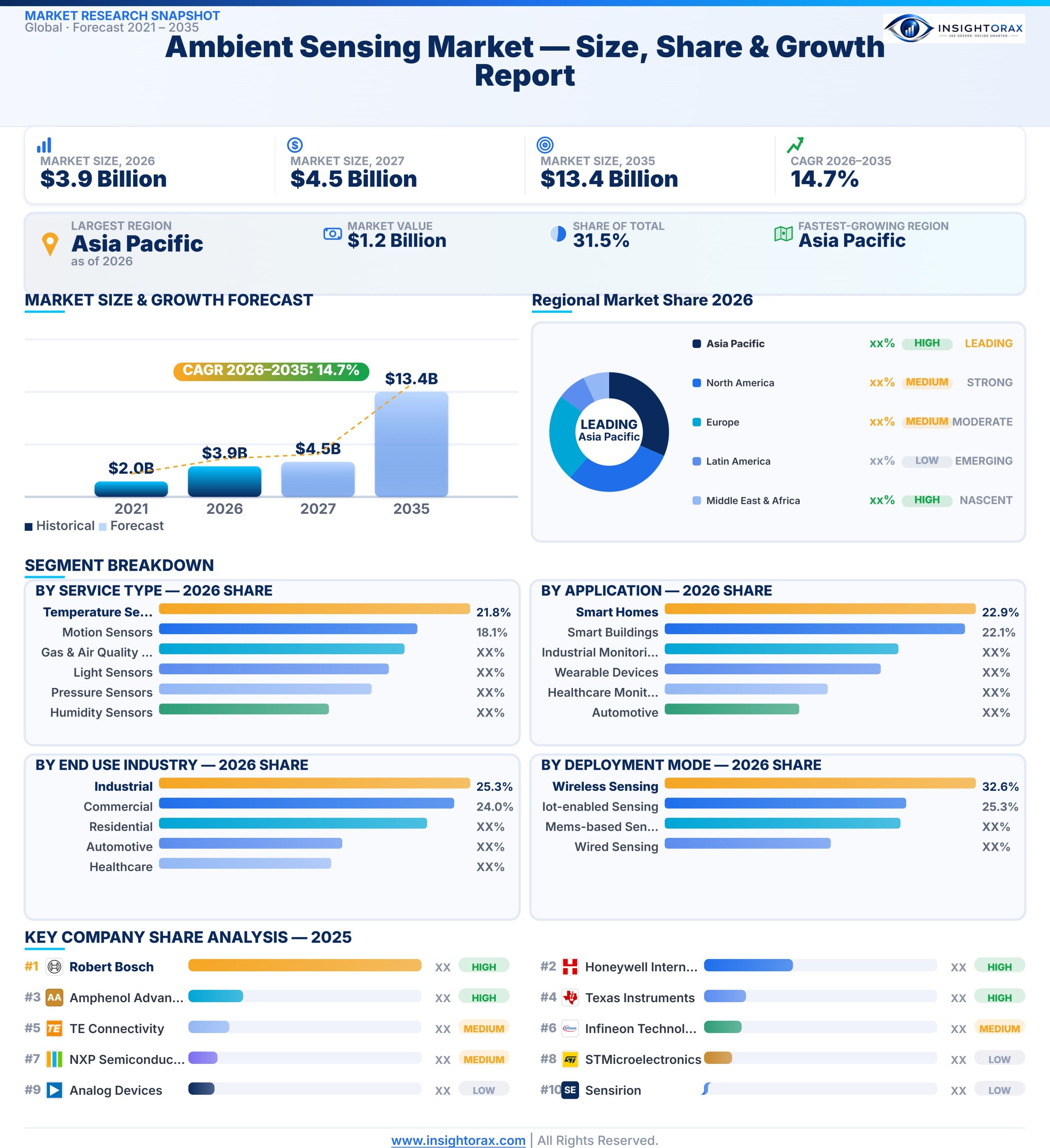
According to data analyzed by Insightorax, the global ambient sensing market size was valued at USD 3.9 billion in 2026 and is projected to grow from USD 4.5 billion in 2027 to USD 13.4 billion by 2035, registering a CAGR of 14.7% during the 2026–2035 forecast period. Asia Pacific accounted for the largest revenue share of 31.5% in 2026. Market growth is driven by the increasing adoption of smart homes, connected buildings, healthcare monitoring, industrial automation, and context-aware consumer electronics. Rising demand for real-time environmental and occupancy data, energy-efficient systems, contactless sensing, enhanced safety, and personalized user experiences is accelerating deployment. Advances in AI, IoT, sensor miniaturization, edge computing, and wireless connectivity are further supporting global adoption across residential, commercial, healthcare, and industrial applications.
2. Market Overview:
The Ambient Sensing Market encompasses technologies that detect, measure, and interpret environmental conditions, human presence, activities, and contextual changes without requiring direct physical interaction. These systems use sensors to continuously collect information from surrounding environments and convert it into actionable data for automated responses, monitoring, and decision-making. The market covers sensing technologies such as motion, presence, temperature, humidity, light, sound, pressure, air quality, proximity, and occupancy sensors, along with integrated sensor platforms.
The market scope extends across residential, commercial, healthcare, industrial, automotive, and smart-city applications. Key components include sensing hardware, embedded processors, connectivity modules, edge and cloud platforms, analytics software, and AI-enabled interpretation technologies. Major use cases include smart building automation, energy management, security and surveillance, healthcare monitoring, industrial automation, environmental monitoring, and context-aware consumer devices.
3. Market Size & Forecast:
The Ambient Sensing Market has evolved from basic environmental and motion detection technologies toward connected, intelligent sensing systems capable of interpreting real-time contextual information. Early adoption focused on applications such as lighting control, security, temperature monitoring, and building automation, while advances in IoT connectivity, sensor miniaturization, and data processing have broadened deployment across healthcare, automotive, retail, industrial, and smart-home environments.
Current expansion is supported by growing demand for energy-efficient buildings, automated operations, occupancy monitoring, environmental intelligence, and contactless interaction. Increasing integration of AI, machine learning, edge computing, wireless connectivity, and sensor fusion is improving sensing accuracy and enabling faster automated responses. Future growth is expected as organizations pursue digital transformation, sustainability, intelligent infrastructure, privacy-conscious monitoring, and personalized user experiences across connected environments.
Key Market Trends & Insights
- By service type: Temperature Sensors segment dominated the market with a 21.8% share in 2026.
- By application: Smart Homes segment led the market in terms of share, accounting for 22.9% in 2026.
- By end user: Industrial segment commanded the largest market share at 25.3% in 2026.
- By deployment mode: Wireless Sensing segment accounted for the highest market share of 32.6% in 2026.
Regional Highlights
- Largest regional market: Asia Pacific (31.5% revenue share, 2026)
- Fastest-growing regional market: Asia Pacific highest CAGR, 2026–2035
Market Size & Forecast
- Market size in 2026: USD 3.9 Billion
- Estimated market size in 2027: USD 4.5 Billion
- Projected market size by 2035: USD 13.4 Billion
- CAGR (2026-2035): 14.7%
4. Market Drivers, Restraints & Opportunities:
The Ambient Sensing Market is driven by the growing adoption of smart buildings, connected homes, industrial automation, and intelligent healthcare systems. Increasing demand for real-time occupancy detection, energy optimization, environmental monitoring, safety, and contactless interaction is encouraging organizations to deploy ambient sensing technologies. Advances in IoT, artificial intelligence, edge computing, sensor miniaturization, and wireless connectivity are further improving sensing capabilities, enabling devices to interpret environmental and contextual information with greater speed and accuracy.
Market expansion faces challenges including privacy and data-security concerns, high integration costs, interoperability issues, sensor reliability, and the complexity of deploying sensing infrastructure across existing environments. Continuous collection of contextual and behavioral information can also create concerns regarding data ownership, consent, and regulatory compliance. In industrial and commercial applications, inconsistent standards and integration requirements across different hardware and software platforms may increase deployment complexity and limit adoption among organizations with constrained technology budgets.
Significant opportunities are emerging through the integration of ambient sensing with AI-enabled analytics, smart-city infrastructure, autonomous systems, healthcare monitoring, and energy-management platforms. Privacy-preserving edge processing can support applications that require real-time intelligence while reducing dependence on centralized data transmission. Sensor fusion combining multiple sensing modalities can improve contextual awareness and reliability. Growing investment in sustainable buildings, connected infrastructure, predictive maintenance, and personalized digital environments is expected to create additional opportunities for technology providers, system integrators, and software developers.
5. Market Trends:
Ambient sensing is moving from standalone detection toward context-aware intelligence across smart buildings, healthcare, retail, industrial environments, and cities. In 2025, Gartner identified ambient invisible intelligence as a strategic technology trend, highlighting low-cost tags and sensors for large-scale tracking. North America remains an important innovation hub, while Europe emphasizes trusted, privacy-conscious digital infrastructure and Asia-Pacific expands connected-device and smart-city ecosystems. Demand is increasingly linked to automation, energy efficiency, occupant experience, safety, and visibility.
Technology trends in 2025–2026 include edge AI, TinyML, multimodal sensing, low-power wireless connectivity, sensor fusion, and event-driven systems. Moving analytics closer to sensors reduces latency, bandwidth requirements, and exposure of raw data. Healthcare applications often combine wearables, ambient monitoring, AIoT, and digital twins, while smart-city deployments explore adaptive sensing that activates devices according to environmental conditions and energy constraints. Energy harvesting and longer battery life are becoming important for distributed sensing.
Regulatory and industry priorities are shifting toward privacy, cybersecurity, interoperability, and responsible data. European deployments need alignment with GDPR, the EU AI Act, and cybersecurity requirements. In 2026, ISO/IEC 25005-1 established a smart-city framework covering availability, quality, usability, security, and innovation. Buyers are prioritizing privacy-by-design, secure edge processing, interoperable architectures, and operational value with sensing accuracy.
6. Technology Landscape:
Ambient sensing increasingly combines MEMS sensors, cameras, radar, LiDAR, infrared, acoustic sensing, and environmental sensors with edge computing and AI-based signal processing. Technologies such as ultra-wideband (UWB) enable precise ranging, while low-power wireless connectivity supports distributed sensor networks. IEEE 802.15.4-2024 defines low-rate, low-power wireless networking and includes precision-ranging capabilities, while its 2026 amendments add privacy enhancements and Ascon cryptographic algorithms.
Technology development is also emphasizing privacy, interoperability, trustworthiness, and standardized evaluation for ambient and IoT sensing systems. ISO/IEC 30141:2024 provides a standardized IoT reference architecture, while ISO/IEC TS 30149:2024 establishes IoT trustworthiness principles. In 2026, ISO/IEC 30187 introduced evaluation indicators for IoT systems, supporting more consistent assessment across applications. IEEE 2951-2025 also defines evaluation methods for intelligent smart-home devices, including perception and security capabilities relevant to ambient sensing environments.
7. Regulatory Framework:
Ambient sensing systems are increasingly governed by regulations covering privacy, wireless communications, cybersecurity, product safety, and responsible AI. In the European Union, the General Data Protection Regulation (GDPR) applies where sensing technologies process personal data, while the Radio Equipment Directive (RED) establishes requirements for safety, health, electromagnetic compatibility, and efficient spectrum use. Its cybersecurity provisions for certain radio equipment applied from August 2025. The EU Cyber Resilience Act (CRA) adds cybersecurity requirements for products with digital elements, including vulnerability management and conformity assessment; its main obligations apply from December 2027.
Government cybersecurity frameworks are also shaping compliance practices for connected sensing devices. In the United States, NIST's IoT guidance provides manufacturers with recommended cybersecurity activities and federal organizations with processes for establishing IoT security requirements. The FCC's U.S. Cyber Trust Mark program uses NIST's IoT cybersecurity criteria as its technical foundation. Where ambient sensing incorporates AI, the EU AI Act introduces risk-based requirements, including cybersecurity, documentation, human oversight, and transparency for applicable systems.
8. Ambient Sensing Market Segmentation Analysis:
9. By Type:
Temperature Sensors account for the highest 2026 share within the Type segment at 21.8%. Demand is supported by continuous thermal monitoring across residential, commercial, industrial, healthcare, and automotive environments, where accurate temperature information supports equipment protection, process control, comfort management, and condition monitoring. Their broad applicability strengthens the role of thermal sensing in ambient intelligence, particularly as connected devices increasingly require reliable environmental inputs for automated responses and operational visibility.
Motion Sensors represent the second-highest 2026 share by Type at 18.1%. Adoption is associated with occupancy detection, security, automation, activity recognition, and energy-management functions across smart spaces and connected equipment. The remaining Type categories—Humidity Sensors, Light Sensors, Gas & Air Quality Sensors, and Pressure Sensors—extend sensing coverage across environmental and physical parameters. Together, these technologies provide complementary inputs that support context-aware systems, real-time monitoring, and increasingly responsive ambient environments.
10. By Application:
Smart Homes hold the highest 2026 share within Application at 22.9%. Demand reflects the integration of ambient sensing into connected residential systems for automation, comfort, safety, energy optimization, and occupancy-aware control. Sensors can provide environmental and activity information that enables devices and home platforms to respond to changing conditions. This application remains important to market development as connected living environments increasingly depend on distributed sensing for responsive household management and seamless device interaction.
Smart Buildings represent the second-highest 2026 Application share at 22.1%. Adoption is linked to building automation, occupancy management, indoor environmental monitoring, security, and energy-efficiency initiatives, where sensor inputs support adaptive operation of facilities and equipment. Wearable Devices, Industrial Monitoring, Healthcare Monitoring, and Automotive also broaden market reach across personal, operational, clinical, and mobility settings. Collectively, these applications reinforce ambient sensing as an enabling layer for continuous data capture and context-sensitive control.
11. By End Use:
Industrial represents the highest 2026 End Use share at 25.3%. Demand is driven by monitoring requirements across equipment, production environments, processes, and operating conditions, with sensing inputs supporting maintenance, safety, efficiency, and real-time operational awareness. Industrial deployments can combine multiple sensing modalities to detect changing environmental or physical conditions and inform automated responses. This use case gives ambient sensing a substantial role in connected operations, where timely measurements contribute to process visibility and asset management.
Commercial holds the second-highest 2026 End Use share at 24.0%. Demand is associated with smart facilities, building automation, environmental monitoring, occupancy management, security, and energy optimization, creating requirements for continuous sensing across offices, retail environments, and other commercial spaces. Residential, Healthcare, and Automotive applications further extend market utilization across consumer, clinical, and mobility contexts. The broad end-use base demonstrates the flexibility of ambient sensing for environments that require persistent monitoring and responsive system control.
12. By Technology:
Wireless Sensing commands the highest 2026 Technology share at 32.6%. Its position reflects demand for flexible, distributed sensing where reduced cabling, scalable deployment, mobility, and connectivity can simplify integration across smart homes, buildings, industrial environments, wearables, healthcare systems, and vehicles. Wireless architectures can support broader sensor placement and communication with connected platforms, strengthening their relevance to ambient intelligence. Their deployment flexibility also supports evolving applications that require continuous data collection across distributed physical spaces.
IoT-enabled Sensing has the second-highest 2026 Technology share at 25.3%. Its adoption is tied to connected-device ecosystems that collect, communicate, and use sensor data for monitoring, automation, analytics, and remote management. Wired Sensing and MEMS-based Sensing remain important technology categories supporting dependable connectivity, compact sensing architectures, and application-specific deployments. Together, these approaches provide complementary technical foundations for ambient systems, enabling environmental information to move from physical conditions toward connected decision-making and automated control.
13. Regional Analysis:
Asia Pacific represents the leading regional share of the Ambient Sensing Market in 2026, accounting for 31.5%. Regional expansion is supported by demand across residential, commercial, and industrial applications. Wireless sensing plays an important role in deployment, while ambient technologies address temperature, humidity, light, motion, gas or air quality, and pressure requirements. Adoption extends across smart homes, smart buildings, wearable devices, healthcare monitoring, automotive systems, and industrial monitoring. The region’s market significance is reinforced by broad opportunities for connected consumer environments and industrial systems, where sensing technologies support automation, monitoring, and responsive operations.
North America holds a 29.8% share of the Ambient Sensing Market in 2026. Demand is supported by sensing adoption across smart homes, smart buildings, industrial monitoring, healthcare, wearable devices, and automotive systems. Wireless sensing has strong representation across deployment applications, supporting flexible monitoring and connected environments. Ambient sensors provide measurement of temperature, humidity, light, motion, air quality, and pressure across diverse operating conditions. Key industry participants include Texas Instruments, Analog Devices, Honeywell, and Amphenol Advanced Sensors. Broad application coverage and continued integration of connected sensing technologies strengthen the region’s significance within the global market.
Europe accounts for 23.8% of the Ambient Sensing Market in 2026. Demand extends across residential and commercial environments, alongside industrial, healthcare, automotive, and monitoring applications. Wireless sensing supports connected monitoring where flexible installation and distributed data collection are required. Ambient technologies serve smart-building management, environmental monitoring, wearable devices, healthcare applications, and automotive systems. Industry participants such as Infineon Technologies, Robert Bosch, and Sensirion contribute to the regional sensing ecosystem. The combination of connected infrastructure, sensor integration, and automation applications supports Europe’s continued importance in the ambient sensing landscape.
Middle East & Africa represents a 7.0% share of the Ambient Sensing Market in 2026. Regional demand spans residential, commercial, industrial, healthcare, and automotive environments, with sensing technologies increasingly supporting environmental and operational monitoring. Wireless sensing enables distributed monitoring and flexible connectivity across different facilities and applications. Technologies covering temperature, humidity, light, motion, gas or air quality, and pressure provide multiple adoption pathways. Applications include building and facility monitoring, industrial environments, healthcare systems, and connected infrastructure. The region represents a developing market opportunity as sensor-enabled monitoring and connected technologies expand across targeted applications.
Latin America holds a 7.9% share of the Ambient Sensing Market in 2026. Regional demand extends across residential, commercial, industrial, healthcare, automotive, smart-building, wearable, and monitoring applications. Wireless sensing contributes to connected monitoring by enabling distributed devices and flexible deployment. Ambient technologies covering temperature, humidity, light, motion, gas or air quality, and pressure create multiple applications across connected environments. Increasing adoption of sensor-enabled monitoring and connected systems supports regional market development. Latin America remains an emerging regional opportunity, with ambient sensing technologies contributing to broader automation, environmental monitoring, and connected-device applications.
14. Competitive Landscape:
The competitive landscape comprises semiconductor, sensor, IoT, and technology companies differentiating through multi-modal sensing, edge AI, low-power architectures, miniaturization, and application-specific solutions. Infineon strengthened its sensor portfolio in July 2026 by completing its acquisition of ams OSRAM’s non-optical analog/mixed-signal sensor business, adding capabilities across automotive, industrial, and medical applications. ams OSRAM continues to focus on digital photonics and optical sensing, including AI/ML-enabled sensors for healthcare, robotics, smart appliances, industrial automation, and automotive applications.
Companies are expanding through partner ecosystems, organic R&D, regional manufacturing, technology integration, and strategic collaborations. Infineon reports more than 30 IoT and AI partners within its Edge AI network, covering sensing, processing, security, software, and application implementation. ams OSRAM similarly operates a partner network involving hardware, software, manufacturing, and design specialists to accelerate customer product development. Competitive strategies increasingly emphasize integrated sensor-to-edge solutions, application-specific engineering, certification support, and long-term supply capabilities rather than standalone sensor components.
15. Ambient Sensing Market Company Insights:
Texas Instruments and Analog Devices provide broad analog, embedded-processing, signal-chain, and sensing portfolios for industrial, automotive, healthcare, and energy applications. STMicroelectronics differentiates through MEMS, infrared, proximity, and edge-AI sensors, including AEC-Q100-qualified automotive products. Infineon, NXP, Renesas, Microchip, Murata, and Silicon Laboratories combine sensors with MCUs, connectivity, security, and edge-processing technologies for IoT and smart environments. NXP additionally targets automotive sensor fusion and in-cabin sensing.
Bosch, Honeywell, TE Connectivity, Sensirion, Amphenol Advanced Sensors, Panasonic, Omron, Sensata, Vishay, Broadcom, and ams OSRAM extend competition across environmental, industrial, building, optical, flow, connectivity, and control sensing. Differentiation increasingly centers on miniaturization, low-power operation, embedded intelligence, application-specific reliability, and integrated modules. Infineon's 30+ partner Edge AI ecosystem and NXP's sensor software and development ecosystem illustrate partnership-led expansion, while ST's automotive portfolio demonstrates certification-focused differentiation through AEC-Q100 and ISO 26262 support.
16. Key Ambient Sensing Market Companies:
· Texas Instruments
· Analog Devices
· Stmicroelectronics
· Infineon Technologies
· Nxp Semiconductors
· Robert Bosch
· Honeywell International
· Te Connectivity
· Sensirion
· Amphenol Advanced Sensors
· Renesas Electronics
· Murata Manufacturing
· Broadcom
· Ams Osram
· Microchip Technology
· Panasonic Corporation
· Omron Corporation
· Sensata Technologies
· Vishay Intertechnology
· Silicon Laboratories
17. Recent Developments:
· January 2026 — Tageos & Wiliot partnership: Tageos, a global leader in RFID and wireless IoT inlays and tags, announced a strategic partnership with ambient IoT pioneer Wiliot, with the first result being a new passive Bluetooth Low Energy inlay, the EOS-654 BLE G3. The new inlay features a dual-band architecture operating at 2.4 GHz and sub-1 GHz.
· January 2026 — Wiliot's Gen3 IoT Pixel at NRF: Wiliot introduced its Gen3 IoT Pixel, the newest generation of its battery-free sensing technology, giving retailers, logistics providers, and supply chain companies real-time data on the location, temperature, humidity, and movement of goods across distributed networks.
· Early 2026 — Simbe's Tally 4.0 robot: Simbe launched Tally 4.0, its most advanced shelf-scanning robot and the flagship data-capture method of its Store Intelligence platform, available to customers starting mid-2026, introducing major advancements in runtime, vision, sensing, and edge AI.
· February 2026 — ADT acquires Origin AI: ADT acquired Origin AI to integrate real-time AI sensing into its smart-home ecosystem, strengthening ambient intelligence capabilities for proactive home protection; the acquisition integrates AI sensing technology designed to identify motion, presence, and occupancy without cameras, audio, or wearable devices.
· February 2026 — Intel & Qualcomm launch Ambient IoT collaboration: Intel Corp. and Qualcomm Inc. became among the first members of the Ambient IoT collaboration, a new industry group aimed at creating and advancing a global internet of things ecosystem.
· February 2026 — AM-FM foundation model for WiFi sensing: Researchers introduced AM-FM, a foundation model for ambient intelligence built on large-scale wireless (WiFi) sensing data, supporting applications like activity recognition, smart environments, and human-centered monitoring.
· July 2026 — NVIDIA expands robotics/sensing collaboration in Japan: NVIDIA expanded its collaboration with Japanese robotics and manufacturing leaders — including Fujitsu, FANUC, Yaskawa, and Kawasaki Heavy Industries — to advance physical AI, intelligent machines, smart spaces, and autonomous systems.
18. Future Outlook:
The ambient sensing market is expected to expand as sensors become more intelligent, energy-efficient, connected, and capable of processing information at the edge. Integration of AI/ML with IoT, multi-sensor data fusion, digital twins, and context-aware computing is creating opportunities across smart buildings, healthcare, industrial automation, automotive, security, and consumer environments. NIST identifies edge processing, AI-enabled devices, interoperability, and ambient intelligence among important directions for IoT development.
Future development will increasingly focus on low-latency sensing, privacy-preserving local processing, reliable connectivity, and integrated sensing and communication. Emerging 6G research is advancing sensing capabilities alongside communications, while AI-enabled smart sensors are being evaluated for real-time environmental perception. Key challenges include cybersecurity, privacy, interoperability, energy consumption, sensor reliability, and managing heterogeneous data.
19. Methodology Overview
Extensive research from reliable academic sources, industry reports, and publications.
Interviews with industry experts, opinion leaders, and key stakeholders.
Validation of data through top-down and bottom-up approaches.