Molecular Memory Market Research Report
Global Market Size, Share & Trends Analysis Report, 2026-2035
Segmentation Analysis By Technology: By Application: By Product Type: By Component: By End-use Industry: By Deployment Mode: By Region and Industry Forecast
1. Market Summary:
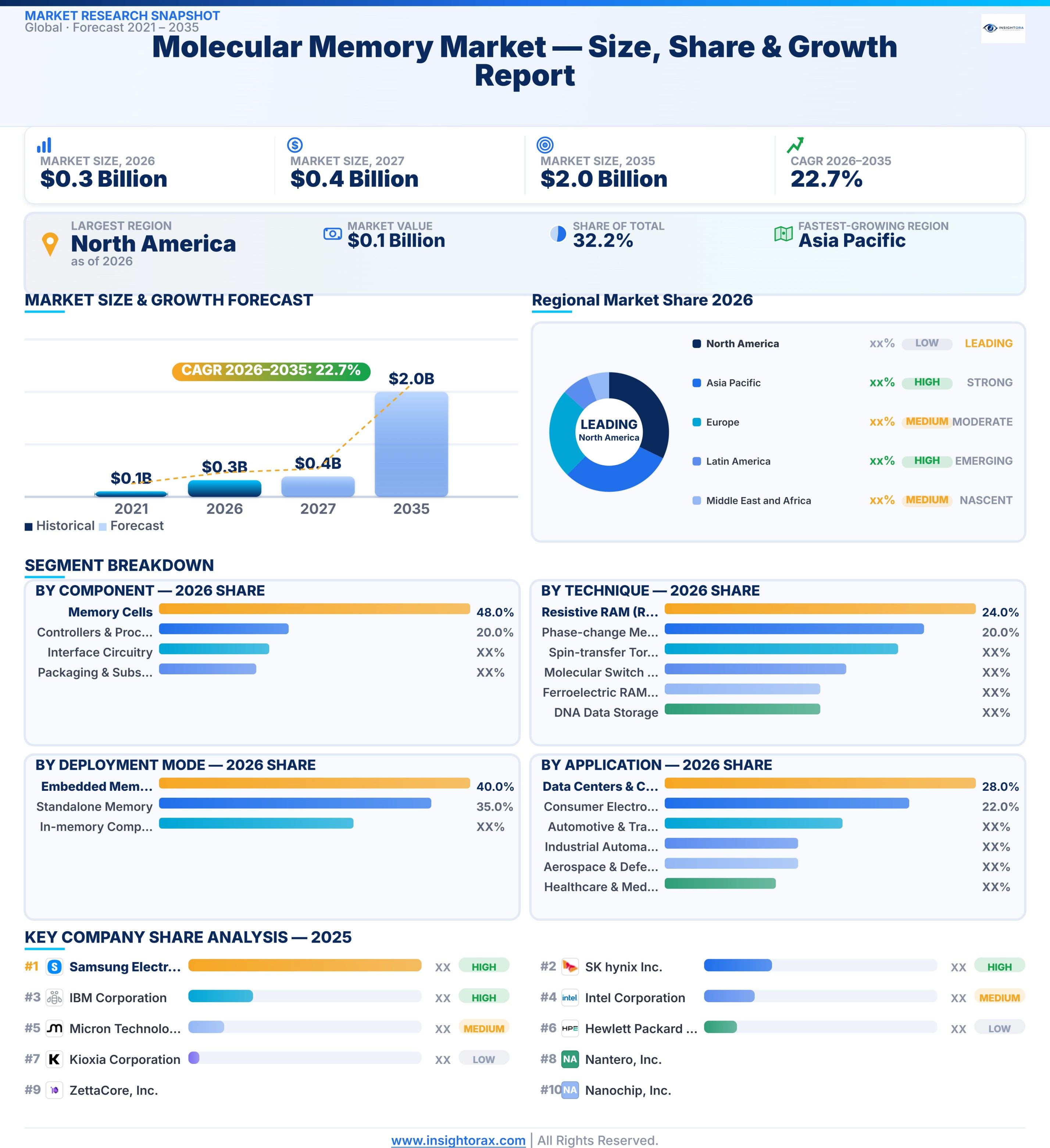
According to data analyzed by Insightorax, the global molecular memory market size was valued at USD 0.3 billion in 2026 and is projected to grow from USD 0.4 billion in 2027 to USD 2.0 billion by 2035, registering a CAGR of 22.7% during the 2026–2035 forecast period. North America accounted for the largest revenue share of 32.2% in 2026. Growth is driven by increasing demand for high-density, energy-efficient, and miniaturized memory technologies capable of supporting advanced computing applications. Rising investments in molecular electronics, nanotechnology, artificial intelligence, and next-generation semiconductor research are further supporting market development. Growing data volumes, demand for faster data processing, limitations of conventional memory architectures, and expanding interest in neuromorphic and quantum-inspired computing are also expected to strengthen demand for molecular memory solutions worldwide.
2. Market Overview:
The molecular memory market covers technologies that use individual molecules, molecular structures, or molecular-scale materials to store, retain, and manipulate digital information. These emerging memory solutions aim to achieve extremely high storage density while reducing power consumption and physical device dimensions compared with conventional semiconductor memory. The market encompasses research, development, fabrication, integration, and commercialization of molecular-based memory devices and associated technologies. It spans applications in advanced computing, data storage, electronics, artificial intelligence, neuromorphic systems, and other high-performance computing environments.
Key components include molecular memory cells, molecular switches, organic and polymer-based memory materials, molecular electronic architectures, nanoscale electrodes, fabrication processes, control and read/write mechanisms, and supporting semiconductor technologies. Market coverage also includes technology development, material innovation, device manufacturing, research institutions, technology providers, and end-use industries. The market is influenced by advances in nanotechnology, molecular electronics, materials science, and next-generation computing architectures.
3. Market Size & Forecast:
The molecular memory market has evolved from early research in molecular electronics and nanoscale information storage toward increasingly sophisticated memory architectures designed to overcome the physical limitations of conventional semiconductor technologies. Historical development has centered on advances in molecular switches, organic materials, nanostructures, and single-molecule devices, supported by progress in materials science and fabrication techniques. These developments have established the technological foundation for commercial exploration and expanded research activity.
Current expansion is supported by growing investments in next-generation computing, high-density data storage, and energy-efficient electronic architectures. Future growth is expected to accelerate as demand rises for smaller memory components, higher storage density, lower power consumption, and faster data processing. Advances in molecular fabrication, nanotechnology, artificial intelligence hardware, neuromorphic computing, and semiconductor integration are expected to improve device performance and encourage broader adoption across emerging computing and electronics applications.
Key Market Trends & Insights
- By component: Memory Cells segment dominated the market with a 48.0% share in 2026.
- By technique: Resistive RAM (ReRAM) segment led the market in terms of share, accounting for 24.0% in 2026.
- By deployment mode: Embedded Memory segment commanded the largest market share at 40.0% in 2026.
- By application: Data Centers & Cloud Storage segment accounted for the highest market share of 28.0% in 2026.
- By end user: IT & Telecommunications segment maintained a leading position in the market, holding a 30.0% share in 2026.
- By product type: Non-volatile Molecular Memory segment dominated the market with a 63.0% share in 2026.
Regional Highlights
- Largest regional market: North America (32.2% revenue share, 2026)
- Fastest-growing regional market: Asia Pacific (Highest CAGR:24.5%, 2026–2035)
- By country: United States held the largest market share in 2026
Market Size & Forecast
- Market size in 2026: USD 0.3 Billion
- Estimated market size in 2027: USD 0.4 Billion
- Projected market size by 2035: USD 2 Billion
- CAGR (2026-2035): 22.7%
4. Market Drivers, Restraints & Opportunities:
The molecular memory market is driven by rising demand for high-density and energy-efficient data storage, increasing data generation, and the need for miniaturized electronic components. Advances in molecular electronics, nanotechnology, materials science, and semiconductor fabrication are improving the feasibility of molecular-scale memory devices. Growing research into artificial intelligence, neuromorphic computing, edge computing, and advanced computing architectures is also creating demand for memory technologies that can deliver greater density and reduced energy consumption.
However, the market faces significant challenges, including complex fabrication processes, difficulties in achieving consistent molecular behavior, limited device durability, and challenges associated with reliable data writing, reading, and retention. High research and development costs, limited commercial-scale manufacturing capabilities, integration issues with existing semiconductor infrastructure, and the absence of widely adopted industry standards can further slow commercialization. Technical scalability and long-term reliability remain important considerations for manufacturers and research organizations.
Opportunities are emerging through continued investment in next-generation memory technologies and molecular electronics research. Improvements in molecular materials, nanoscale fabrication, device architectures, and hybrid integration could enhance performance and support commercialization. Collaboration among semiconductor companies, research institutions, and technology developers may accelerate innovation and address scalability challenges. Emerging applications in high-performance computing, AI hardware, neuromorphic systems, advanced data storage, and ultra-low-power electronics could provide additional avenues for market expansion as the technology matures.
5. Market Trends:
Globally, molecular memory research is shifting toward practical device architectures that combine molecular-scale storage with established nanoelectronics. Recent work emphasizes single-molecule junctions, molecular switches, redox-active materials, memristive behavior, and DNA-directed self-assembly. In 2025, researchers reported a scalable platform using DNA-directed assembly to position functional molecules between nanoscale electrodes, addressing reproducibility and device-yield challenges that have historically limited molecular electronics.
Regionally, North America, Europe, and Asia remain important centers for molecular electronics research, supported by university laboratories, semiconductor research programs, and nanotechnology infrastructure. Asia is strengthening activity through advanced materials and semiconductor capabilities, while European and North American institutions continue emphasizing single-molecule devices, molecular spin systems, and scalable fabrication. Industry participation remains largely research and development oriented because fully commercial molecular memory remains immature. Collaboration between universities, materials developers, and semiconductor organizations is becoming important for translating laboratory demonstrations into manufacturable technologies.
Technological trends during 2025–2026 include low-power switching, molecular memristors, hybrid bio-electronic architectures, improved molecular contacts, and atomic-scale fabrication. Regulatory activity remains indirect, with existing semiconductor, nanomaterial, chemical handling, environmental, and workplace-safety requirements influencing development rather than molecular-memory-specific rules. Standardization, reproducibility, reliability, and integration with conventional semiconductor processes are emerging priorities as researchers pursue scalable next-generation memory platforms.
6. Technology Landscape:
Molecular memory technologies encompass molecular switches, single-molecule junctions, molecular electronic devices, resistive/memristive structures, and nucleic-acid-based storage. Current advances focus on improving molecular addressing, switching reliability, information retrieval, error correction, and integration with nanoscale electrodes. DNA-based molecular storage is progressing through improved synthesis, sequencing, coding, random-access methods, and preservation techniques; 2025–2026 research has specifically targeted scalable and robust retrieval systems.
There is currently no widely established, molecular-memory-specific certification framework comparable to mature semiconductor standards. Development therefore relies on applicable semiconductor and memory-device test methodologies. For example, IEC 62951-9:2022 specifies performance testing for resistive memory cells, including read, forming, SET, RESET, endurance, and retention. NIST also conducts research relevant to single-molecule measurement and nanoscale electronics, supporting measurement and characterization practices rather than a dedicated molecular-memory certification.
7. Regulatory Framework:
The molecular memory market is primarily governed through broader chemical, nanomaterial, semiconductor, and electronic-product regulations rather than a dedicated molecular-memory law. In the European Union, REACH requires manufacturers and importers to identify and manage chemical risks, while specific requirements apply to nanoforms, including characterization, chemical-safety assessment, and registration information. The EU’s 2018/1881 amendment to REACH introduced these nanoform-specific provisions from January 2020.
Safety and compliance increasingly emphasize nanoscale material characterization, exposure assessment, worker protection, and lifecycle environmental impacts. In the United States, the National Nanotechnology Initiative and NIST support measurement methods, reference materials, and standards for evaluating environmental, health, and safety risks of engineered nanomaterials. International standardization through organizations such as ISO, ASTM, and OECD also supports reproducible nanomaterial testing and characterization.
8. Molecular Memory Market Segmentation Analysis:
9. By Technology:
Resistive RAM (ReRAM) dominated the technology landscape in 2026, accounting for an estimated 24% of the global mix. Its leading position reflects growing demand for non-volatile architectures capable of combining fast switching, data retention, endurance, and comparatively efficient power characteristics. ReRAM is particularly relevant to embedded processing, edge devices, intelligent electronics, and computing architectures seeking to minimize data movement. Its scalability and compatibility with emerging memory-system designs further support its adoption potential. From a market-development perspective, continued progress in materials, fabrication processes, reliability, and integration will determine how effectively ReRAM moves from research and qualification programs into higher-volume commercial applications. The segment's significance is therefore linked not only to device-level performance but also to its ability to provide measurable system-level improvements over established memory architectures.
Phase-change Memory (PCM) was the second-largest technology in 2026, representing an estimated 20% share. Its position is supported by sustained research and development, persistent-memory capabilities, scalability potential, and suitability for architectures requiring a balance between density, endurance, and retention. PCM has attracted attention for applications spanning storage-class memory, embedded systems, and compute-oriented architectures. While its commercial opportunity is substantial, broader adoption depends on manufacturing economics, write endurance, thermal characteristics, controller integration, and consistency at scale. Other approaches, including STT-RAM, FeRAM, molecular switches, and DNA-based storage, address more specialized or emerging requirements. Consequently, the technology landscape remains diverse, with future competition likely to be determined by application-specific performance, energy efficiency, manufacturability, and total system cost rather than by a single technical characteristic.
10. By Application:
Data Centers & Cloud Storage dominated application demand in 2026, accounting for an estimated 28% of the market. The segment is supported by accelerating data creation, artificial-intelligence workloads, hyperscale infrastructure expansion, and growing pressure to improve computing efficiency. Memory architectures capable of reducing latency and unnecessary data movement can provide value in environments where conventional storage and memory hierarchies increasingly constrain performance. Persistent and energy-efficient architectures are also relevant as operators seek to control infrastructure power consumption. From a commercial perspective, this application represents an important early adoption pathway because infrastructure operators can justify advanced architectures where performance improvements translate into measurable productivity or operating-cost benefits. Qualification requirements, compatibility with existing platforms, reliability, and economics will nevertheless remain important considerations before emerging memory technologies can achieve broader deployment.
Consumer Electronics was the second-largest application in 2026, with an estimated 22% share. Demand is supported by the proliferation of connected devices, intelligent endpoints, portable electronics, and increasingly sophisticated processing requirements. Manufacturers value memory solutions that can provide compact form factors, rapid access, low power consumption, and dependable operation within constrained thermal and physical environments. Advanced architectures may become particularly relevant as more functionality is integrated into smartphones, wearables, smart-home equipment, and other connected products. However, consumer applications are highly cost sensitive and generally require substantial manufacturing maturity before new memory approaches can achieve meaningful volumes. As a result, commercial penetration will depend on achieving competitive unit economics alongside reliability, low power consumption, integration simplicity, and sufficient supply-chain capacity.
11. By Product Type:
Non-volatile Molecular Memory was the dominant product type in 2026, representing an estimated 63% of the market. Its commanding share reflects strong demand for architectures that retain information without continuous power, particularly across embedded systems, edge devices, intelligent electronics, and persistent computing applications. Data retention, lower standby consumption, and rapid access make non-volatile designs attractive where conventional memory architectures create power or latency constraints. The category also aligns with broader industry efforts to develop memory systems capable of supporting increasingly data-intensive workloads while improving energy efficiency. Commercial progress will depend on endurance, retention characteristics, manufacturing yield, controller compatibility, and the ability to integrate the technology into established semiconductor processes. These factors will determine whether the substantial technical interest translates into sustained commercial adoption.
Hybrid Memory Modules ranked second in 2026, accounting for an estimated 25% share. Their appeal lies in combining complementary memory characteristics within a coordinated architecture, allowing system designers to balance speed, capacity, persistence, endurance, and cost according to workload requirements. Such configurations can provide a transitional route between conventional memory hierarchies and emerging architectures by allowing different memory technologies to perform specialized roles. Demand is therefore likely to be strongest in systems where no single memory type can simultaneously satisfy all performance and economic requirements. Continued development of controllers, interfaces, packaging, and system software will be important to successful deployment. The category's market significance ultimately depends on whether hybrid architectures can deliver tangible improvements in total system performance and efficiency without introducing excessive integration complexity.
12. By Component:
Memory Cells dominated the component structure in 2026, accounting for an estimated 48% share. As the fundamental storage element, the cell determines critical characteristics including switching behavior, retention, endurance, density, power consumption, and reliability. Consequently, investment in advanced materials, device structures, fabrication techniques, and process integration remains concentrated around improving cell performance. The commercial value of the overall architecture is closely linked to whether cells can achieve consistent characteristics across large production volumes. Manufacturers must also address variability, defect rates, thermal behavior, and compatibility with existing semiconductor manufacturing infrastructure. These considerations make cell development one of the most important determinants of commercialization. Improvements in cell-level performance can create downstream benefits across embedded, standalone, and computing-oriented memory configurations, supporting broader adoption as manufacturing maturity increases.
Controllers & Processors were the second-largest component category in 2026, representing an estimated 20% share. Their importance reflects the growing complexity of advanced memory architectures, where efficient addressing, error management, workload coordination, and communication between memory and processing elements are essential. Controllers can determine how effectively emerging memory characteristics are translated into practical system performance. Increasingly heterogeneous architectures also require sophisticated coordination between different memory tiers and processing resources. As a result, controller development is becoming an important part of the commercialization pathway rather than merely a supporting function. Interface Circuitry and Packaging & Substrates provide additional system-level value by supporting connectivity, signal integrity, thermal management, physical integration, and reliability. Successful deployment will therefore depend on coordinated advancement across the entire component ecosystem.
13. By End-Use Industry:
IT & Telecommunications dominated end-use demand in 2026, accounting for an estimated 30% of the industry mix. The sector's leading position reflects substantial requirements for computing capacity, data processing, communications infrastructure, cloud services, and artificial-intelligence workloads. Advanced memory can potentially reduce data-transfer bottlenecks and improve energy efficiency in systems handling increasingly intensive workloads. Adoption opportunities extend across enterprise infrastructure, network equipment, high-performance computing, and specialized processing platforms. Because these environments can place a high economic value on performance and efficiency, they provide an important pathway for qualifying emerging architectures. Nevertheless, reliability, interoperability, system economics, and manufacturing consistency remain critical before broader deployment can occur. The sector's scale also provides a substantial addressable base for technologies that demonstrate clear advantages over conventional memory solutions.
Automotive and Consumer Electronics jointly formed the second-largest position in 2026, with each accounting for an estimated 18% share. Automotive demand is supported by increasingly sophisticated electronic architectures, advanced driver-assistance systems, connected vehicles, and real-time processing requirements. Consumer electronics, meanwhile, benefits from continued growth in intelligent, connected, and portable devices requiring compact and efficient memory. Both industries place strong emphasis on reliability and power efficiency, although their qualification and cost requirements differ substantially. Automotive platforms generally demand longer qualification cycles and stringent reliability standards, while consumer products are particularly sensitive to unit economics and rapid product cycles. Their comparable modeled shares demonstrate the diversification potential of emerging memory technologies across industrial and consumer applications rather than dependence on a single end-user category.
14. By Deployment Mode:
Embedded Memory dominated deployment patterns in 2026, representing an estimated 40% share. Its leading position reflects the benefits of integrating memory directly into processors, systems-on-chip, controllers, and application-specific architectures. Such integration can reduce latency, shorten data paths, and improve energy efficiency by limiting movement between separate processing and memory components. Embedded implementations are particularly relevant to automotive electronics, edge computing, industrial systems, and intelligent devices where space and power constraints are important. The commercial pathway will depend on semiconductor-process compatibility, design-tool support, reliability, thermal management, and manufacturing economics. As integration requirements become more sophisticated, the ability to demonstrate a clear system-level advantage will be increasingly important for securing adoption among device and platform manufacturers.
Standalone Memory was the second-largest deployment mode in 2026, accounting for an estimated 35% share. Its comparatively high contribution reflects the flexibility of independent memory products, which can be added, configured, or upgraded at the system level without redesigning the primary processor architecture. This deployment model can therefore provide a practical route for introducing new memory technologies into selected platforms while limiting changes to the broader system design. Standalone solutions remain relevant for storage, specialized computing, enterprise equipment, and other applications requiring configurable memory capacity. In-memory Computing represents an additional emerging pathway, particularly for artificial intelligence and analytics workloads where processing closer to stored data can reduce movement-related latency and energy consumption. Adoption across deployment models will ultimately depend on workload suitability, software support, integration complexity, reliability, and total system economics.
15. Regional Analysis:
North America dominated the global Molecular Memory Market in 2026, accounting for a 31.9% market share according to the ME data sheet. The region’s position is supported by a mature semiconductor ecosystem, substantial research and development capabilities, and strong participation from leading technology companies across memory, computing, and advanced semiconductor technologies. The United States remains the principal contributor, benefiting from investments in next-generation memory architectures, artificial intelligence infrastructure, high-performance computing, and data-center technologies. Demand for faster, energy-efficient, and scalable memory solutions is encouraging development of ReRAM, PCM, embedded memory, and in-memory computing technologies. Automotive electronics, aerospace and defense systems, industrial automation, and cloud infrastructure also create opportunities for advanced memory adoption. Continued commercialization of emerging memory technologies, strategic semiconductor investments, and collaboration between technology companies and research institutions are expected to sustain regional expansion.
Asia Pacific represented the second-largest regional share in 2026 at 30.6%, reflecting its extensive semiconductor manufacturing base and rapidly expanding electronics ecosystem. China, Japan, South Korea, India, and Australia collectively contribute through semiconductor production, electronics manufacturing, research activities, and growing digital infrastructure. The region benefits particularly from strong demand for memory-intensive consumer electronics, smartphones, connected devices, automotive electronics, artificial intelligence systems, and data-center infrastructure. South Korea and Japan provide established capabilities in memory technologies and advanced semiconductor research, while China and India are increasing investments in domestic semiconductor and electronics ecosystems. The expansion of AI computing, edge devices, industrial automation, and high-performance systems is creating demand for non-volatile and high-density memory solutions. Increasing regional semiconductor capacity and government-supported technology initiatives are likely to reinforce Asia Pacific’s role in the market’s long-term development.
Europe accounted for a 24.1% share of the Molecular Memory Market in 2026, positioning it as another important regional market. Growth is influenced by Europe’s emphasis on advanced semiconductor research, automotive electrification, industrial digitalization, and energy-efficient computing. Germany, France, the United Kingdom, Italy, Spain, and other European markets support demand through automotive electronics, industrial automation, healthcare technologies, telecommunications, and aerospace applications. The automotive sector is particularly relevant because increasing electronic content in electric and autonomous vehicles requires memory solutions capable of supporting real-time processing, reliability, and lower power consumption. European research institutions and semiconductor companies are also contributing to developments in emerging memory architectures and advanced materials. The increasing deployment of edge computing, connected industrial systems, and intelligent devices is broadening potential applications. Regulatory and strategic initiatives aimed at strengthening regional semiconductor capabilities may further support investment and commercialization over the forecast period.
Latin America held a 7.4% regional share in 2026, with market development primarily linked to increasing digitalization, electronics consumption, telecommunications infrastructure, industrial modernization, and automotive production. Brazil represents a significant demand center, while Argentina and other Latin American markets provide additional opportunities as enterprises modernize computing and industrial infrastructure. Molecular memory technologies can benefit from expanding data-processing requirements, connected devices, smart manufacturing, automotive electronics, and telecommunications applications. Although the region has a smaller advanced-semiconductor manufacturing base than North America, Europe, or Asia Pacific, increasing dependence on digital infrastructure is supporting demand for more efficient memory and computing systems. Adoption is also influenced by investments in cloud services, data centers, industrial automation, and connected technologies. Over time, broader technology deployment and greater integration of advanced electronics across commercial and industrial applications are expected to create additional opportunities for molecular memory solutions.
Middle East and Africa accounted for a 6.0% share of the global market in 2026. Regional growth is being shaped by digital transformation programs, data-center development, telecommunications expansion, smart-city initiatives, industrial automation, and increasing adoption of advanced computing infrastructure. Saudi Arabia is an important market due to investments in digital infrastructure, artificial intelligence, smart-city projects, and technology diversification, while South Africa contributes through enterprise technology adoption, telecommunications, and industrial applications. Molecular memory technologies may gain opportunities as organizations seek energy-efficient, compact, and high-performance memory solutions for increasingly data-intensive systems. Demand from healthcare digitization, defense technologies, industrial automation, and connected infrastructure can also support adoption. While the regional semiconductor ecosystem remains less developed than those of the leading markets, continued investment in digital infrastructure and emerging technology applications provides a foundation for gradual market expansion.
16. Competitive Landscape:
Competition in the molecular memory market remains primarily research- and technology-driven, with differentiation centered on molecular materials, switching mechanisms, device density, stability, retention, power consumption, and compatibility with conventional semiconductor architectures. IBM and Hewlett-Packard have documented early molecular-memory research, while newer academic programs are advancing molecular memristors, redox-active molecular layers, and atomic-scale fabrication. Recent research emphasizes improved molecular-film uniformity, scalable deposition, reproducibility, and integration with logic and interconnects.
Geographic expansion is expected to follow research clusters, semiconductor ecosystems, and university-industry partnerships rather than conventional mass-market deployment. Companies and research institutions are pursuing collaborations that combine chemistry, nanofabrication, electronics, and materials science. Technology adoption is focused on CMOS-compatible integration, high-density architectures, resistive switching, and 3D manufacturing. Certifications and standardized qualification frameworks remain an emerging requirement because commercial molecular-memory integration is still developing. Organic and molecular materials, including redox-active compounds and self-assembled molecular films, are receiving attention for their tunable electronic properties and scalable fabrication potential.
17. Molecular Memory Market Company Insights:
IBM, Intel, Samsung, Micron, Kioxia, SK hynix and HPE contribute semiconductor, memory, compute and advanced-memory R&D capabilities. Nantero develops CNT-based NRAM, while ZettaCore historically developed porphyrin-based molecular memory and ZettaRAM; its former molecular-memory business should be treated as historical. Nantero, Nanochip, Crossbar, Weebit Nano and 4DS Memory represent emerging-memory activity spanning ReRAM, interface-switching and embedded NVM technologies. Weebit has silicon-qualified IP and partnerships with SkyWater, onsemi and CEA-Leti, with JEDEC and AEC-Q100 qualification supporting automotive and industrial adoption.
Everspin supplies MRAM, while STMicroelectronics, AMD, Panasonic, Fujitsu, NEC and Toshiba apply semiconductor, computing, embedded and storage expertise to adjacent memory ecosystems. Crossbar focuses on ReRAM-based secure-processing architectures, while 4DS targets high-endurance, tunable-retention ReRAM for advanced CMOS and AI applications. CrossBar, Inc. Nantero pursues foundry partnerships and DDR5-compatible NRAM for persistent-memory applications. Nantero Nanochip’s supplied company listing could not be unambiguously verified as a molecular-memory company and therefore requires qualification before inclusion as a leading market participant.
18. Key Molecular Memory Market Companies:
IBM Corporation
Intel Corporation
Samsung Electronics Co., Ltd.
Micron Technology, Inc.
Kioxia Corporation
SK hynix Inc.
Hewlett Packard Enterprise
Nantero, Inc.
ZettaCore, Inc.
Nanochip, Inc.
Crossbar, Inc.
Weebit Nano Limited
4DS Memory Limited
Everspin Technologies, Inc.
STMicroelectronics N.V.
Advanced Micro Devices, Inc. (AMD)
Panasonic Holdings Corporation
Fujitsu Limited
NEC Corporation
- Toshiba Corporation
19. Recent Developments:
· September 16, 2025 – IBM Corporation: IBM Research published research on disturbance-resilient analog ReRAM crossbar arrays for in-memory deep-learning acceleration, demonstrating fast non-volatile switching and parallel weight updates. The development represents advanced ReRAM research rather than verified commercial molecular-memory sales.
· December 3, 2025 – Micron Technology, Inc.: Micron announced plans to exit its Crucial consumer-memory business by February 2026 and redirect resources toward higher-growth memory markets, including HBM. This development concerns conventional memory rather than molecular memory.
· January 5, 2026 – Weebit Nano Limited: Weebit reported licensing agreements with onsemi and Texas Instruments and achieved JEDEC-based non-volatile-memory qualification at DB HiTek. Its ReRAM IP was also being integrated into next-generation products.
· January 28, 2026 – SK hynix Inc.: SK hynix reported record FY2025 revenue, supported by HBM and other high-value memory products. No molecular-memory-specific commercial revenue was verified.
· January 29, 2026 – Samsung Electronics Co., Ltd.: Samsung reported record 2025 memory-business performance and indicated that HBM4 deliveries were on track for Q1 2026. The development relates to advanced conventional memory, not molecular memory.
· January 29, 2026 – STMicroelectronics N.V.: STMicroelectronics reported FY2025 net revenue of approximately $11.8 billion. Reviewed disclosures did not establish molecular-memory-specific commercial revenue.
· January 30, 2026 – Weebit Nano Limited: Weebit announced a major Texas Instruments licensing agreement, DB HiTek qualification under JEDEC standards, successful onsemi test chips, a new U.S. subsidiary and FY2026 revenue guidance of at least A$10 million.
· February 4, 2026 – Advanced Micro Devices, Inc.: AMD reported FY2025 revenue of $34.639 billion. No molecular-memory-specific commercial development was verified in the reviewed disclosures.
· February 27, 2026 – Weebit Nano Limited: Weebit reported record H1 FY2026 revenue of A$5.6 million, continued integration of its ReRAM IP into next-generation products, JEDEC qualification at DB HiTek and first onsemi test chips.
· March 4, 2026 – Everspin Technologies, Inc.: Everspin reported FY2025 revenue of $55.2 million, including $48.3 million from MRAM products, and 238 design wins during 2025. The development strengthens commercial MRAM activity but does not represent molecular memory.
· May 6, 2026 – CrossBar, Inc.: CrossBar published an updated overview of its ReRAM-based hardware platform, highlighting its ReRAM architecture and Daric secure-processing technology. Its developments remain focused on ReRAM rather than verified molecular memory.
· July 1, 2026 – CrossBar, Inc.: CrossBar described Daric as a secure-processing chip integrating embedded ReRAM, ARM and RISC-V processing, cryptographic hardware and 4 MB of ReRAM on TSMC's 22-nm process.
20. Future Outlook:
The molecular memory market is expected to remain an emerging, research-intensive segment as advances in molecular electronics, nanotechnology, organic materials, resistive switching, and atomic-scale fabrication improve memory density, energy efficiency, retention, and switching performance. Growing demand for high-density storage and memory-centric computing could create opportunities for molecular architectures in neuromorphic systems, edge computing, AI accelerators, and future semiconductor platforms. Continued investment by research institutions and semiconductor companies is expected to accelerate material discovery, device optimization, and CMOS-compatible integration.
Commercialization, however, will depend on overcoming challenges involving manufacturing scalability, device-to-device variability, endurance, thermal stability, reliability, packaging, and integration with established semiconductor processes. Standardized testing and qualification frameworks will become increasingly important as technologies mature. Partnerships between materials researchers, chip manufacturers, foundries, and memory-IP developers are likely to support technology transfer from laboratory prototypes toward manufacturable devices and specialized applications.
21. Methodology Overview
Extensive research from reliable academic sources, industry reports, and publications.
Interviews with industry experts, opinion leaders, and key stakeholders.
Validation of data through top-down and bottom-up approaches.