Stablecoin Payments Infrastructure Market Research Report
Global Market Size, Share & Trends Analysis Report, 2026-2035
Segmentation Analysis By Type: By Application: By End Use: By Component: By Region and Industry Forecast
1. Market Summary:
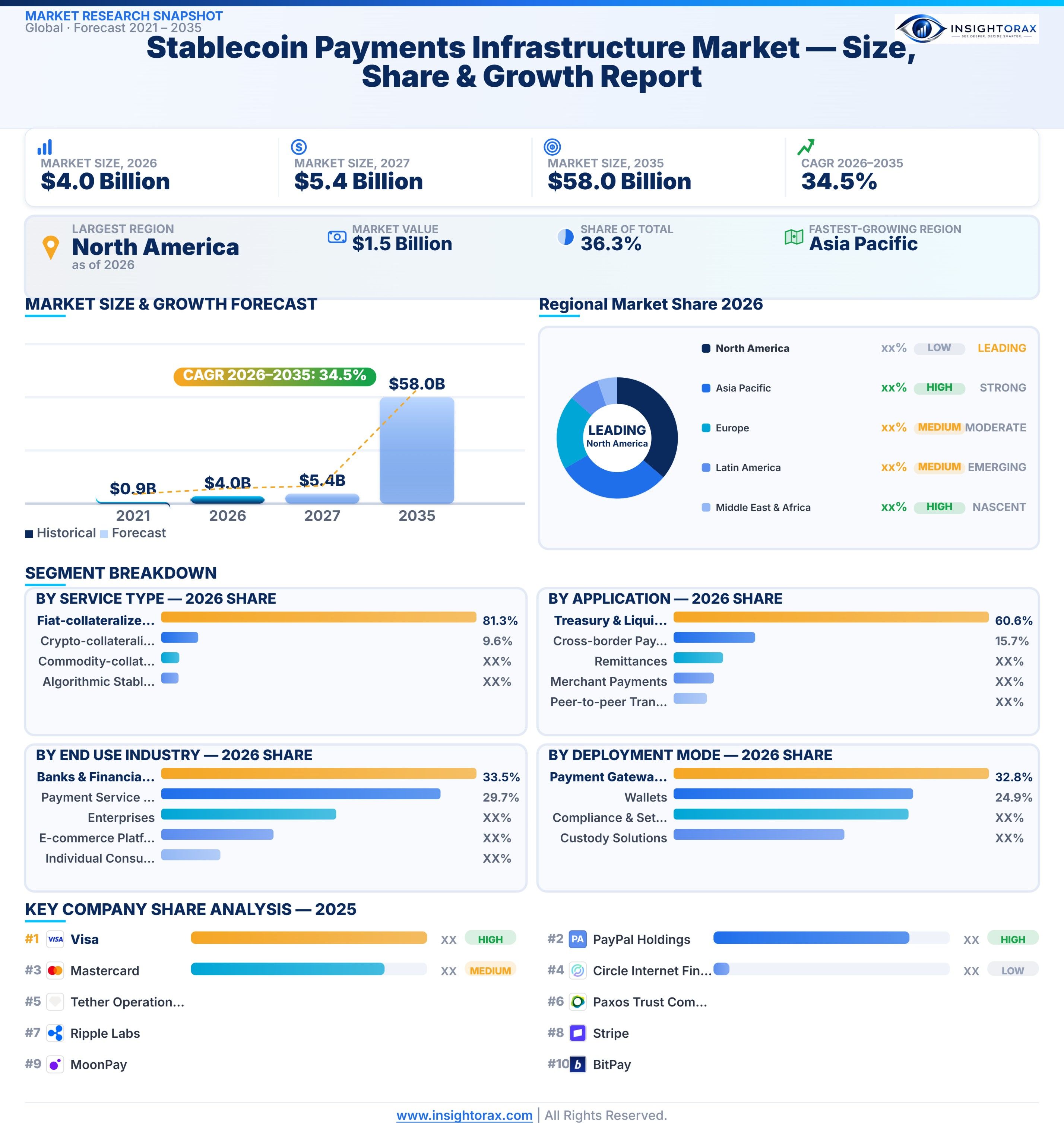
According to data analyzed by Insightorax, the global stablecoin payments infrastructure market size was valued at USD 4.0 billion in 2026 and is projected to grow from USD 5.4 billion in 2027 to USD 58.0 billion by 2035, registering a CAGR of 34.5% during the 2026–2035 forecast period. North America accounted for the largest revenue share of 36.3% in 2026. Market growth is driven by increasing adoption of digital payments, demand for faster and lower-cost cross-border transactions, rising stablecoin usage in commerce and financial services, and advancements in blockchain-based payment infrastructure. Growing institutional participation, regulatory developments, integration with digital wallets and payment platforms, and demand for programmable settlement solutions are further supporting market expansion. Businesses increasingly seek efficient, transparent, and interoperable payment infrastructure for global transactions.
2. Market Overview:
The Stablecoin Payments Infrastructure Market comprises the technologies, platforms, services, and supporting systems that enable businesses, financial institutions, payment providers, and consumers to send, receive, settle, and manage stablecoin-based transactions. The market covers infrastructure designed to facilitate blockchain-enabled payments while maintaining stable value through assets or mechanisms linked to fiat currencies or other reference assets. Its scope includes payment processing, transaction settlement, wallets, custody, liquidity management, compliance, and integration solutions that connect stablecoins with existing financial and payment networks.
Key components include stablecoin payment gateways, blockchain networks, digital wallets, custody platforms, APIs, payment orchestration systems, settlement infrastructure, compliance and risk-management tools, and on/off-ramp services. The market also encompasses merchant payment solutions, cross-border transaction platforms, institutional payment infrastructure, and enterprise integrations. Demand is supported by requirements for faster settlement, lower transaction costs, improved transparency, and broader digital payment interoperability.
3. Market Size & Forecast:
The Stablecoin Payments Infrastructure Market has evolved from early blockchain-based payment experiments toward increasingly structured infrastructure supporting digital-asset transactions. Initial development focused on stablecoin issuance, wallets, exchanges, and basic transfer capabilities, while subsequent advances introduced payment gateways, APIs, custody solutions, compliance tools, and integrations with traditional financial networks. Growing merchant acceptance and institutional participation have strengthened the market’s infrastructure base and expanded practical use cases.
The market is expected to expand significantly as businesses and financial institutions seek faster settlement, lower-cost cross-border payments, improved transaction transparency, and greater liquidity efficiency. Integration of stablecoins with payment processors, digital wallets, banking platforms, and enterprise systems is broadening adoption. Regulatory clarity, improved blockchain scalability, interoperability, institutional digital-asset strategies, and increasing demand for programmable and always-on payment infrastructure are also expected to support continued market development.
Key Market Trends & Insights
- By service type: Fiat-collateralized Stablecoins segment dominated the market with a 81.3% share in 2026.
- By application: Treasury & Liquidity Management segment led the market in terms of share, accounting for 60.6% in 2026.
- By end user: Banks & Financial Institutions segment commanded the largest market share at 33.5% in 2026.
- By deployment mode: Payment Gateways segment accounted for the highest market share of 32.8% in 2026.
Regional Highlights
- Largest regional market: North America (36.3% revenue share, 2026)
- Fastest-growing regional market: Asia Pacific Highest CAGR, 2026–2035
- By country: United States held the largest market share in 2026
Market Size & Forecast
- Market size in 2026: USD 4 Billion
- Estimated market size in 2027: USD 5.4 Billion
- Projected market size by 2035: USD 58 Billion
- CAGR (2026-2035): 34.5%
4. Market Drivers, Restraints & Opportunities:
Growing demand for faster, lower-cost, and more transparent digital payments is driving the Stablecoin Payments Infrastructure Market. Stablecoins can support near-real-time settlement and facilitate cross-border transactions without relying solely on conventional correspondent banking networks. Increasing adoption by merchants, fintech companies, payment processors, and financial institutions is expanding infrastructure requirements. Rising digital-asset activity, improved blockchain scalability, growing integration with wallets and payment platforms, and demand for programmable settlement are further supporting market growth.
Regulatory uncertainty remains a major restraint, particularly differences in stablecoin frameworks, licensing requirements, reserve standards, taxation, and compliance obligations across jurisdictions. Concerns surrounding cybersecurity, fraud, money laundering, operational risks, blockchain congestion, interoperability, and dependence on underlying reserve assets can also limit adoption. Traditional financial institutions may face integration costs and complex compliance requirements when connecting stablecoin infrastructure with established payment systems, while businesses may remain cautious about regulatory and counterparty risks.
Significant opportunities are emerging through enterprise payments, cross-border commerce, remittances, treasury management, and institutional settlement. Payment providers can develop stablecoin-enabled gateways, APIs, wallets, custody services, compliance platforms, and liquidity solutions. Opportunities are also expanding through integration with central bank digital currency ecosystems, tokenized assets, embedded finance, and decentralized applications. Greater regulatory clarity and standardized interoperability could further accelerate institutional and commercial adoption.
5. Market Trends:
Stablecoin payments infrastructure is shifting from crypto-native transfers toward broader payment and settlement applications. In 2025, stablecoin supply expanded materially, while payment providers and financial institutions increased efforts to integrate wallets, APIs, merchant acceptance, and on-chain settlement. Cross-border payments remain a major use case because stablecoins can support continuous settlement and reduce traditional payment frictions. Asia recorded high stablecoin activity, while Europe is developing euro-denominated alternatives alongside regulatory frameworks.
Technology trends in 2025–2026 include multi-chain interoperability, programmable payments, tokenized deposits, automated compliance, improved custody, and integration with instant-payment systems. Stablecoin infrastructure is also increasingly linked with tokenized securities and institutional treasury workflows. At the same time, market analysis is placing more emphasis on separating payment activity from trading, automated transactions, and internal blockchain transfers. This is encouraging infrastructure providers to develop analytics and transaction-monitoring capabilities.
Regulation is becoming a central market trend. The EU’s MiCA framework provides requirements for stablecoin issuers, reserves, governance, and crypto-asset services, while its review reflects evolving risks. In 2026, regulators and policymakers are examining interoperability, financial stability, consumer protection, and cross-border coordination. Non-USD stablecoins, including euro, yen, and local-currency instruments, are gaining attention, potentially broadening regional payment applications and reducing reliance on dollar-denominated settlement assets.
6. Regulatory Framework:
Regulatory frameworks for stablecoin payments are becoming more defined across major financial jurisdictions. In the United States, the GENIUS Act establishes a federal framework for payment stablecoin issuers, including licensing, supervision, reserve, capital, liquidity, and risk-management requirements; implementing rules were under development in 2026. In the European Union, the Markets in Crypto-Assets Regulation (MiCA) provides harmonized requirements for stablecoin issuers and crypto-asset service providers, including organizational, prudential, operational, cybersecurity, market-abuse, and AML/CTF safeguards.
Internationally, CPMI and IOSCO apply the Principles for Financial Market Infrastructures to systemically important stablecoin arrangements, emphasizing governance, comprehensive risk management, settlement finality, and money settlement. Regulatory authorities are also emphasizing redemption, reserve management, operational resilience, consumer protection, financial-crime controls, and clear issuer responsibilities. The BIS continues to support coordinated international approaches and highlights the need for strong legal frameworks and supervision as stablecoin payment use expands.
7. Technology Landscape:
Stablecoin payment infrastructure is built primarily on distributed ledger technology (DLT), tokenization, cryptographic signatures, consensus mechanisms, digital wallets, and blockchain-based settlement rails. Smart contracts add programmability, allowing payment conditions and other financial operations to execute automatically, while atomic settlement can coordinate delivery and payment within a single transaction. Recent BIS research confirms that stablecoin activity increasingly involves complex, programmable transactions rather than simple transfers.
Technology advancement is also focused on interoperability, scalability, cybersecurity, operational resilience, and integration with existing payment systems. CPMI-IOSCO guidance applies the Principles for Financial Market Infrastructures (PFMI) to systemically important stablecoin arrangements, including their DLT-related characteristics and settlement functions. International guidance remains technology-neutral rather than mandating a specific blockchain or technical architecture. Standards and controls increasingly emphasize secure data handling, cryptography, resilience, governance, and risk management.
8. Stablecoin Payments Infrastructure Market Segmentation Analysis:
9. By Type:
Fiat-collateralized Stablecoins account for an exact 81.2% market share in 2026, according to the data sheet. Their substantial representation reflects the continued relevance of fiat-backed stablecoin structures within the Stablecoin Payments Infrastructure Market. Demand for supporting infrastructure is connected with payment processing, asset access, custody, compliance, and settlement requirements surrounding these stablecoin arrangements. Wallets and payment gateways facilitate transaction access and processing, while custody solutions and compliance and settlement tools support operational control and regulated payment workflows. The scale of this category gives it considerable significance within the overall type structure and indicates strong infrastructure requirements around fiat-collateralized stablecoin usage. The type segmentation also includes Crypto-collateralized Stablecoins, Algorithmic Stablecoins, and Commodity-collateralized Stablecoins. These additional structures contribute to a diversified market environment in which infrastructure providers must accommodate differing operational and transaction requirements across stablecoin-based payment activities.
Crypto-collateralized Stablecoins represent an exact 9.5% market share in 2026, placing them second within the type segmentation. Their presence reflects demand for infrastructure capable of supporting stablecoin payment activity beyond fiat-collateralized structures. Wallets provide access and transaction-management functionality, while payment gateways connect stablecoin transactions with payment workflows. Custody Solutions address asset safeguarding requirements, and Compliance & Settlement Tools support operational oversight and settlement processes. The category therefore contributes to infrastructure demand across multiple technical and operational layers. Algorithmic Stablecoins and Commodity-collateralized Stablecoins form the remaining type categories and further broaden the market structure. Their inclusion demonstrates that stablecoin payments infrastructure must support different underlying mechanisms and collateral approaches. The modeled 2026 share of Crypto-collateralized Stablecoins gives this category a meaningful position within the market, while its relationship with the other types reinforces the need for adaptable infrastructure across payment applications and transaction environments.
10. By Application:
Treasury & Liquidity Management represents an exact 60.6% market share in 2026, according to the data sheet. Its substantial proportion highlights the importance of stablecoin infrastructure for treasury-oriented financial workflows and liquidity-related activities. Demand is connected with infrastructure that enables organizations to manage stablecoin-based payment operations through wallets, payment gateways, custody solutions, and compliance and settlement tools. These capabilities can support transaction access, movement of payment assets, operational safeguards, and settlement processes within the defined market scope. The application structure also encompasses Cross-border Payments, Remittances, Merchant Payments, and Peer-to-peer Transfers, indicating that stablecoin infrastructure serves several distinct transaction requirements. Treasury & Liquidity Management therefore has significant market relevance within the 2026 application mix. Its share reflects the scale of infrastructure demand associated with treasury and liquidity functions while the broader application categories provide additional channels through which stablecoin payment infrastructure can be deployed.
Cross-border Payments account for an exact 15.6% market share in 2026, representing the second-highest application category in the data sheet. Their position reflects the role of stablecoin infrastructure in supporting transactions that extend across geographic markets and payment environments. Payment gateways, wallets, custody solutions, and compliance and settlement tools provide the infrastructure capabilities required for transaction processing, asset management, safeguarding, and settlement. Demand is also shaped by the broader application mix, which includes Treasury & Liquidity Management, Remittances, Merchant Payments, and Peer-to-peer Transfers. This combination indicates that infrastructure requirements are distributed across institutional financial activities and transaction-oriented payment use cases. Cross-border Payments therefore contribute materially to the 2026 market structure and reinforce the importance of infrastructure that can support payment connectivity and settlement processes. Their share also demonstrates the relevance of international transaction activity within the wider stablecoin payments infrastructure landscape.
11. By End Use:
Banks & Financial Institutions hold an exact 33.4% market share in 2026, making this the leading end-use category in the data sheet. Their substantial participation reflects the importance of institutional financial users within the Stablecoin Payments Infrastructure Market. Demand from this segment connects with infrastructure requirements spanning wallets, payment gateways, custody solutions, and compliance and settlement tools. Such infrastructure supports payment processing, transaction access, asset safeguarding, and operational settlement activities. The end-use structure additionally includes Payment Service Providers, E-commerce Platforms, Enterprises, and Individual Consumers, creating a broad user environment across financial, commercial, corporate, and consumer activities. Banks & Financial Institutions therefore represent a significant source of infrastructure demand in 2026. Their market position also underscores the importance of systems capable of supporting institutional payment workflows and related operational requirements. The combination of financial institutions with the other end-use groups creates a diversified demand base for stablecoin payments infrastructure across multiple participant categories and transaction contexts.
Payment Service Providers account for an exact 29.6% market share in 2026, representing the second-highest end-use category. Their substantial share highlights the role of payment-focused organizations in the stablecoin infrastructure ecosystem. Infrastructure requirements for this group extend across wallets, payment gateways, custody solutions, and compliance and settlement tools, supporting transaction routing, payment processing, asset management, and settlement activities. Banks & Financial Institutions, E-commerce Platforms, Enterprises, and Individual Consumers form the other end-use categories and broaden the market beyond payment intermediaries. This structure demonstrates that stablecoin infrastructure demand spans financial institutions, payment operators, commercial platforms, corporate users, and individual participants. Payment Service Providers therefore have considerable significance within the 2026 market composition because their activities connect infrastructure capabilities with practical payment workflows. Their share also reflects the importance of payment-oriented infrastructure in facilitating stablecoin transactions across multiple applications and participant environments within the defined market scope.
12. By Component:
Payment Gateways represent an exact 32.8% market share in 2026, according to the data sheet. Their position highlights the importance of transaction-processing infrastructure within the Stablecoin Payments Infrastructure Market. Payment gateways facilitate connections between stablecoin payment activity and broader transaction workflows, supporting the movement and processing of payment transactions. Their relevance is reinforced by demand across applications such as Treasury & Liquidity Management, Cross-border Payments, Remittances, Merchant Payments, and Peer-to-peer Transfers. The component segmentation also includes Wallets, Custody Solutions, and Compliance & Settlement Tools, creating an integrated infrastructure framework. Payment Gateways therefore have substantial significance because they address a core transaction-processing requirement within stablecoin payment environments. Their 2026 share indicates meaningful infrastructure demand associated with connecting stablecoin transactions to payment processes. The broader component mix demonstrates that market development depends on coordinated infrastructure capabilities covering transaction access, processing, asset safeguarding, regulatory functions, and settlement activities.
Wallets account for an exact 24.9% market share in 2026, representing the second-highest component category. Their role reflects demand for infrastructure that enables users and organizations to access, manage, and transact with stablecoin-based payment assets. Wallet functionality complements Payment Gateways by providing an operational interface for stablecoin payment activity, while Custody Solutions and Compliance & Settlement Tools address safeguarding, oversight, compliance, and settlement requirements. The component structure therefore demonstrates that stablecoin payment infrastructure involves interconnected functions rather than a single technical layer. Wallets are relevant across multiple applications and end-use groups, including financial institutions, payment providers, enterprises, commercial platforms, and consumers. Their 2026 share indicates a substantial infrastructure requirement associated with stablecoin access and transaction management. Together with Payment Gateways, Custody Solutions, and Compliance & Settlement Tools, Wallets contribute to the infrastructure foundation supporting stablecoin payment operations across the market’s defined applications and participant categories.
13. Regional Analysis:
Asia Pacific holds a 30.3% share in 2026. The allocation indicates demand for stablecoin payments infrastructure supporting wallets, payment gateways, custody solutions, compliance, settlement, and payment applications. Cross-border payments, treasury and liquidity management, remittances, merchant payments, and peer-to-peer transfers provide application pathways. Technology adoption is tied to digital transaction connectivity and stablecoin-enabled payment workflows. The region has market relevance for infrastructure deployment. Demand extends across transaction access, processing, custody, compliance, and settlement functions, creating infrastructure requirements. Asia Pacific’s 2026 position highlights its importance within the geographic structure of the Stablecoin Payments Infrastructure Market.
North America accounts for a 36.2% share in 2026. Demand is associated with infrastructure requirements spanning wallets, payment gateways, custody solutions, compliance tools, settlement capabilities, and applications. Stablecoin workflows support cross-border payments, treasury and liquidity management, remittances, merchant payments, and peer-to-peer transfers. Technology adoption is relevant where stablecoin infrastructure connects digital payment activity with financial and commercial processes. The region has significance because infrastructure demand covers transaction access, payment processing, asset safeguarding, compliance, and settlement. Its allocation demonstrates broad infrastructure requirements across institutional and commercial environments, supporting integrated tools for payment operations.
Europe represents a 19.8% share in 2026. The allocation indicates demand for infrastructure enabling stablecoin payment operations while supporting custody, transaction processing, compliance, and settlement requirements. Wallets and payment gateways provide access and transaction functionality, while custody solutions and compliance tools support operations. Cross-border payments, treasury and liquidity management, remittances, merchant payments, and peer-to-peer transfers provide application channels. Technology adoption is connected with integrating stablecoin payment capabilities into financial and commercial workflows. Europe’s 2026 share gives the region a role in the market structure. Its significance is linked to infrastructure supporting transaction connectivity, operational controls, asset management, compliance, and settlement across participant environments.
Middle East & Africa holds a 5.2% share in 2026. The allocation reflects a developing market for stablecoin payments infrastructure covering wallets, payment gateways, custody solutions, compliance tools, and settlement tools. Demand factors include support for cross-border payments, remittances, treasury and liquidity management, merchant payments, and peer-to-peer transfers. Technology adoption is associated with digital transaction infrastructure and stablecoin-enabled payment workflows. The region’s share represents a smaller portion of the 2026 market while retaining relevance for infrastructure deployment across financial and payment applications. Transaction access, processing, custody, compliance, and settlement requirements create areas for technology utilization, contributing to geographic diversification across the market.
Latin America accounts for an 8.2% share in 2026. The regional position reflects demand for stablecoin payments infrastructure across wallets, payment gateways, custody solutions, compliance, settlement tools, and payment applications. Cross-border payments and remittances are relevant, alongside merchant payments, treasury and liquidity management, and peer-to-peer transfers. Technology adoption is supported by digital payment infrastructure capable of facilitating stablecoin transaction workflows across financial environments. Latin America’s 2026 allocation gives the region a role in the geographic composition of the market. Its significance is connected with transaction access, payment connectivity, asset safeguarding, compliance processes, and settlement functionality, reinforcing demand for integrated infrastructure across payment uses.
14. Competitive Landscape:
Competition is intensifying among stablecoin issuers, payment networks, fintech infrastructure providers, banks, and blockchain platforms, with differentiation centered on settlement speed, global reach, compliance capabilities, liquidity, APIs, wallets, and enterprise integration. Circle is expanding its Payments Network and managed settlement infrastructure, while Visa is developing a Stablecoin Platform and expanding Bridge-based stablecoin-linked card programs across international markets. Mastercard is supporting regulated stablecoins across multiple blockchain networks, including USDC, PYUSD, USDG, USDP, RLUSD, and SoFiUSD.
Geographic expansion increasingly relies on partnerships with banks, payment providers, and local payout networks. Circle partnered with Nium to connect USDC settlement with payouts across more than 190 countries and 100 currencies, while Stripe identifies Bridge and Paxos among its stablecoin partners. Technology adoption focuses on APIs, wallet infrastructure, blockchain interoperability, automated compliance, and on-chain settlement. Companies are also pursuing regulated-market access, institutional integrations, ecosystem partnerships, and full-stack infrastructure strategies to reduce operational complexity and accelerate enterprise adoption.
15. Stablecoin Payments Infrastructure Market Company Insights:
· Circle Internet Financial
· Tether Operations Limited
· Paxos Trust Company
· Ripple Labs
· Stripe
· Visa
· Mastercard
· Paypal Holdings
· Moonpay
· Bitpay
· Fireblocks
· Bitso
· Coinbase
· Binance
· Alchemy Pay
· Checkout.com
· Bridge (stripe)
· Flutterwave
· Zero Hash
· Transak
16. Key Stablecoin Payments Infrastructure Market Companies:
Circle, Tether, Paxos, Ripple, Stripe, Visa, Mastercard, PayPal, MoonPay and Fireblocks are building core stablecoin issuance, settlement, payment, custody and orchestration infrastructure. Circle is expanding USDC and CPN, while Tether advances USD₮ settlement; Ripple develops RLUSD and enterprise payments, and Stripe integrates stablecoin acceptance and Bridge orchestration. Visa and Mastercard are extending multi-chain settlement, with Mastercard also expanding regulated stablecoin rails.
PayPal, BitPay, Coinbase, Binance, Bitso, Alchemy Pay, Checkout.com, Flutterwave, Zero Hash and Transak focus on merchant acceptance, cross-border transfers, wallets, on/off-ramps and embedded infrastructure. PayPal expands PYUSD globally; Coinbase powers USDC payouts; Checkout.com combines stablecoin acceptance and settlement with Coinbase and Fireblocks; Flutterwave supports USDC, USDT and RLUSD; Transak provides compliance-ready APIs across 26+ countries.
17. Recent Developments:
· April 2, 2025 — Ripple Labs: Integrated RLUSD into Ripple Payments to support enterprise cross-border payments.
· April 30, 2025 — Visa / Bridge: Announced a stablecoin-linked Visa card-issuing product through Bridge, enabling fintechs to offer stablecoin-funded cards.
· June 12, 2025 — Stripe: Announced USDC payment acceptance for Shopify merchants across 34 countries through its payments infrastructure.
· July 1, 2025 — Paxos: Launched USDG in the EU under a MiCA-compliant framework, expanding access across 30 European countries.
· August 12, 2025 — Transak: Raised $16 million in strategic funding from Tether and IDG Capital to expand its stablecoin payments infrastructure.
· August 19, 2025 — Fireblocks: Provided infrastructure for Wyoming's Frontier Stable Token (FRNT), including token minting, custody, compliance controls and seven-blockchain connectivity.
· December 16, 2025 — Visa: Launched USDC settlement in the U.S. for participating issuer and acquirer partners.
· January 30, 2026 — Tether: Reported more than $10 billion in 2025 net profit, alongside record USD₮ circulation and reserve levels.
· February 12, 2026 — Coinbase: Reported its 2025 results, including record USDC held on its platform and continued expansion across its crypto and financial infrastructure products.
· February 24, 2026 — Checkout.com: Reported more than $300 billion in 2025 total payment volume, representing 64% year-over-year growth.
· February 25, 2026 — Circle: Reported $2.7 billion in FY2025 total revenue and reserve income, with USDC circulation reaching $75.3 billion at year-end.
18. Future Outlook:
The stablecoin payments infrastructure market is expected to move toward greater integration with mainstream financial and payment systems as regulatory clarity, institutional adoption, and enterprise use cases expand. Opportunities are emerging across cross-border payments, treasury management, merchant settlement, payouts, and programmable transactions. Visa, Mastercard, and Circle are expanding infrastructure that connects stablecoins with established payment networks, banking partners, and enterprise applications.
Future development will increasingly emphasize interoperability, local-currency stablecoins, automated compliance, wallet infrastructure, liquidity management, and always-on settlement. Visa reports expanding use of non-USD stablecoins, while Circle is developing managed infrastructure that abstracts blockchain complexity for businesses. However, scalability, fragmented blockchain networks, financial-integrity risks, redemption resilience, and regulatory differences remain challenges. BIS research highlights these limitations alongside the potential for tokenisation to improve cross-border payment efficiency.
19. Methodology Overview
Extensive research from reliable academic sources, industry reports, and publications.
Interviews with industry experts, opinion leaders, and key stakeholders.
Validation of data through top-down and bottom-up approaches.