Semiconductor Foundry Market Research Report
Global Market Size, Share & Trends Analysis Report, 2026-2035
Segmentation Analysis By Type: By Wafer Size: By Technology Node: By Application: By Region and Industry Forecast
1. Market Summary:
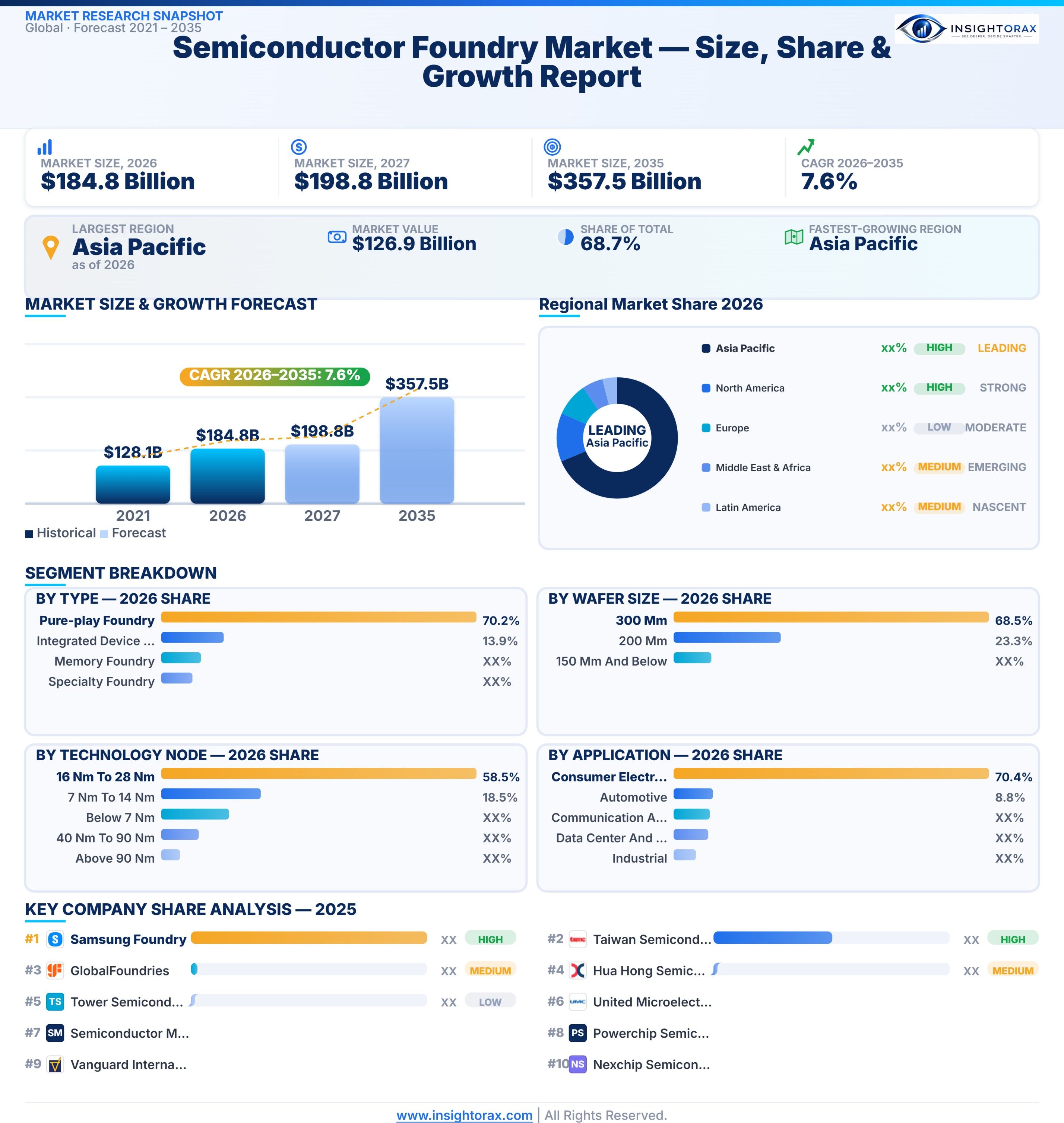
According to data analyzed by Insightorax, the global semiconductor foundry market size was valued at USD 184.8 billion in 2026 and is projected to grow from USD 198.8 billion in 2027 to USD 357.5 billion by 2035, registering a CAGR of 7.6% during the 2026–2035 forecast period. Asia Pacific accounted for the largest revenue share of 68.7% in 2026. Market growth is driven by rising demand for advanced semiconductor chips, increasing adoption of artificial intelligence, high-performance computing, 5G connectivity, automotive electronics, and Internet of Things (IoT) applications. Growing investments in semiconductor manufacturing capacity, process-node advancements, chiplet architectures, and regional supply-chain localization are further supporting expansion. Increasing electronics consumption, data-center infrastructure development, and demand for energy-efficient and high-performance processors remain major global demand factors.
2. Market Overview:
The Semiconductor Foundry Market comprises companies that manufacture semiconductor wafers and integrated circuits on behalf of fabless semiconductor firms, integrated device manufacturers, and other technology companies. Foundries provide manufacturing capabilities across different process technologies, ranging from mature nodes used in automotive, industrial, consumer, and connectivity applications to advanced nodes designed for high-performance computing, artificial intelligence, smartphones, and data centers. The market covers wafer fabrication, process development, packaging-related manufacturing support, and specialized semiconductor production services.
Key components of the market include wafer fabrication facilities, process technologies, semiconductor manufacturing equipment, specialty processes, and production services. Major foundry offerings encompass logic, analog, mixed-signal, radio-frequency, power, memory-related, and other specialized semiconductor technologies. Market coverage spans different technology nodes, wafer sizes, applications, and geographic regions, with demand influenced by electronics production, digitalization, automotive electrification, AI infrastructure, 5G deployment, and increasing semiconductor content across industries.
3. Market Size & Forecast:
The Semiconductor Foundry Market has evolved from conventional wafer fabrication to a highly advanced manufacturing ecosystem supporting increasingly complex electronic devices. Historically, foundry growth was driven by expanding personal computer, telecommunications, and consumer electronics production, alongside the rise of fabless semiconductor companies. Improvements in manufacturing processes, wafer utilization, and production efficiency enabled foundries to serve diverse industries while reducing the need for companies to establish their own fabrication facilities.
Currently, market expansion is supported by growing demand for AI processors, high-performance computing, automotive semiconductors, and advanced connectivity solutions. Foundries are investing in advanced process nodes, larger production capacities, and specialized manufacturing technologies to meet evolving customer requirements. Future growth is expected to benefit from data-center expansion, electric vehicle adoption, industrial automation, and rising semiconductor content in connected devices. Government incentives, supply-chain diversification, and strategic investments in regional fabrication facilities are also expected to strengthen manufacturing capabilities and support long-term market development.
Key Market Trends & Insights
- By type: Pure-play Foundry segment dominated the market with a 70.2% share in 2026.
- By wafer size: 300 Mm segment led the market in terms of share, accounting for 68.5% in 2026.
- By technology node: 16 Nm To 28 Nm segment commanded the largest market share at 58.5% in 2026.
- By application: Consumer Electronics segment accounted for the highest market share of 70.4% in 2026.
Regional Highlights
- Largest regional market: Asia Pacific (68.7% revenue share, 2026)
- Fastest-growing regional market: Asia Pacific (Highest CAGR, 2026-2035)
- By country: Taiwan held the largest market share in 2026
Market Size & Forecast
- Market size in 2026: USD 184.8 Billion
- Estimated market size in 2027: USD 198.8 Billion
- Projected market size by 2035: USD 357.5 Billion
- CAGR (2026-2035): 7.6%
4. Market Drivers, Restraints & Opportunities:
The Semiconductor Foundry Market is driven by increasing semiconductor demand across artificial intelligence, high-performance computing, 5G infrastructure, automotive electronics, smartphones, and Internet of Things applications. Rapid expansion of data centers and AI-enabled computing is increasing demand for advanced processors manufactured using leading-edge process technologies. Growing semiconductor content in electric vehicles, advanced driver-assistance systems, industrial automation, and connected devices is further supporting foundry utilization. Rising investments in domestic semiconductor manufacturing and supply-chain localization are also encouraging new fabrication capacity across major regions.
However, the market faces challenges including extremely high capital requirements for fabrication facilities, complex manufacturing processes, lengthy technology development cycles, and shortages of specialized semiconductor equipment and skilled personnel. Geopolitical tensions, export controls, supply-chain disruptions, and dependence on critical materials and equipment can affect production continuity. Increasing technological complexity at advanced nodes also raises manufacturing costs and yield-management challenges, while intense competition among leading foundries puts pressure on technology investment and operational efficiency.
Significant opportunities are emerging from advanced-node manufacturing, chiplet-based architectures, heterogeneous integration, and specialized process technologies. Growing demand for automotive, power, radio-frequency, and compound semiconductor applications creates opportunities beyond conventional logic manufacturing. Government incentives supporting domestic semiconductor ecosystems can accelerate fabrication investments and regional capacity expansion. Foundries can also benefit from partnerships with fabless chip designers, integrated device manufacturers, equipment suppliers, and technology developers. Continued innovation in process optimization, advanced packaging, energy-efficient manufacturing, and specialty foundry services is expected to create additional avenues for long-term market expansion.
5. Market Trends:
The Semiconductor Foundry Market is increasingly shaped by AI, high-performance computing, and advanced-node demand. In 2026, strong AI processor requirements are driving greater utilization of 5/4 nm and more advanced technologies, while advanced packaging capacity remains a key bottleneck. Foundries are also expanding 300mm wafer capacity to support AI, automotive, and high-density computing applications.
Regional diversification is becoming a major industry trend as governments promote domestic semiconductor manufacturing and supply-chain resilience. North America, Europe, Japan, and Asia are supporting new fabrication projects through incentives and strategic industrial policies. Japan’s Rapidus initiative and Europe’s proposed Chips Act 2.0 highlight efforts to strengthen advanced manufacturing capabilities and reduce external dependencies.
Technology development is moving toward smaller process nodes, High-NA EUV lithography, advanced packaging, and heterogeneous integration. Foundries are simultaneously optimizing mature-node capacity for automotive, industrial, and power applications, with utilization improving in several segments. Regulatory controls on advanced semiconductor and manufacturing technology exports are also influencing investment decisions, production locations, and supply-chain strategies.
6. Technology Landscape:
Semiconductor foundry technology is advancing through smaller process nodes, EUV lithography, advanced transistor architectures, silicon-on-insulator technologies, and sophisticated process-control and metrology systems. Advanced packaging, including 3D integration and heterogeneous integration, is becoming increasingly important for high-performance computing and AI applications. Smart-factory technologies are also expanding, with automated equipment communication, real-time manufacturing data, predictive analytics, and digital-twin applications supporting yield and productivity improvements.
Technology-related standards are central to interoperability, safety, materials quality, automation, traceability, and manufacturing consistency. The SEMI International Standards Program covers equipment automation, microlithography, packaging, facilities, gases, materials, process control, and traceability. Relevant frameworks include SEMI E-series equipment-automation standards, SEMI S-series safety guidelines, and SEMI M-series silicon-material standards. SEMI E187 specifically addresses cybersecurity requirements for fab equipment, while newer initiatives cover digital twins and autonomous manufacturing.
7. Innovation & R&D Analysis:
Semiconductor foundry R&D is focused on advanced process nodes, gate-all-around transistor architectures, high-NA EUV lithography, advanced packaging, chiplets, and heterogeneous integration. Research is also targeting improved process control, yield optimization, energy efficiency, and manufacturing automation to address increasing complexity and cost. Industry initiatives increasingly emphasize collaboration among foundries, equipment suppliers, chip designers, and research institutes to accelerate technology development while strengthening semiconductor manufacturing capabilities.
Cybersecurity and equipment interoperability are also becoming important R&D priorities as fabs adopt increasingly connected manufacturing systems. SEMI E187 establishes baseline cybersecurity requirements covering operating systems, network security, endpoint protection, and security monitoring, while SEMI E188 addresses malware-free equipment integration. In 2026, SEMI is advancing a major E187 revision incorporating tiered security levels and alignment with IEC 62443. SEMI S2 also provides environmental, health, and safety guidance for semiconductor manufacturing equipment.
8. Semiconductor Foundry Market Segmentation Analysis:
9. By Type:
Pure-play Foundry held the highest position in the Semiconductor Foundry Market in 2026, accounting for 70.23%. Its extensive manufacturing capacity, multi-customer business model, advanced process capabilities, and ability to serve fabless semiconductor companies support continued demand. Growing outsourcing of wafer fabrication, increasing chip complexity, and investments in advanced nodes are reinforcing pure-play foundry utilization across consumer electronics, communications, computing, automotive, and industrial applications.
Integrated Device Manufacturer (IDM) Foundry represented 13.94% in 2026, supported by vertically integrated manufacturing capabilities and continued internal production requirements. IDM activity remains important for companies seeking greater control over process technology, supply security, and production economics. Memory Foundry and Specialty Foundry also contribute to market development, serving differentiated semiconductor requirements across automotive, industrial, communications, consumer, and computing applications.
10. By Wafer Size:
300 Mm wafers accounted for the highest share of the Semiconductor Foundry Market in 2026 at 68.52%. Their strong position reflects manufacturing efficiency, higher die output per wafer, improved economies of scale, and suitability for high-volume semiconductor production. Demand for advanced processors, connectivity chips, automotive semiconductors, and data-center components continues encouraging investment in larger-diameter wafer fabrication, particularly where manufacturers prioritize productivity and cost optimization.
200 Mm wafers held 23.28% in 2026 and remain important for established process technologies and applications requiring mature-node manufacturing. Their continuing relevance is supported by automotive electronics, industrial components, power-related devices, analog products, and other specialty semiconductor requirements. 150 Mm And Below wafers continue serving selected mature and specialized production needs, maintaining relevance where legacy equipment, lower-volume manufacturing, or differentiated process requirements influence fab utilization and capacity decisions.
11. By Technology Node:
16 Nm To 28 Nm represented the leading technology-node category in 2026, with a 58.46% market share. Its broad adoption reflects balanced performance, manufacturing maturity, cost efficiency, and suitability for high-volume semiconductor production. Demand across automotive electronics, consumer devices, communications equipment, industrial systems, and computing applications supports continued utilization of this process range, while manufacturers benefit from established production ecosystems and comparatively optimized fabrication economics.
7 Nm To 14 Nm accounted for 18.46% in 2026, supported by increasing requirements for higher performance, power efficiency, and processing density. Adoption is particularly relevant to advanced computing, communications, consumer electronics, and increasingly sophisticated automotive systems. Below 7 Nm, 40 Nm To 90 Nm, and Above 90 Nm continue addressing different performance, cost, power, and application requirements, giving foundries a diversified technology portfolio across advanced and mature semiconductor manufacturing.
12. By Application:
Consumer Electronics maintained the strongest position in 2026, accounting for 70.38% of the Semiconductor Foundry Market. High-volume production of smartphones, personal devices, embedded electronics, connectivity components, and other consumer products sustains substantial wafer-fabrication requirements. Semiconductor content expansion, product refresh cycles, increasing processing capabilities, and continued electronics adoption support foundry demand, while manufacturers increasingly optimize capacity and process technologies to meet volume, performance, and cost requirements.
Automotive represented 8.78% in 2026 and is gaining strategic importance as vehicles incorporate more semiconductor-intensive systems. Electrification, advanced driver-assistance systems, vehicle connectivity, infotainment, power management, and increasingly software-defined vehicle architectures are expanding semiconductor requirements. Communication And Networking, Industrial, and Data Center And Computing also support foundry demand through networking infrastructure, automation, embedded systems, AI-related computing, and high-performance processing, broadening end-use diversification.
13. Regional Analysis:
Asia Pacific is the largest regional base of the Semiconductor Foundry Market, accounting for 68.67% of the global market in 2026. Taiwan is the largest country-level manufacturing hub, supported by advanced foundry capacity, while China represents another major production and demand center. South Korea and Japan reinforce regional strength through memory, logic, materials, equipment, and semiconductor ecosystems. Demand comes from consumer electronics, communication and networking, automotive electronics, data-center computing, and industrial applications. Adoption of advanced process nodes and 300 mm wafers strengthens competitiveness. Manufacturing scale, supplier concentration, infrastructure, and integration across design, fabrication, packaging, and electronics assembly make Asia Pacific the largest and most influential regional geography.
North America holds 12.94% of the global Semiconductor Foundry Market in 2026, ranking second highest among the five regions. The United States is the region’s largest country-level market and an important center for semiconductor design, computing, artificial intelligence, defense electronics, and automotive technologies. Canada and Mexico contribute through electronics activity and industrial supply chains. Demand is shaped by data-center computing, communication infrastructure, consumer electronics, automotive semiconductors, and industrial applications. Investment in domestic fabrication, advanced processes, supply-chain resilience, and semiconductor localization supports foundry development. North America’s significance reflects integration among chip designers, equipment suppliers, and manufacturing partners, supporting both leading-edge and established-node production.
Europe represents 8.89% of the global Semiconductor Foundry Market in 2026. Germany is the largest country-level market, supported by automotive manufacturing, industrial automation, power electronics. The United Kingdom, France, the Netherlands, Italy, Ireland, Spain, and the Rest of Europe contribute through semiconductor design, equipment, automotive systems, industrial applications, and specialized manufacturing. Demand is connected with vehicle electrification, advanced driver-assistance systems, factory automation, communications, and high-reliability electronics. Technology adoption emphasizes process specialization, automotive-grade production, power and analog capabilities, and supply-chain resilience alongside advanced-node development. Europe’s market significance rests on its strong industrial base and manufacturing globally, strategic role in semiconductor equipment, automotive electronics, and specialized chip ecosystems.
Middle East & Africa accounts for 5.55% of the global Semiconductor Foundry Market in 2026. Israel is the region’s most significant semiconductor country-level center, while Saudi Arabia and South Africa contribute through emerging technology ecosystems. Foundry demand is supported by communication systems, industrial electronics, computing infrastructure, automotive-related electronics, and government technology programs. Digitalization, electronics deployment, data infrastructure, and digital infrastructure are important regional factors. Technology adoption remains more selective than in Asia Pacific, North America, or Europe, but the region has strategic relevance for semiconductor innovation and supply-chain diversification as advanced electronics applications expand across regional industries and infrastructure.
Latin America holds 3.96% of the global Semiconductor Foundry Market in 2026, making it the smallest of the five major regions. Brazil is the largest country-level market, with demand linked to electronics manufacturing, automotive systems and communications, consumer devices, and digital infrastructure. Development is supported by electronics adoption, industrial modernization, and connectivity expansion. Foundry activity supports automotive electronics, industrial control, telecommunications, and embedded systems. Technology adoption is influenced by supply-chain access, manufacturing capabilities, investment conditions and global semiconductor integration. Although its global share is comparatively limited, Latin America remains strategically relevant as an emerging demand center for regional electronics and manufacturing networks activity.
14. Competitive Landscape:
Competition in the Semiconductor Foundry Market centers on advanced process leadership, manufacturing scale, yield, reliability, packaging capabilities, customer ecosystems, and geographic resilience. TSMC differentiates through leading-edge and specialty processes, advanced packaging, and its Open Innovation Platform, while Samsung combines advanced GAA processes, packaging, design platforms, and smart-fab automation. Intel Foundry emphasizes geographically diversified manufacturing and secure supply.
Geographic expansion is accelerating as major foundries establish capacity closer to customers and strengthen regional supply chains. Partnerships with fabless designers, EDA providers, IP companies, equipment suppliers, and packaging partners are increasingly important for technology adoption and faster commercialization. Recent examples include Samsung’s collaboration with Broadcom on AI infrastructure and TSMC’s Grand Alliance ecosystem. Companies also differentiate through quality systems, manufacturing certifications, customer-specific process qualifications, sustainable operations, and supplier integration. Organic growth remains focused on process-node advancement, capacity expansion, advanced packaging, automation, and AI-enabled yield improvement.
15. Semiconductor Foundry Market Company Insights:
TSMC leads the pure-play segment with advanced logic, specialty processes, and advanced packaging, supported by its broad customer ecosystem and technology leadership. Samsung Foundry combines GAA logic, advanced packaging, and IDM capabilities. GlobalFoundries focuses on differentiated specialty platforms, while UMC, SMIC, Hua Hong, PSMC, VIS, Nexchip, and DB HiTek serve mature and specialty-node requirements. Tower Semiconductor, X-FAB, SK Keyfoundry, Win Semiconductors, Silterra, and Polar Semiconductor specialize in RF, analog, power, automotive, MEMS, and other differentiated technologies.
Intel Foundry is expanding domestic and international manufacturing with advanced process and packaging capabilities, while SkyWater emphasizes U.S.-based trusted manufacturing. Canon Semiconductor Foundry provides specialty manufacturing services, and Rapidus is developing advanced-node production in Japan. Competitive strategies increasingly center on capacity expansion, customer partnerships, process qualification, automation, advanced packaging, supply-chain resilience, and certifications addressing quality, automotive, environmental, and security requirements.
16. Key Semiconductor Foundry Market Companies:
· Taiwan Semiconductor Manufacturing Company (tsmc)
· Samsung Foundry
· Globalfoundries
· United Microelectronics Corporation (umc)
· Semiconductor Manufacturing International Corporation (smic)
· Hua Hong Semiconductor
· Tower Semiconductor
· Powerchip Semiconductor Manufacturing Corporation (psmc)
· Vanguard International Semiconductor Corporation (vis)
· Nexchip Semiconductor
· X-fab Silicon Foundries
· Intel Foundry
· Db Hitek
· Sk Keyfoundry
· Win Semiconductors
· Silterra Malaysia
· Polar Semiconductor
· Skywater Technology
· Canon Semiconductor Foundry
· Rapidus
17. Recent Developments:
· July 28, 2025: Samsung disclosed a semiconductor contract-manufacturing agreement valued at approximately US$16.54 billion, effective through December 31, 2033. Samsung later identified Tesla, Inc. as the counterparty.
· February 11, 2026: GlobalFoundries reported US$6.791 billion in FY2025 revenue and highlighted growth opportunities in AI data centers, physical AI, and semiconductor onshoring.
· March 12, 2026: SkyWater reported record FY2025 revenue of US$442.1 million, representing 29% year-over-year growth, supported by expanded manufacturing and advanced technology activities.
· April 2026: TSMC reported US$122.42 billion in 2025 consolidated revenue, up 35.9% year over year. Advanced technologies of 7 nm and below accounted for 74% of wafer revenue, while 2 nm entered high-volume manufacturing in Q4 2025. TSMC also reported continued robust AI-related demand entering 2026.
18. Future Outlook:
The Semiconductor Foundry Market is expected to maintain strong long-term expansion as semiconductor content increases across artificial intelligence, high-performance computing, automotive electronics, 5G infrastructure, data centers, industrial automation, and connected devices. Demand for advanced processors and specialized chips will encourage foundries to expand leading-edge and specialty-node capabilities, while advanced packaging, chiplets, heterogeneous integration, and silicon photonics create additional growth opportunities. Regional semiconductor initiatives and government incentives are also expected to accelerate fabrication investments and strengthen domestic supply chains.
However, high fabrication costs, technological complexity, equipment constraints, skilled-labor shortages, geopolitical tensions, and export restrictions will remain significant challenges. Leading foundries are expected to prioritize process-node innovation, capacity expansion, energy-efficient manufacturing, AI-enabled process optimization, and strategic partnerships. Emerging developments in gate-all-around architectures, high-NA EUV lithography, advanced packaging, and specialized automotive and power technologies should further reshape competitive dynamics and support sustained market growth.
19. Methodology Overview
Extensive research from reliable academic sources, industry reports, and publications.
Interviews with industry experts, opinion leaders, and key stakeholders.
Validation of data through top-down and bottom-up approaches.