Autonomous Charging Market Research Report
Global Market Size, Share & Trends Analysis Report, 2026-2035
Segmentation Analysis By Technology: By Application: By Component: By Deployment Mode: By End User: By Sales Channel: By Region and Industry Forecast
1. Market Summary:
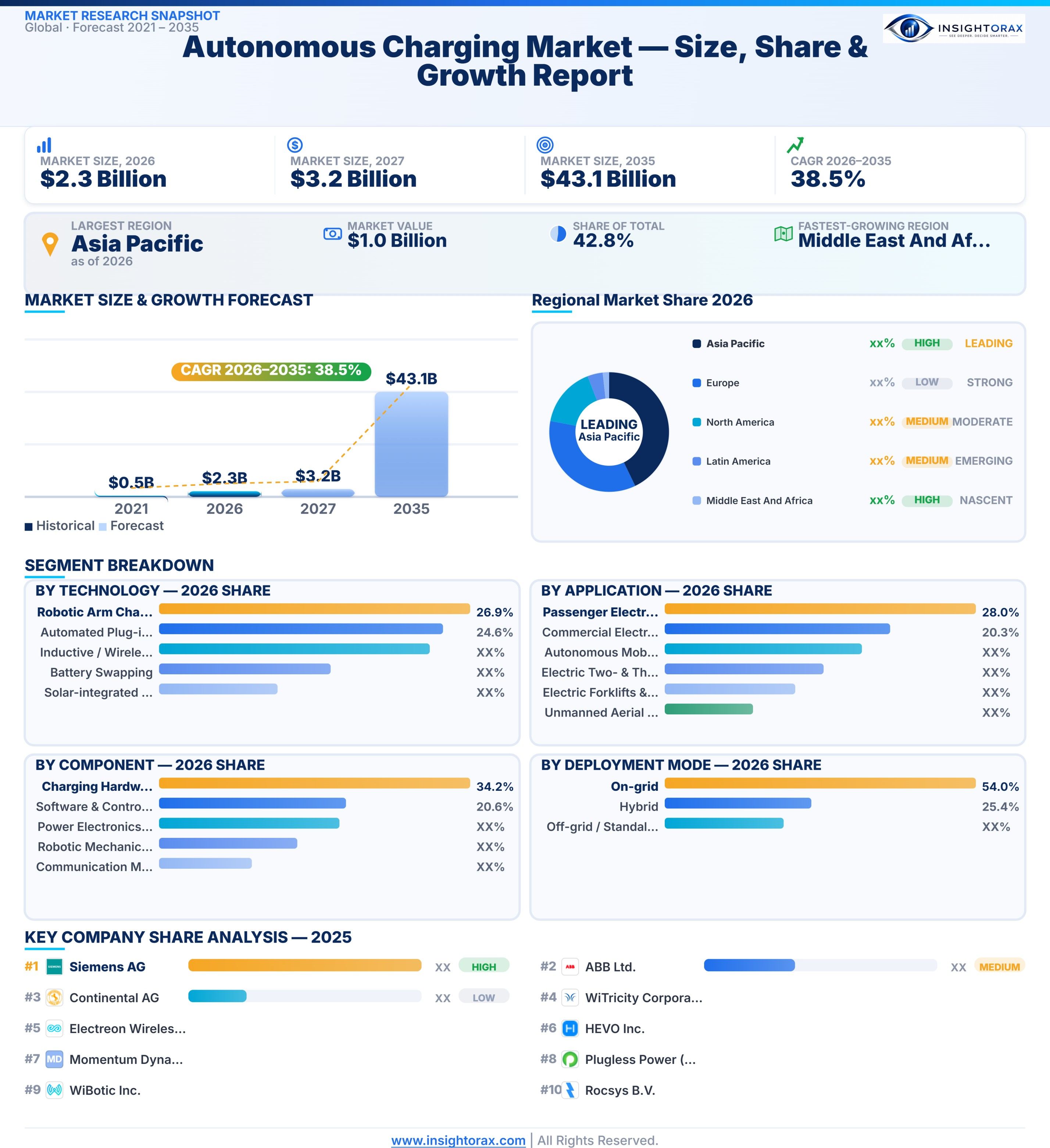
According to data analyzed by Insightorax, the global autonomous charging market size was valued at USD 2.3 billion in 2026 and is projected to grow from USD 3.1 billion in 2027 to USD 43.1 billion by 2035, registering a CAGR of 38.5% during the 2026–2035 forecast period. Asia Pacific accounted for the largest revenue share of 42.8% in 2026. Growth is driven by the rapid adoption of electric vehicles, increasing demand for convenient and automated charging solutions, and advancements in wireless power transfer, robotics, and autonomous mobility technologies. Rising investments in EV charging infrastructure, smart transportation systems, and fleet electrification are further supporting market expansion. Demand is also increasing from autonomous vehicles, commercial fleets, logistics robots, and industrial equipment seeking efficient, hands-free, and reliable charging capabilities.
2. Market Overview:
The Autonomous Charging Market refers to technologies and solutions that enable electric vehicles, robots, industrial machines, and other electric systems to recharge with minimal or no human intervention. The market covers automated charging methods such as wireless charging, robotic charging arms, automated conductive charging, and inductive power transfer. These solutions are designed to improve charging convenience, reduce manual operations, and support continuous equipment utilization.
The market scope includes charging hardware, software, control systems, power management technologies, and related services. Key components include charging stations, wireless charging pads, robotic charging systems, power transmitters and receivers, sensors, connectivity solutions, and charging management software. Applications span passenger and commercial EVs, autonomous vehicles, logistics and warehouse robots, industrial equipment, and fleet operations. Deployment models include residential, commercial, public, and industrial environments, with demand influenced by EV adoption, automation, fleet electrification, and smart mobility infrastructure.
3. Market Size & Forecast:
The Autonomous Charging Market has evolved from early automated and wireless charging concepts toward commercially viable solutions designed for electric vehicles, autonomous mobility, robotics, and industrial equipment. Early development focused on improving charging convenience and reducing dependence on manual plug-in systems, while advances in wireless power transfer, robotics, sensors, connectivity, and charging controls have expanded practical applications. Increasing EV adoption and the growing use of automated equipment are now accelerating market expansion across transportation, logistics, and industrial environments.
Future growth is expected to be supported by rising demand for hands-free charging, fleet electrification, autonomous vehicles, and continuous operation of robotic systems. Improvements in charging efficiency, interoperability, smart energy management, and wireless technologies are expected to strengthen adoption. Expanding charging infrastructure and investments in smart mobility and automated transportation will further create opportunities for autonomous charging solutions across developed and emerging markets.
Key Market Trends & Insights
- By technology: Robotic Arm Charging segment dominated the market with a 26.9% share in 2026.
- By application: Passenger Electric Vehicles segment led the market in terms of share, accounting for 28.0% in 2026.
- By component: Charging Hardware segment commanded the largest market share at 34.2% in 2026.
- By deployment mode: On-grid segment accounted for the highest market share of 54.0% in 2026.
- By end user: Automotive OEMs segment maintained a leading position in the market, holding a 27.9% share in 2026.
- By sales channel: Direct Sales / OEM Integration segment dominated the market with a 54.9% share in 2026.
Regional Highlights
- Largest regional market: Asia Pacific (42.8% revenue share, 2026)
- Fastest-growing regional market: Middle East And Africa (1.7% revenue share, 2026)
- By country: China held the largest market share in 2026
Market Size & Forecast
- Market size in 2026: USD 2.3 Billion
- Estimated market size in 2027: USD 3.2 Billion
- Projected market size by 2035: USD 43.1 Billion
- CAGR (2026-2035): 38.5%
4. Market Drivers, Restraints & Opportunities:
The Autonomous Charging Market is driven by the rapid adoption of electric vehicles, expansion of autonomous and connected mobility, and increasing demand for convenient, hands-free charging solutions. Growing electrification of commercial fleets, logistics operations, warehouse robots, and industrial equipment is encouraging organizations to adopt automated charging technologies that reduce downtime and manual intervention. Advancements in wireless power transfer, robotic charging systems, sensors, and smart charging software are further supporting market development. Government initiatives promoting EV infrastructure and cleaner transportation are also creating favorable conditions for adoption.
However, high installation costs, complex system integration, interoperability issues, limited standardization, and concerns regarding charging efficiency can restrain market growth. Infrastructure upgrades and compatibility with diverse vehicle platforms may also increase deployment complexity. Significant opportunities exist in autonomous vehicle fleets, electric buses, robotic logistics, and industrial automation. Integration with renewable energy, smart grids, AI-based energy management, and vehicle-to-grid technologies can further expand applications and improve long-term commercial potential.
5. Market Trends:
The Autonomous Charging Market is increasingly shaped by the shift toward hands-free and automated EV charging, with wireless inductive charging and robotic charging systems gaining attention across passenger vehicles, commercial fleets, and autonomous mobility. Recent developments also emphasize integration with smart charging platforms, real-time energy management, sensors, and connected vehicle systems. Fleet operators are increasingly evaluating automated charging to reduce vehicle downtime and improve utilization, particularly for electric buses, delivery vehicles, and autonomous fleets.
Regionally, North America and Europe continue to focus on automated charging infrastructure, fleet electrification, interoperability, and smart-grid integration, while Asia-Pacific is experiencing strong momentum from expanding EV production, electric mobility programs, robotics adoption, and charging infrastructure investment. Automotive manufacturers, charging technology providers, and infrastructure companies are increasingly collaborating on wireless and automated charging deployments. Integration with renewable energy, AI-driven charging optimization, and vehicle-to-grid capabilities is also emerging as an important direction for the market.
6. Technology Landscape:
Autonomous charging technologies combine wireless power transfer, inductive charging, automated conductive charging, robotic connectors, vehicle positioning, sensors, and charging-control software. Recent advances focus on improving alignment, power-transfer efficiency, interoperability, communication, and automated charging control. For EV wireless charging, SAE J2954:2024 defines criteria for interoperability, electromagnetic compatibility, EMF, performance, safety, and testing for light-duty vehicles, while IEC 61980-1:2020 covers general requirements for wireless power-transfer equipment, including communication, efficiency, alignment, and electrical safety.
Technology standardization is also expanding into higher-power and dynamic applications. IEC PAS 61980-4:2025 addresses interoperability and safety for high-power stationary wireless charging, while IEC PAS 61980-5:2024 covers dynamic wireless power transfer for vehicles in motion. SAE J2954 also references UL 2750 certification for ground-assembly WPT equipment, supporting standardized safety and certification practices.
7. Industry & Regulatory Environment:
The Autonomous Charging Market operates within evolving EV charging, electrical safety, electromagnetic compatibility, and interoperability requirements. SAE J2954:2024 establishes criteria for wireless power transfer for light-duty plug-in electric vehicles, covering interoperability, EMF, electromagnetic compatibility, safety, performance, and testing. IEC 61980-1:2020 specifies general requirements for EV wireless power-transfer equipment, including electrical safety, communication, efficiency, alignment, and EMC. Newer IEC specifications extend the framework to high-power stationary and dynamic wireless charging applications.
Government policies are also supporting charging infrastructure deployment. In Europe, Regulation (EU) 2023/1804 (AFIR) establishes mandatory national targets and common technical requirements for alternative-fuels infrastructure, including interoperability, user information, data, and payment requirements. Compliance therefore increasingly requires manufacturers and operators to address electrical safety, EMC, interoperability, communication, positioning, and applicable national requirements. Industry standardization through SAE and IEC is helping create consistent technical and safety frameworks for automated and wireless charging technologies.
8. Autonomous Charging Market Segmentation Analysis:
9. By Technology:
Inductive/Wireless Charging is expected to remain a leading technology because it enables convenient, hands-free energy transfer without physical plug handling. Its adoption is supported by growing interest in passenger EVs, autonomous vehicles, electric fleets, and robotic systems that require frequent or automated charging. Robotic arm charging is also gaining traction, particularly where vehicles need automated connection to charging infrastructure without driver intervention. Automated plug-in systems offer a practical alternative for controlled fleet and depot environments, while battery swapping provides rapid energy replenishment where standardized battery architectures are feasible.
Solar-integrated autonomous charging represents an emerging opportunity, particularly for off-grid applications and locations seeking lower dependence on conventional electricity sources. Technology selection increasingly depends on charging speed, vehicle compatibility, infrastructure costs, operating environment, safety, and automation requirements. As autonomous mobility expands, solutions capable of reliable positioning, automatic connection, efficient energy transfer, and intelligent charging management are expected to gain greater commercial significance.
10. By Application:
Passenger electric vehicles represent a major application area as consumers and manufacturers seek greater charging convenience and reduced dependence on manual cable connections. Wireless and automated systems can support home, workplace, parking, and public charging environments. Commercial electric vehicles are another important demand center because buses, delivery vehicles, taxis, and fleet vehicles require predictable charging schedules and high operational availability. Automated systems can reduce charging-related downtime and simplify depot operations.
Autonomous mobile robots, electric forklifts, and AGVs require frequent charging to maintain continuous warehouse and industrial operations, creating strong demand for automated energy replenishment. UAVs represent an emerging application, particularly for systems requiring repeated autonomous missions and rapid turnaround. Electric two- and three-wheelers also offer opportunities in urban mobility and delivery operations, especially where battery swapping or compact automated charging can improve utilization. Application growth will depend on operating cycles, charging requirements, automation levels, and infrastructure availability.
11. By Component:
Charging hardware forms the core of autonomous charging installations and includes charging pads, connectors, charging stations, robotic interfaces, power-transfer equipment, and associated electrical components. Demand is closely linked to the expansion of EV infrastructure and automated industrial equipment. Power electronics and inverters are essential for converting, controlling, and efficiently delivering electrical energy, making them important to system performance, reliability, and charging efficiency. Improvements in power-density and control technologies can support more compact and capable installations.
Software and control systems are becoming increasingly significant as charging operations require automated scheduling, vehicle detection, energy optimization, monitoring, and communication with fleet-management platforms. Communication modules enable data exchange between vehicles, chargers, networks, and management systems, supporting coordinated charging operations. Robotic mechanics and actuators are particularly important for automated plug connection and physical positioning. Component demand will increasingly reflect requirements for interoperability, reliability, cybersecurity, safety, and seamless integration with broader mobility and industrial automation systems.
12. By Deployment Mode:
On-grid deployment is expected to account for a substantial share of installations because most EV charging infrastructure and industrial charging facilities are connected to established electricity networks. Grid-connected systems can provide consistent power availability and support integration with smart charging, energy-management platforms, and utility services. They are particularly suitable for homes, commercial properties, fleet depots, parking facilities, logistics centers, and public charging locations where dependable electricity access is available.
Off-grid or standalone systems provide an alternative for remote locations, temporary facilities, and applications where grid connectivity is limited or costly. Solar generation combined with energy storage can improve the practicality of autonomous charging in these environments. Hybrid systems combine grid electricity with renewable generation and storage, providing greater flexibility and resilience. Their adoption can increase where users seek reduced grid dependence, backup capability, or improved energy management. Deployment choices will therefore depend on electricity availability, operating conditions, infrastructure costs, energy requirements, and the desired level of operational independence.
13. By End User:
Automotive OEMs are important end users because autonomous charging technologies can be incorporated into vehicle platforms, charging ecosystems, and connected mobility strategies. Fleet operators are also expected to generate strong demand because automated charging can reduce manual intervention, improve vehicle utilization, and support predictable charging schedules. Logistics and warehousing organizations increasingly use electric forklifts, AGVs, and autonomous mobile robots, creating demand for charging systems capable of supporting continuous operations with minimal disruption.
Defense and aerospace applications provide specialized opportunities where autonomous energy replenishment can support unmanned systems and remote operations. Residential and commercial property owners represent a broader market for automated charging solutions as EV adoption expands and convenient charging becomes increasingly important. Charging network operators are investing in technologies that can improve station utilization, simplify user interactions, and integrate automated charging into larger infrastructure networks. Across these groups, purchasing decisions are influenced by operational efficiency, total ownership costs, reliability, compatibility, safety, and integration with existing energy-management systems.
14. By Sales Channel:
Direct sales and OEM integration are expected to remain important because autonomous charging systems often require customization, technical integration, installation support, and compatibility with specific vehicles or equipment. Automotive manufacturers, fleet operators, industrial companies, and charging infrastructure providers may prefer direct relationships when projects involve large deployments or specialized engineering requirements. OEM integration can also enable charging functionality to be incorporated into vehicle designs and automated mobility platforms from the development stage.
Third-party distributors provide access to established sales and service networks, particularly for standardized charging equipment and components. Their role can be valuable in markets where manufacturers need broader geographic coverage without developing independent distribution infrastructure. Online channels are more relevant to standardized products, accessories, smaller charging systems, and components that require less technical customization. Channel selection will increasingly depend on product complexity, installation requirements, customer size, geographic reach, technical support needs, and purchasing preferences. Large-scale deployments are likely to favor direct engagement, while standardized products can benefit from distributor and online availability.
15. Regional Analysis:
Asia Pacific is expected to remain the leading regional market and strengthen its position throughout the forecast period, supported by expanding electric vehicle adoption, rapid development of charging infrastructure, growing automation, and increasing deployment of autonomous mobility and robotic systems. Europe is projected to remain a significant market but gradually lose relative share as growth in Asia Pacific accelerates. The region will continue benefiting from strong automotive capabilities, electrification policies, and investments in advanced charging technologies.
North America is expected to maintain a relatively stable market position, supported by EV adoption, fleet electrification, technological innovation, and charging infrastructure development. Latin America is likely to experience gradual expansion as electric mobility and charging networks develop. The Middle East and Africa are also expected to gain market presence, supported by renewable-energy integration, smart infrastructure projects, and emerging electrification initiatives. Overall, regional growth is increasingly shifting toward Asia Pacific, while other regions continue expanding at comparatively moderate rates.
16. Competitive Landscape:
The competitive landscape is characterized by technology-focused competition among wireless charging developers, charging infrastructure providers, automotive technology companies, and automation specialists. Companies differentiate through charging efficiency, power capacity, automated positioning, interoperability, reliability, software capabilities, and integration with vehicles or industrial equipment. Geographic expansion is supported by growing EV adoption and charging infrastructure investments across North America, Europe, and Asia Pacific. Partnerships between technology providers, automotive OEMs, fleet operators, infrastructure developers, and research organizations are important for commercial deployment. Certifications and compliance with recognized safety, interoperability, and electromagnetic standards also strengthen market credibility and facilitate adoption.
Companies are pursuing both organic and collaborative growth strategies, including product development, pilot deployments, technology upgrades, regional expansion, and strategic partnerships. Increasing adoption of AI, sensors, connectivity, robotics, and intelligent energy-management systems is improving automated charging capabilities. Businesses are also focusing on customized solutions for fleets, logistics, autonomous vehicles, and industrial applications to establish differentiated market positions and create long-term customer relationships.
17. Autonomous Charging Market Company Insights:
Leading participants include Rocsys, WiTricity, Electreon, HEVO, Plugless Power, ABB, Siemens, KUKA, Beam Global, WiBotic, EV Safe Charge, Mob-Energy, Conductix-Wampfler, Wiferion (PULS), and Mercedes-Benz. Their competitive strengths span autonomous robotic charging, wireless power transfer, automated connectors, mobile charging, fleet energy management, industrial automation, and smart charging infrastructure. Rocsys has expanded hands-free multi-bay charging for robotaxi fleets, while WiBotic focuses on autonomous platforms including robots and UAVs. Electreon and WiTricity specialize in wireless EV charging, whereas HEVO and Plugless Power target automated wireless charging deployments.
ABB, Siemens, KUKA, and Conductix-Wampfler leverage established electrification, automation, robotics, and industrial connectivity capabilities. Wiferion provides wireless charging for AGV and AMR fleets, while Mob-Energy develops mobile robotic charging and storage systems. EV Safe Charge, Beam Global, and Mercedes-Benz are advancing autonomous charging through robotic, wireless, and automated charging initiatives. Companies increasingly emphasize partnerships, pilot deployments, certification compliance, technology integration, and geographic expansion to commercialize autonomous charging solutions.
· · Rocsys — In April 2026, Rocsys launched the M1, described as the world's first multi-bay hands-free charging solution for robotaxi fleets, and announced a $13 million Series A extension.
· WiBotic — Provides autonomous wireless charging hardware and fleet energy-management software for mobile robots, UAVs, and other autonomous platforms. Its Commander software monitors charger utilization, battery performance, and fleet charging operations.
· Hyundai Motor Group — In May 2025, Hyundai Motor Group and Incheon International Airport Corporation signed an MoU to demonstrate and commercialize AI-based EV automatic charging robots. Hyundai provides robotics hardware/software and smart-parking solutions, while the airport serves as the demonstration environment. The charging robot has Korean KC and European CE certifications.
· ABB — ABB reported FY2025 revenue of $33.2 billion. The company remains active in electrification, industrial automation, robotics, and related technologies that can support automated charging ecosystems.
· Siemens — Siemens reported FY2025 revenue of €78.9 billion. Its activities span industry, infrastructure, mobility, electrification, automation, and digital technologies relevant to smart and automated transportation infrastructure.
· KUKA — KUKA reported 2024 sales of approximately €3.7 billion. The company continues to focus on robotics, intelligent intralogistics, automation, and digitalized industrial systems.
· The $28.236 million revenue statement — Do not use this statement as currently written. I could not verify that the figure refers to a relevant autonomous-charging company or that the accompanying claim about increasing commercial revenue and autonomous-charging infrastructure is accurate. It should be removed unless the company name and original source are identified.
· HEVO + Beam Global — In February 2026, HEVO and Beam Global launched an integrated autonomous wireless charging platform for autonomous vehicles. The solution combines HEVO's Rezonant wireless charging technology and Journey software with Beam Global's solar-powered, off-grid EV ARC infrastructure.
· Electreon — Develops wireless charging for autonomous EVs, including automated depot charging and charging during slowdowns or stops. Its technology supports parked, stationary, and dynamic charging using embedded wireless infrastructure.
· Automated EV charging connector technology — This statement needs a company name before it should be included. As written, it is too generic to attribute accurately to a specific market participant.
· Mob-Energy — The company develops mobile robotic charging solutions designed to bring charging to electric vehicles, supporting flexible charging deployments. However, I recommend removing the specific reference to "energy-storage solutions" unless you have a source specifically supporting that wording.
· EV Safe Charge — The claim that it "showcased an autonomous charging robot at CES 2024" should not be used without further qualification/source verification. I could not establish sufficient authoritative evidence for that exact statement during this check.
· Conductix-Wampfler — Provides automated and contactless charging technologies for industrial environments. Its WirelessCharger 3.0 uses inductive power transfer for automated charging of AGVs, AMRs, and other mobile equipment used in production and logistics.
· Wiferion (PULS) — Wiferion, a PULS business unit, develops inductive wireless charging systems for AGVs, AMRs, mobile robots, forklifts, and industrial vehicles. Its technology supports in-process charging and continuous automated operations. The etaLINK 3000 system has also received ISO Class 4 cleanroom certification from Fraunhofer IPA.
· Mercedes-Benz — Mercedes-Benz has publicly discussed and demonstrated research into automated robotic EV charging, including concepts designed to enable charging without manual cable handling. However, I would phrase this as a research/development initiative, rather than implying that Mercedes-Benz currently commercially operates autonomous robotic charging at scale.
18. Key Autonomous Charging Market Companies:
· WiTricity Corporation
· Electreon Wireless Ltd.
· HEVO Inc.
· Momentum Dynamics
· Plugless Power (Evatran Group)
· Siemens AG
· ABB Ltd.
· Continental AG
· WiBotic Inc.
· Rocsys B.V.
· Volterio GmbH
· Mob-Energy SAS
· Wiferion (PULS)
· Conductix-Wampfler
· KUKA AG
19. Recent Developments:
· 8 Sep 2026 — WiTricity Corporation: Completed a new R&D laboratory in Stuart, Florida, supporting wireless charging systems for passenger EVs, autonomous vehicles, robotaxis, and fleets, with medium-power systems ranging from 7.2 kW to 50 kW.
· 18 Aug 2026 — HEVO Inc.: Announced a crowdfunding campaign and disclosed U.S. Patent No. 12,700,758 B2 covering dynamic roadway charging technology. HEVO also announced partnerships for wireless fleet charging in Saudi Arabia and autonomous-vehicle charging.
· 19 Jun 2026 — Wiferion (PULS): Continued development of inductive wireless charging solutions for AGVs, AMRs, mobile robots, and industrial trucks, including in-process charging applications.
· 29 Apr 2026 — Rocsys B.V.: Launched the Rocsys M1 multi-bay hands-free charging system for robotaxi fleets and announced a $13 million Series A extension.
· 10 Mar 2026 — Electreon Wireless Ltd.: Completed the acquisition of InductEV, strengthening its wireless EV-charging portfolio across dynamic and static charging applications.
· 4 Mar 2026 — Continental AG: Reported preliminary FY2025 consolidated sales of €19.7 billion and continued its strategic realignment across its automotive and mobility technology businesses.
· 29 Jan 2026 — ABB Ltd.: Reported FY2025 revenue of $33.2 billion and continued activities across electrification, automation, and robotics technologies relevant to automated charging ecosystems.
· 15 Jan 2026 — Mob-Energy SAS: Deployed its Eiko mobile charging platform at Réseau APA, providing 12 operational charging points without conventional fixed charging infrastructure.
· 17 Nov 2025 — Siemens AG: Reported FY2025 revenue of €78.9 billion, while continuing activities across electrification, automation, mobility, and infrastructure technologies.
· 30 Apr 2025 — KUKA AG: Reported 2024 sales of approximately €3.7 billion and identified robotics and automation as important future growth markets.
20. Future Outlook:
The Autonomous Charging Market is expected to move toward fully automated, software-connected, and high-power charging ecosystems, supported by rising EV adoption, robotaxi deployment, autonomous fleets, and the expansion of charging infrastructure. Wireless charging, robotic charging arms, AI-based charging management, and vehicle-to-grid (V2G) integration are likely to create new opportunities across passenger vehicles, commercial fleets, logistics, and mobility hubs.
Future growth will depend on improvements in charging efficiency, interoperability, battery technology, and grid integration. However, high installation costs, infrastructure availability, technology standardization, grid capacity, and regulatory requirements may remain key challenges. Emerging developments are expected to focus on dynamic wireless charging, autonomous fleet charging, predictive energy management, renewable-powered charging, and charging-as-a-service models, making unattended charging an increasingly important component of autonomous mobility.
21. Methodology Overview
Extensive research from reliable academic sources, industry reports, and publications.
Interviews with industry experts, opinion leaders, and key stakeholders.
Validation of data through top-down and bottom-up approaches.